
You are currently browsing the category archive for the ‘Class’ category.
Is the economy “recovering”? What does a “jobless recovery” mean anyway? How should workers respond to a deteriorating situation? Professor Richard Wolff drops some knowledge and suggests that workers need to take control of their companies.
An excellent talk on the relation between mental health and capitalism/neoliberalism. This is worth watching all the way through if you can. Dr. Stephen Bezruchka discusses the pharmaceutical/psychiatric industry and the spiraling rates of anti-depressants and other drugs given out to adults and children. This medicating of America doesn’t seem to be curbing mental illness or mental disorders, which are more prevalent in the US today than ever before, or in any other countries.
He suggests a more “caring and sharing” society, focused especially on better childhood development and reducing the gap between rich and poor, would do much to help us heal our over-stressed and depressed nation. This is a great line of thought, as understanding psychological disorder within the context of political decision-making allows us to imagine strategies to overcome it. Human-made problems have human solutions.
For up-to-date coverage of these events, check out Narco News.
As the demonstrations in Iran continue despite mounting repression, another dramatic showdown between military and public has broken out in Honduras after a violent coup organized by the country’s wealthy elites kidnapped left-leaning president Manuel “Mel” Zelaya and removed him from the country. This action has not only been condemned by much of the international community, it was immediately resisted by Hondurans taking to the streets in large numbers.

Image from Narco News

Image from School of Americas Watch

Image from the BBC
Even before the coup had taken place, anxious pedestrians shouted and cursed the approaching soldiers. In this video, one woman hits every soldier passing her. The surging protesters than begin to block military vehicles and surround a tank!
I’ve also reposted an article giving some background on the situation, this one from the School of Americas Watch. The “School of Americas”, now called the “Western Hemisphere Institute for Security Cooperation,” is a combat and torture training institute in Fort Benning, Georgia that has trained thousands of Latin American paramilitary soldiers to return to their countries and terrorize peasant and student movements. Many of these “graduates” have gone on to become fascist generals or dictators in their home countries, as in the current coup in Honduras. The institute remains open to this day, but every year SOA Watch organizes large protests to shut it down.
From: SOA Watch <info@soaw.org>
Date: June 28, 2009 1:26:08 PM EDT
Subject: Military Coup in Honduras
Military Coup in Honduras
A military coup has taken place in Honduras this morning (Sunday, June 28),
led by SOA graduate Romeo Vasquez. Read the rest of this entry »
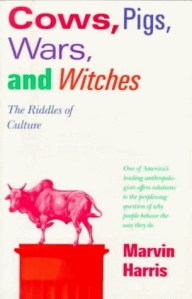 “Cows, Pigs, Wars, and Witches: The Riddles of Culture”
by Marvin Harris
1974 Random House
Why do Jews and Muslims refuse to eat pork? Why were thousands of witches burned at the stake during late medieval Europe? These and other riddles are explored by famous anthropologist Marvin Harris, and his conclusions are simple: people act within social and ecological contexts that make their actions meaningful. Put another way: cultural ideas and practices that seem strange to us may actually be vital and necessary to the people of those cultures.
Harris is especially good at explaining how societies create elaborate rituals to avoid harming the natural ecosystems they depend on, which clarifies the Middle Eastern ban on pig products. It turns out the chubby animals compete with humans for the same foods. Raising them in large numbers would place great strain on a land made fragile by thousands of years of deforestation and desertification. Better to ban them entirely and not risk further ecological damage.
This logic is then extended to elucidate why the institution of warfare probably first arose as a way to limit population pressure on the environment. In Harris’ words, “In most primitive societies, warfare is an effective means of population control because intense, recurring intergroup combat places a premium upon rearing male rather than female infants.” Since the rate of population growth depends on the number of healthy women, privileging males by making their larger bodies necessary for combat is a way of reducing the need to “eat the forest.” Not that male supremacy and violence is the BEST way to curb population growth, but it’s one ritual that societies have adopted to meet that goal.
This discussion of patriarchy leads to an exploration of class. The emergence of “big men”, chiefs, and finally the State is explained as a cascading distortion of the original principles of reciprocity into the rule of redistribution. “Big men” work harder than anyone in their tribe to provide a large feast for their community – with the only goal being prestige. Chiefs similarly pursue prestige, and plan great feasts to show off their managerial skills, but they themselves harvest little food. Finally “we end up with state-level societies ruled over by hereditary kings who perform no basic industrial or agricultural labor and who keep the most and best of everything for themselves.” At the root of this construction of inequality is the impetus to make people work harder to create larger surpluses so that greater social rewards can be given out to show off the leader’s generosity. But only at the State or Imperial level is this hierarchy enforced not by prestige but by force of arms, to stop the poor and working classes from revolting and sharing the fruits of their labor.
The most provocative sections of the book deal with revolutionary movements that fought for this liberation, within the context of the religious wars of Biblical Judea and Late Medieval Europe.
First, Harris tackles the Messiah complex Read the rest of this entry »
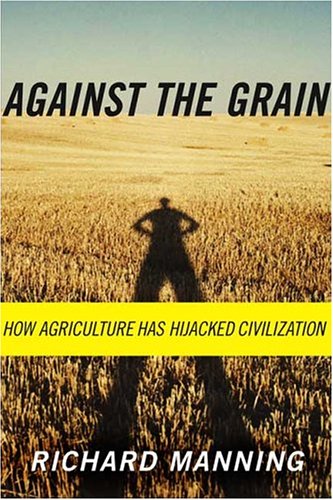 “Against the Grain: How Agriculture Has Hijacked Civilization”
Richard Manning
2004 North Point Press
Agriculture has domesticated humans. This is the argument at the center of Richard Manning’s stunning history of food. Written with journalistic flavor, Manning explores the ways that agriculture has diminished human life and threatens the planet itself.
The book begins by exploring the hunter-gatherer lifestyle, in many ways superior to our own even at the height of industrial capitalism. Hunter-gatherers, it turns out, ate a wider variety of tasty foods, worked far less, and lived much more sensually and connected than “civilized” humans. About 10,000 years ago, certain groups of humans traded all this in for security, namely the ability to stay in one spot and harvest grain to be stored for future food.
What this crop manipulation produced, however, was the first wealth inequality known to the species, as leaders left working the fields to their followers. In time, these stationary and hierarchical societies expanded and conquered/killed their hunter-gatherer neighbors. Soon enough crops like wheat, corn, and rice spread across the globe through violence and disease.
Manning focuses on these three crops because, as he explains, some 2/3 of all calories consumed today originate with them. In the US, corn is especially dominant, made into all kinds of commodities, for example corn syrup which can be found in just about everything we eat now. The dominance of these few grains is a consequence of capitalism, as they lend themselves easily to processing and storage – making them ideal commodities.
But an important plot twist in the story of grain’s dominance lies hidden in the open. Farm subsidies, especially in the US and Europe, distort the market to make these crops extremely cheap at the expense of all other nutrition. This has the added effect of enriching a few large agribusiness corporations (like Archer Daniels Midland) that grow or process them from enormous monocrop fields, although at the cost of ruining millions of small farmers all over the world. Our health, and the health of the planet are likewise jeopardized by the overabundance of these few crops produced with massive inputs of oil and chemicals.
Nevertheless, Richard Manning is able to summon the hope at the end of the book that our food system doesn’t have to be this way. Finding a distinction between agriculture and “simply growing food”, he argues that we can build an economy based on feeding people, and not just accumulating wealth. Organic agriculture, permaculture, intercropping, farmer’s markets and co-ops all point in this more just and sustainable direction, and awareness of the superiority of these more human methods has been growing at a phenomenal rate.
If we can nourish ourselves by reconnecting with the land and our sensual natures, perhaps we can also heal society and the planet. Against the Grain is a big step in educating us for that effort. Highly recommended.
Salt of the Earth is a classic organizing movie about striking Mexican-American miners and their wives. Based on an incredible true story, the 1953 film follows the organizing efforts of the town’s women, who must overcome the company’s classism, the sheriff’s racism, as well as their own husband’s sexism, to win the strike (while the men stay at home and take care of the house and children). Highly recommended!
This is just the first segment of the movie, make sure to click the Up-Arrow button to watch the rest!
 “The Mass Psychology of Fascism”
by Wilhelm Reich
1946 The Noonday Press
First written in Germany in 1932 as Hitler was coming to power, then revised in the US in 1944, this is a classic study of the characteristics of fascist movement. Reich, a former Marxist from the Frankfurt School, emphasizes that fascism is not unique to Germany or Japan or Italy, but is instead “the basic emotional attitude of the suppressed man of our authoritarian machine civilization and its mechanistic-mystical conception of life.”
In other words it’s not enough to blame Hitler or the Nazis or any political party for the rise of fascism, we have to understand why millions of people have been, and continue to be, drawn to Right-wing movement (its mass character is what distinguishes fascism from simple authoritarianism). Finding its base in the Middle Classes, fascist movement feeds upon authoritarian patriarchal social structures, especially the father-dominated family, which prepares children to obey and even revere a harsh “leader.”
But what was most interesting to me about this book is the politics of sexuality. Reich as a psychiatrist observed that the repression of sexuality, especially from a young age, prepares people for lifetimes of neurotic self-hatred as some of their most basic and healthy life functions become embedded with deep shame and guilt. I would add, sexual assault and child abuse add much fuel to this fire. Reich stresses that children, adolescents and women are perpetually denied control over their sexual desires and bodies, which is what gives the patriarchal father so much power in the family, and therefore the sexual repression of masses of people becomes the seeds that grow fascist political movements.
I will write more on this train of thought in my review of Yes Means Yes!, and it’s also something I’ve been sparked to consider after watching the film The Handmaid’s Tale, about a dark future where pollution has made most women sterile, and a Christian fascist movement seizes control of society to make the remaining fertile women into the sex slaves of powerful male leaders. It’s surprisingly realistic in some scary ways, because it builds from the sad truth that the patriarchal Christian Right is a real force in society and continues to attack the rights of women to control their own bodies and sexuality. This tendency must be overcome, by women and trans folks taking back their body sovereignty and proclaiming their sexuality as no one’s but their own.
Part 1 of The Handmaid’s Tale. Read the rest of this entry »
More and more people are using the language of peak oil and becoming aware that the future we once took for granted is now being foreclosed (not incidentally, by the same folks who are foreclosing a lot of our homes). It is increasingly clear that we stand at a cross-roads, and that neither road leads anywhere similar to the global capitalist era we just passed through.
Here are some excerpts from a good article that acknowledges the reasons why the future will be nothing like the past, and lays out the 2 paths we can now head down. I wrote some thoughts at the end to inspire us to think realistically and demand the impossible. [alex]
Time to Deliver: No Turning Back, Part I.
by Sara Robinson
April 7, 2009
Originally published by Campaign for America’s Future
..[T]he two dominant scenarios about the American future that progressives seem to be wrestling with right now [might be described as]:
1) Permanent Decline — Due to Americans’ native hyperindividualism, political apathy, and overweening willingness to accept personal blame for their country’s failures, the corporatists finally succeed in turning the US into Indonesia. This time, we will not find the will to fight back (or, if we do, it will be too late). As a result, in a few years there will be no more middle class, no upward mobility, few remaining public institutions devoted to the common good, no health care, no education, and no hope of ever restoring American ideals or getting back to some semblance of the America we knew.
2) Reinvented Greatness — Americans get over their deeply individualistic nature, come together, challenge and restrain the global corporatist order, and finally establish the social democracy that the Powers That Be — corporate, military, media, conservative — have denied to us since the 1950s. This happens in synergy with a move to energy and food self-sufficiency, the growth of a sustainable economy, a revival of participatory democracy, and a general renewal of American values that pulses new life into our institutions and assures us a much more stable future.
Conservatives and the mainstream media, of course, are also offering a third scenario:
3) Happy Face — Prop up the banks, keep people in their houses, and by and by everything will get back to “normal” (defined as “how it all was a few years ago.”)
[Sara recognizes that this third “road” is an illusion, for the following underlying realities which cannot be ignored any longer. -alex]
1. Energy regime change
The first reason there’s no going back to the way it was is that there’s simply not enough oil left in the ground — or carbon sinks left in the world — to sustain America as we’ve known it. We may well be able to sustain some semblance of that way of life (or perhaps, find our way to one even more satisfying); but we won’t be running it on oil or coal.
And when the oil goes, so goes the empire. Read the rest of this entry »


 The End of Capitalism
Recent Comments