You are currently browsing the category archive for the ‘Capitalism’ category.
Wonderful essay by Stephanie Guilloud on the shifting sands of movement strategy in the wake of the high-tide of the Global Justice Movement, which in Seattle articulated a world beyond capitalism that was not controlled by corporate giants and corrupt governments, but built by democratic cooperation of communities all around the world.
The Seattle direct actions shut down the World Trade Organization for a weekend in 1999, because the WTO had been spreading the corporate agenda across the planet, and this began a string of movement victories that shut down the WTO permanently – by delegitimizing the organization and emboldening Global South nations to refuse rich countries’ poverty-spreading deals and abandon its negotiations.
Now, as Global South nations lead the call for justice in Copenhagen and as we gear up for the US Social Forum in Detroit next summer, it’s a great time to look back at the lessons the movement for justice, democracy and sustainability has learned in the past decade. [alex]
 From Seattle to Detroit: 10 Lessons for Movement Building on the 10th Anniversary of the WTO Shutdown
By Stephanie Guilloud November 30, 2009 | Reposted from the Indypendent
For five days in 1999, 80,000 people from Seattle and from all over the country stopped the World Trade Organization from meeting. Despite extreme police and state violence, students, organizers, workers, and community members participated in a public uprising using direct actions, marches, rallies, and mass convergences. Longshoremen shut down every port on the West Coast. Global actions of solidarity happened from India to Italy. Trade ministers, heads of state, and corporate hosts were forced to abandon their agenda and declare the Millenium Ministerial a complete failure. We said we would shut it down, and we did.
“The fact is that the Social Forum and Peoples Movement Assembly process actually started in Seattle. The Social Forum took off from the experience of the ‘Battle of Seattle’ when the Brazilian organizing committee formed in 2000 and held the first World Social Forum in 2001. Ten years later, we come back to where this started. What has been accomplished in the last 10 years? How have our social movements developed to build the power towards real social systemic change in the US? How do we map the new forces and what is the power of the social movement assembly?”
– Ruben Solis, Southwest Workers Union, participant in the Seattle shutdown, and one of the founders of the Grassroots Global Justice Alliance
As one of the founders and leaders of the Direct Action Network and a resident of Olympia, Washington, I offer personal and political reflections on the WTO shutdown as a major turning point in my life as an organizer and in our lives working to build movements in the US. As an organizer with the US Social Forum process and a co-lead to develop the People’s Movement Assembly, I carry these lessons with me on a daily basis. I offer these stories with humility and a sense of responsibility. When I refer to “we” in this brief article, I refer to my community of young people in their early twenties, living in Seattle, Olympia, Portland, and the Bay Area, who, with many others, mobilized, organized, and implemented the direct action strategies we had planned for months.
1.) Know your history: Seattle was a turning point
Seattle was a historic turning point in our movements for racial, economic and gender justice for a few reasons. On a global scale, the demonstrations and effective shutdown of the World Trade Organization’s ministerial was historic because of our position and location in the US. Seattle did not mark the beginning of a movement, it marked the beginning of a significant connection between the US and the rest of the world. Global movements had and have been challenging and confronting financial institutions and their systemic effects for decades. The demonstrations – the five days of direct action, the massive and violent state response, and the subsequent alliances – accomplished a few major shifts in historic directions. The demonstrations exposed to the US public the tangible affects of globalization on regular people’s lives. The effectiveness of the actions and stalling of the meetings allowed for delegates from the global South to challenge the policies and procedures of the WTO. And for the first time in history, the decision-making rounds of a global financial institution collapsed.
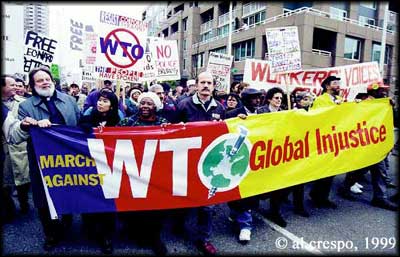
Seattle also opened a door on a new era for movement in the US. The strengths and weaknesses of our organizing efforts served as a spark for new work, new alliances, new conversations, and a new generational drive. It opened the possibility for a generation of people to understand action, movement, and strategy as effective. It also offered an opportunity to see the strengths of innovation and mass organizing, as well as the weaknesses of underdeveloped leadership and lack of connection to long-term transformative practices.
2.) Claim your victories and evaluate your mistakes. Read the rest of this entry »
 http://www.democracynow.org/2009/12/17/bolivian_president_evo_morales_on_climate
AMY GOODMAN: Just before we went to air today, I interviewed Evo Morales, Bolivia’s first indigenous president. He was re-elected in a landslide victory earlier this month. On Wednesday, Evo Morales called on world leaders to hold temperature increases over the next century to just one degree Celsius, the most ambitious proposal so far by any head of state. Morales also called on the United States and other wealthy nations to pay an ecological debt to Bolivia and other developing nations.
AMY GOODMAN: President Morales, welcome to Democracy Now!
PRESIDENT EVO MORALES: [translated] Thank you very much for the invitation.
AMY GOODMAN: You spoke yesterday here at the Bella Center and said we cannot end global warming without ending capitalism. What did you mean?
PRESIDENT EVO MORALES: [translated] Capitalism is the worst enemy of humanity. Capitalism—and I’m speaking about irrational development—policies of unlimited industrialization are what destroys the environment. And that irrational industrialization is capitalism. So as long as we don’t review or revise those policies, it’s impossible to attend to humanity and life.
AMY GOODMAN: How would you do that? How would you end capitalism?
PRESIDENT EVO MORALES: [translated] It’s changing economic policies, ending luxury, consumerism. It’s ending the struggle to—or this searching for living better. Living better is to exploit human beings. It’s plundering natural resources. It’s egoism and individualism. Therefore, in those promises of capitalism, there is no solidarity or complementarity. There’s no reciprocity. So that’s why we’re trying to think about other ways of living lives and living well, not living better. Not living better. Living better is always at someone else’s expense. Living better is at the expense of destroying the environment.
AMY GOODMAN: President Morales, what are you calling here—for here at the UN climate summit?
PRESIDENT EVO MORALES: [translated] Defense of the rights of Mother Earth. Read the rest of this entry »
This is a great, short video that shows why “Cap and Trade” schemes to reduce carbon emissions, like what world leaders are discussing at the Copenhagen Summit, are fundamentally flawed. Turns out that selling our atmosphere to corporations might actually be a bad way to stop climate change. It’s just another attempt to bail out capitalism, this time by making a commodity out of our hopes for a sustainable future.
Annie Leonard, creator of the original “Story of Stuff,” has hit another one out of the park by breaking down complex political issues into simple, accessible and visually appealing viral videos. Check it out (And share with family and friends)! [alex]
And here is the original, highly-acclaimed “Story of Stuff”
see more at storyofstuff.com
The efforts of these pirates to gain desperately-needed resources to escape the extreme poverty of Somalia by capturing vulnerable international shipping seem to be virtually unstoppable. As the article says, Somali pirates now hold about 12 different ships hostage, and this oil tanker (whose cargo is worth about $20 million) was captured some 800 miles off the coast of Somalia.
This constitutes yet another significant “social limit to growth” as I explain in my synopsis – people across the world are less and less willing, or able, to “play by the rules” of global capitalism, when they know the system isn’t working for them. The actions of the Somali pirates are just one dramatic and violent example of a much more generalized pattern of resistance, which is placing significant barriers to profit, and thereby opening up possibilities for new systems to emerge and replace capitalism. [alex]
Somali pirates hijack oil tanker headed to New Orleans
By The Associated Press, Published by Nola.com
November 30, 2009, 11:06AM

The Greece-flagged tanker Maran Centaurus, pictured here, was seized by Somali pirates on Sunday, Nov. 29, 2009. It was headed to New Orleans, according to a report in the New York Times.
The Greece-flagged Maran Centaurus was hijacked Sunday about 800 miles (1,300 kilometers) off the coast of Somalia, said Cmdr. John Harbour, a spokesman for the EU Naval Force. Harbour said it originated from Jeddah, Saudi Arabia and was destined for New Orleans, according to a report the New York Times.
The ship has 28 crew members on board, he said.
The shipping intelligence company Lloyd’s List said the Maran Centaurus is a “very large crude carrier, with a capacity of over 300,000 tons.”
Stavros Hadzigrigoris from the ship’s owners, Maran Tankers Management, said the tanker was carrying around 275,000 metric tons of crude. At an average price of around $75 a barrel, the cargo is worth more than $20 million. Hadzigrigoris declined to say who owned the oil.
Pirates have increased attacks on vessels off East Africa for the millions in ransom that can be had. Though pirates have successfully hijacked dozens of vessels the last several years, Sunday’s attack appears to be only the second ever on an oil tanker. Read the rest of this entry »
Also published by The Rag Blog and OpEdNews.
 “We stand at a critical moment in Earth’s history, a time when humanity must choose its future. As the world becomes increasingly interdependent and fragile, the future at once holds great peril and great promise. To move forward we must recognize that in the midst of a magnificent diversity of cultures and life forms we are one human family and one Earth community with a common destiny. We must join together to bring forth a sustainable global society founded on respect for nature, universal human rights, economic justice, and a culture of peace. Towards this end, it is imperative that we, the peoples of Earth, declare our responsibility to one another, to the greater community of life, and to future generations. – The Earth Charter” (pg. 1).
David Korten, long-time global justice activist, co-founder of Yes! Magazine, and author of such books as When Corporations Rule the World, lays out the fundamental crossroads facing the world in his 2006 book The Great Turning: From Empire to Earth Community. In response to global climate change, war, oil scarcity, persistent racism and sexism and many other mounting crises, Korten argues we must recognize these as symptoms of a larger system of Empire, so that we might move in a radically different direction of equality, ecological sustainability, and cooperation, which he terms Earth Community. This is a powerful and important book, which excels in overviewing the big picture of threats facing our ecosphere and our communities at the hands of global capitalism1, and translating this into the simplest and most accessible language so we might all do something about it. It’s pretty much anti-capitalism for the masses. And it has the power to inspire many of us to transform our lives and work towards the transformation of society.
Capitalism and Empire
Of course, Korten has made the strategic decision to avoid pointing the finger at “capitalism” as such in order to speak to an American public which largely still confuses the term as equivalent to “freedom” or “democracy.” In fact the “C” word is rarely mentioned in the book, almost never without some sort of modifier as in “corporate capitalism” or “predatory capitalism”, as if those weren’t already features of the system as a whole. Instead, Korten names “Empire” as the culprit responsible for our global economic and ecological predicament, which is defined as a value-system that promotes the views that “Humans are flawed and dangerous”, “Order by dominator hierarchy”, “Compete or die”, “Masculine dominant”, etc. (32).
Korten explains that Empire, “has been a defining feature of the most powerful and influential human societies for some five thousand years, [and] appropriates much of the productive surplus of society to maintain a system of dominator power and elite competition. Racism, sexism, and classism are endemic features” (25). In this way the anarchist concept of the State is repackaged as a transcendent human tendency, which has more to do with conscious decision-making and maturity level than it does with political power. While this compromise does limit the book’s effectiveness in offering solutions later on, it does speak in a language more familiar to the vast non-politicized majority of Americans, and may have the potential to unify a larger movement for change.
Whatever you want to call the system, the danger it presents to the planet is now clear. Korten spells out the grim statistics: “Fossil fuel use is five times what it was [in 1950], and global use of freshwater has tripled… the [Arctic] polar ice cap has thinned by 46 percent over twenty years… [while we’ve seen] a steady increase over the past five decades in severe weather events such as major hurricanes, floods, and droughts. Globally there were only thirteen severe events in the 1950s. By comparison, seventy-two such events occurred during the first nine years of the 1990s” (59-60). If this destruction continues, it’s uncertain if the Earth will survive.
This ecological damage is considered alongside the social damage of billions living without clean water or adequate food, as well as the immense costs of war and genocide. But Korten understands that the danger is relative to where you stand in the social hierarchy – the system creates extreme poverty for many, and an extreme wealth for a few others. He explains how the system is based on a deep inequality that is growing ever worse, “In the 1990s, per capita income fell in fifty-four of the world’s poorest countries… At the other end of the scale, the number of billionaires worldwide swelled from 274 in 1991 to 691 in 2005” (67). The critical point that these few wealthy elites wield excessive power and influence within the system to stop or slow necessary reform could be made more clearly, but at least the book exposes the existence of this upper class, who are usually quite effective at hiding from public scrutiny and outrage over the suffering they are causing.2
Earth Community – Growing a Revolution
Standing at odds with the bastions of Empire is what David Korten calls “Earth Community,” a “higher-order” value-system promoting the views of, “Cooperate and live,” “Love life”, “Defend the rights of all”, “Gender balanced”, etc. (32). Read the rest of this entry »
This shocking article in the UK Independent shows the deadly effects of asbestos in England, where just as in my home town of Ambler, people continue to die from an industry that stopped producing decades ago.
Among the revelations here are that UK officials knew about the “evil effects” of asbestos in 1898, yet it took a century to outlaw. Another startling statistic is that asbestos kills 90,000 people a year worldwide, and the death rate in England will continue to increase until 2016.
More evidence of the social and ecological harm inherent in a capitalist system that values profit above all else.
[alex]
Asbestos: A shameful legacy
The authorities knew it was deadly more than 100 years ago, but it was only banned entirely in 1999. The annual death rate will peak at more than 5,000 in 2016 – now MPs have a chance to do the decent thing.
By Emily Dugan
Sunday, 22 November 2009

Even as the Sanders brothers posed for these photos, each was already sentenced to a terrible death decades later. Why? They had hugged a family friend who worked at the local factory
They called it “the Barking cough”. First it began like any other: a tickle in the chest and slight pain on breathing. Then, within a matter of months, the sufferer was in agony, gasping for air and eventually suffocating to death as a vicious cancer attacked their lungs waiting for the final lingering, inevitable end which might not come for decades.The legacy of the Cape Asbestos factory in Barking, east London, where asbestos-related cancers continue to kill scores of residents, is a deadly one. Hundreds of people have died since the factory closed in 1968.
The story of Barking’s “industrial killing machine” is a story repeated up and down the country where thousands of Britons continue to be blighted by their industrial past. Exposure to asbestos is now the biggest killer in the British workforce, killing about 4,000 people every year – more than who die in traffic accidents. The shocking figures are the grim legacy of the millions of tons of the dust shipped to Britain to make homes, schools, factories and offices fire resistant. It was used in products from household fabrics to hairdryers.
Those most at risk are ordinary workers and their families. Whether it was dockyard workers who unloaded the lethal cargoes, or those in the factories exposed to the fibres, or the carpenters, laggers, plumbers, electricians and shipyard workers who routinely used asbestos for insulation – all suffered. So did the wives who washed the work overalls and the children who hugged their parents or played in the dust-coated streets.
The exposure to asbestos in Britain is largely historical but the death toll is alarmingly etched on our future. Asbestos fibres can lie dormant on victims’ lungs for up to half a century; deaths from asbestos in Britain will continue to rise until 2016.
Nor is it confined to Britain. The World Health Organisation says asbestos currently kills at least 90,000 workers every year. One report estimated the asbestos cancer epidemic could claim anywhere between five and 10 million lives before it is banned worldwide and exposure ceases.
Asbestos was hailed as the “magic mineral” when its tough, flexible but fire-resistant qualities were realised, but for more than a century doctors and others have been warning of its dangers. Asbestos dust was being inhaled into the lungs where it could lie unnoticed before causing crippling illnesses such lung cancer, asbestosis and mesothelioma which one medical professor has described as “perhaps the most terrible cancer known, in which the decline is the most cruel”. Read the rest of this entry »
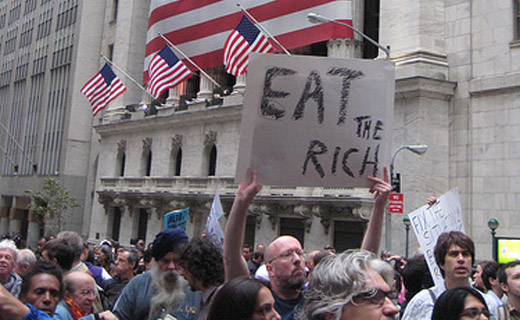 Today, Democracy Now! reported that two major records have been broken in 2009 – Wall St. profits ($35.7 billion in the first half of the year), and the number of Americans going hungry (50 million). These two seemingly unrelated tragedies immediately suggest a common solution – carve up the bloated hulks of Wall St. swine and serve them up to the American people!
On Tuesday, the NY Comptroller’s Office released a report showing that “broker-dealer operations of New York Stock Exchange member firms earned a record $35.7 billion in the first half of 2009.” Through September, $22.5 billion in profits were reported from the four largest firms alone —Goldman Sachs, Merrill Lynch, Morgan Stanley, JPMorgan Chase. These are the same banks who got bailed out by the Federal Government last year – which means that taxpayers like you and I paid for these creeps’ bonuses.
Not coincidentally, these obscene profits were recorded at the same moment that the Department of Agriculture released a report showing that “nearly 50 million people — including almost one child in four — struggled last year to get enough to eat” (as written in the Washington Post on Monday). While the economy has been in the tank and unemployment has surpassed 10% officially, food prices have been skyrocketing, and so millions more Americans are being forced to go without needed nutrition.
Why isn’t it a coincidence? Because the crooks who sent global markets into a freefall last September, causing millions to lose their homes and jobs, have been rewarded for their bad behavior with preferential treatment from Uncle Sam. These Wall St. piggies have been gorging themselves on trillions of U.S. Federally approved dough, while regular folks struggle to pay the rent or put food on the table – without so much as a measly health care reform bill to give hope to their deteriorating condition. Now 1 out of every 4 of our kids are going hungry while the government subsidizes the very stock market slimeballs responsible for creating the trouble to begin with.
“Where’s OUR bailout?” struggling folks are wondering, as they see food prices climb and jobs shipped overseas by the day. 50 million folks are wondering where their next meal is gonna come from… and it’s time to entertain innovative, cost-effective proposals, even if they may seem exotic.
Well it turns out there’s one way to solve this problem without tapping the Treasury for so much as a penny!
It would bring down the cost of high-protein, high-quality food, providing much-needed nutrition to the hungry.
It could create high-paid and unionized manufacturing jobs, right here in the U.S. of A!
It would be environmentally friendly, dolphin-safe, and carbon-neutral (although there may be some associated methane emissions after the plan is implemented).
Best of all, this solution would remove the parasitic, bonus-hungry, pyramid-scheming, derivative-trading, regulation-gutting, President-advising, economy-wrecking, bailout mongers from the picture, allowing the American people to determine our economic future democratically!
And it’s so straightforward even Timothy Geithner could understand it:
Eat the Rich!
[alex, Nov. 19]
below is the transcript from Democracy Now!’s interview of Robert Scheer on these 2 unprecedented reports and what they mean for the economy: Read the rest of this entry »


 The End of Capitalism
Recent Comments