
You are currently browsing the category archive for the ‘Capitalism’ category.
A short article I wrote for local Philly paper The Defenestrator, with a few tips on how to avoid paying back student loans. Student debt functions as an enclosure on youth – it keeps post-college youth from pursuing their dreams or working with others for a better world, because they feel pressured to pay their debt back. This affects students even before they graduate – rather than study what they care about, students feel immense pressure to study a subject that will land them a good job.
A few statistics:
- By 2008 average college tuition had increased by 439% since the 1980s, meaning it’s over 5 times as expensive as a generation ago. This doesn’t include books, housing, meal plans, etc.
- Graduating college seniors in 2008 had an average debt of $23,200. 67% of seniors graduated with student debt. (Project on Student Debt)
- As recently as 1993, less than half of seniors graduated with debt.
- Prior to 1980, 80% of government financial aid was given in the form of grants and scholarships that did not have to be repaid. Today, 80% of gov’t financial aid comes in the form of loans.
- 78% of undergraduates worked full or part-time jobs while taking classes in 2003-04. In 1984, it was 49%.
- In 1970, 40% of new college students considered “being very well-off financially” to be very important, and about 70% considered “developing a meaningful philosophy of life” to be very important. In 2005, 70% considered “being very well-off financially” to be very important, and about 40% considered “developing a meaningful philosophy of life” very important.
Please comment if you have other suggestions on how to break free of student debt! [alex]
Break the Chains of Student Debt!
Alex Knight, June 3, 2010
Paying back student loans can be a real downer. Loans can make organizing after college virtually impossible as they force debtors to work a full-time corporate or nonprofit job, or join the military just to pay them off. When I graduated from college, I had $50,000 worth of student loan debt. I felt I was forced to get a full-time job, and pay them off as quickly as possible so in the future I could finally dedicate myself to social change work. Luckily I didn’t have to make this choice, as there are other options available! Here are a few worth knowing about.
First, you can defer or get a forbearance, to delay payments. Often with these you can delay paying your loans for years, although interest may accrue during that time, and you may be forced to make special payments. For example Sallie Mae used to require you to pay $100 for a 6-month forbearance on private loans, but now they’ve chopped this to $200 for only a 3-month forbearance, which often makes it almost pointless. Nevertheless, you can often easily qualify for an “unemployment” deferment, even if you are working part-time.
Second, you can try to run from your loans altogether and go into default. The only problem with this, besides destroying your credit rating, is if you have co-signers on your loans, such as parents. If you go into default, you’d also be screwing them over.
A third option has recently emerged, which should be taken advantage of as much as possible. It’s called Income-Based Repayment, and it can be used to reduce or eliminate your monthly payments for most Federal loans (not those pesky private ones, unfortunately). Through the federal government’s Direct Loan program, which was recently enlarged by Obama’s Health Care reform, you can consolidate your federal loans into an IBR (or Income-Contigent Repayment – ICR) plan. Payments then become “based” or “contingent” on your income, so if you work part-time and don’t make a lot of money, you won’t have to pay a lot, and you could even eliminate your monthly payments entirely if you earn less than 150% of the poverty line. If you’re a full-time activist like me, you almost certainly qualify. And after 25 years, your debt will be forgiven.
So check out IBR, and don’t let student loans stop you from dedicating your life to building the social movements our communities and world so desperately need!
Income-Based Repayment
 Income-Based Repayment (IBR) is a new payment option for federal student loans. It can help borrowers keep their loan payments affordable with payment caps based on their income and family size. For most eligible borrowers, IBR loan payments will be less than 10 percent of their income – and even smaller for borrowers with low earnings. IBR will also forgive remaining debt, if any, after 25 years of qualifying payments.
Who can use IBR? IBR is available to federal student loan borrowers in both the Direct and Guaranteed (or FFEL) loan programs, and covers most types of federal loans made to students, but not those made to parents. To enter IBR, you have to have enough debt relative to your income to qualify for a reduced payment. That means it would take more than 15 percent of whatever you earn above 150% of poverty level to pay off your loans on a standard 10-year payment plan. Use our calculator to see if you’re likely to be eligible.
How does IBR make payments more affordable? IBR uses a kind of sliding scale to determine how much you can afford to pay on your federal loans. If you earn below 150% of the poverty level for your family size, your required loan payment will be $0. If you earn more, your loan payment will be capped at 15 percent of whatever you earn above that amount.
Except for the highest earners, that usually works out to less than 10 percent of your total income. Read the rest of this entry »
Sakura Saunders’ excellent article from ZNet exposing one form of the “modern Enclosures” – displacing communities from their land to make money for transnational corporations, in this case mining companies in Papua New Guinea. Read this closely!
As described by Silvia Federici’s excellent book Caliban and the Witch, the Enclosures are the violence and displacement that created the first class of landless workers in Europe, commodifying their labor with the wage. And these Enclosures have continued to expand and develop alongside the system of capitalism, in fact I will make the argument that this violence is the base, the foundation, for the system as a whole, and it could not function without it.
We must never forget that at every moment, capitalism is committing violence against poor and indigenous communities in order to make its profits. As Sakura cites, “more than 10 million people are involuntarily displaced every year to make room for development projects.” So much for ‘laissez-faire’! [alex]
Mining Through Roots
Displacement, Poverty and the Global Extractive Industry
Monday, June 14, 2010
In the highlands of Papua New Guinea, several villages rest on a man-made island literally surrounded by an open pit gold mine and its expanding waste dumps. As the waste dumps have grown, they’ve devoured homes, schools, and most of the areas once used for gardening, making the indigenous population rely on money to acquire food while crowding them into increasingly squashed living quarters. At the same time, these same communities – the original landowners of the mine site – are criminalized for what the company calls “illegal mining,” a practice of panning for gold that the local community considers its birthright.
This so-called illegal mining is used by the company as a pretext for detentions, killings, and even the burning down of an entire hillside of homes*. Meanwhile, public funds are diverted from schools and hospitals to deal with “law and order” issues and the construction of a multi-million dollar fence to surround the mine site.
This scenario – the protection of the have’s from the have-not’s by a process of criminalization, militarization and the construction of walls – is an all-too-familiar response to the social issues created by global capitalism and colonization. Immigration policies criminalize people, militarize borders, and separate communities along boundaries set up to trap people in an economic reality that conspires against them. Meanwhile, the developed nations that aggressively protect their borders against new entrants have created a global economic and military system that forces people out of rural areas that are then used by large industry to extract resources, be they cash crops, minerals, lumber, oil and gas, or the industrial infrastructure needed to produce and export these goods (such as dams, highways, and pipelines). This rural to urban migration turns cities into sweatshops with expendable labor and the corresponding rights, leaving few options for the dispossessed. Labor exploitation becomes codified in Temporary Foreign Worker Programs, where developed countries attempt to receive maximum benefit from the desperation of the world’s impoverished. Read the rest of this entry »
 Yesterday CNN broke the story that BP is dumping toxic dispersant Corexit 9500 into the Gulf in order to sink the oil under the surface, hiding the true size of the spill and therefore reducing their financial liability. In other words, instead of cleaning up the horrible mess they’ve made, BP has decided to try to hide the disaster as much as possible so they won’t need to pay for it.
Such outrageous corporate irresponsibility perfectly illustrates of how capitalism’s obsession with profits necessarily leads to ecological and social trauma. BP is forced by the stock market to concentrate all their efforts on increasing their bottom line and limiting losses, even if it means driving more oil underwater and away from the cleanup crews.
We need to move to a world where marine life, biodiversity, as well as human health and well-being are valued as more important than a corporation’s profit margin. It fills me with great anger and frustration for every daily tragedy that we have to suffer at the hands of this monstrous system. Even the slightest amount of rationality or simple human empathy would prevent these kinds of machine-brained crimes against the Earth if they were allowed to intervene.
Here’s the transcript, via Crooks and Liars, which also has the video. [alex]
Anderson Cooper talked to Fred McCallister, an investment banker with Allegiance Capital Corporation, who is going to be testifying before the Senate Commerce, Science and Transportation Committee today about something that’s appeared painfully obvious to me for some time now, that BP is using dispersants to hide the size of the oil spill in the hopes if limiting their liability. My only question is why has the government allowed them to do it?
ANDERSON COOPER: Fred McCallister joins us now.
Fred, why do you think that BP would prefer to use dispersants over skimmers?
FRED MCCALLISTER, VICE PRESIDENT, ALLEGIANCE CAPITAL CORPORATION: Anderson, thank you for having me on tonight.
The issue that BP is facing right now is whether to use what’s practices that are normal around the world, which is to try to cause the oil to come to the surface, and then deploy the right amount of equipment and the right type of equipment to gather that oil up and get it out of the Gulf.
Using the dispersants allows the oil to stay under the surface, and this accomplishes several purposes. It allows the — it makes it a lot more difficult to quantify the amount of oil that’s coming out, which has a direct impact on damages and royalties that have to be paid.
It keeps it out of sight and out of mind. And it allows BP to amortize the cost of the cleanup over several years, 10 to 15 years, because some of this oil is going to biodegrade, but a lot of that oil is going to roll up on the beaches for 10 or 15 years.
And if they can amortize that over 10 or 15 years,as opposed to dealing with that over the next 15 months, that’s a much better financial position for BP to be in. Read the rest of this entry »
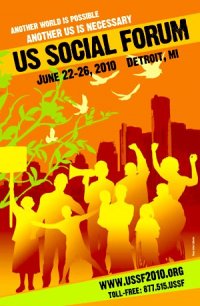 Economic collapse. Ecological disaster. Who’s going to make sense of this chaos? YOU!
Joanna Grim and Alex Knight will facilitate a participatory workshop to explore the questions: Is capitalism coming to an end? if so, Why? and What does this mean for the future of our planet? Are we headed towards a neo-fascist nightmare or is this an opportunity to create real democracy and sustainability?
The End of Capitalism? At the Crossroads of Crisis and Sustainability
When: Wednesday, 06/23/2010 – 3:30pm – 5:30pm
Where: WSU Old Main: 1134, Detroit Michigan!
Who: YOU! along with members of the End of Capitalism Study Group, who recently studied the book “Caliban and the Witch” by Silvia Federici on the origins of capitalism in the witch hunts of Europe.
Why: It’s up to us to figure out what the heck is happening to our world! Bring your ideas and hear ours!
Workshop description:
The ongoing global economic crisis has dramatically called into question the future of capitalism – a system that relies on perpetual growth but exists on a finite Earth. In this workshop, participants will take a “big picture” look at the ecological limits and social limits which lie below the current economic crisis and which threaten capitalist growth. These include climate change, peak oil, the Global Justice Movement and resistance from unexpected sources, like the Chinese labor movement. We will then imagine possible non-capitalist futures, both democratic/sustainable and authoritarian/fascist, in order to understand the historic crossroads at which our movements find themselves.
The goal of this workshop will be to broaden and deepen the anti-capitalist analysis of participants, while creating an open but directed space for us to articulate our vision of the world we are working towards, and the major dangers that are in our path. It will be led by youth members of the End of Capitalism Study Group, and build from the ideas of endofcapitalism.com. This will be a participatory workshop, not a speech, and old/dogmatic ideas will be questioned by new critical perspectives, with the goal of discovering deeper truth about our world and our work for social change in the 21st Century.
More info: http://organize.ussf2010.org/ws/end-capitalism-crossroads-crisis-and-sustainability
The US Social Forum is the nation’s largest gathering of progressive individuals and organizations. It is more than a conference, it is a movement-building process. This year’s Social Forum is the second one, and will be held in Detroit, MI from June 22-26. check out http://ussf2010.org/
RSVP on Facebook: http://www.facebook.com/event.php?eid=113425255370297

The Grapes of Wrath
by John Steinbeck
published 1939 during the last Great Depression.
Alex Knight, endofcapitalism.com, May 25, 2010
Also posted on The Rag Blog and TowardFreedom.
Arizona SB1070, signed into law by Governor Jan Brewer on April 23, requires Arizona’s local and state law enforcement to demand the immigration status of anyone they suspect of being in the country illegally, and arrest them if they lack documents proving citizenship or legal residency. Effectively making racial profiling into state policy, this law is the latest in a series of attacks on Latin American immigrants, as well as the entire Latino community, who must live with the fear of being interrogated by police for their brown skin. Then on May 11, Arizona went one step further, outlawing the teaching of ethnic studies classes, or any classes that “are designed primarily for students of a particular ethnic group or advocate ethnic solidarity”. This same law also states that schools must fire English teachers who speak with a “heavy accent.”
Perhaps these new laws make sense if we imagine that undocumented immigrants are merely “aliens”, a danger to the good, mostly white citizens of this great country. But suppose we look at the problem of immigration from the perspective of the immigrants? Why are they risking life and limb to come to a foreign land, far from their home and families? Why aren’t they deterred from making this trip no matter how many walls we put up, no matter how many police collaborate with ICE, no matter how many angry armed “Minutemen” vigilantes are conscripted to guard the border?
John Steinbeck’s classic novel The Grapes of Wrath, following the Joad family as they migrate to California during the “Dust Bowl” of the 1930s, sheds light on these questions in a way that perhaps every American can relate to. One of the most popular and well-written American books of all time, The Grapes of Wrath provides a very human perspective on the harsh lives of migrants, personified by the Joads – a family of poor sharecroppers from Oklahoma. Evicted from their family farm, just as the millions of Mexicans who have suffered enclosure from their land and become homeless and jobless because of NAFTA, the Joads travel to California in a desperate search of work, only to encounter the harassment of authorities and the hatred of the local population.
There are important differences between the “Okies” who traveled to the Southwest in the 1930s and Latino migrantes of the 2000s. The Joads, of course, were white, and did not cross a national border when they made their exodus. But at its core the story of the Joads is the story of the migrant workers, their troubles, their fears, but also their humanity, and their hope. It is a story that can inspire us to recognize the historic nature of the moment in which we live, understand why these enormous transformations are occurring, and recognize that justice for the immigrants is justice for everyone, regardless of color or citizenship status.
Enclosure
In order to understand the migrantes we first have to understand the story of their displacement, or the enclosure of their land, which has left them homeless and with no other options than to leave their homeland in search of a wage. What can The Grapes of Wrath tell us about this reality?
People usually do not resort to risky and desperate moves unless they have nothing left to lose. Steinbeck begins the Joads’ story with the loss of everything they had: the small farm on which they had sustained their family for generations by growing cotton. Young Tom Joad, fresh out of prison, returns to his home to find it deserted. “The Reverend Casy and young Tom stood on the hill and looked down on the Joad place… Where the dooryard had been pounded hard by the bare feet of children and by stamping horses’ hooves and by the broad wagon wheels, it was cultivated now, and the dark green, dusty cotton grew… ‘Jesus!’ he said at last. ‘Hell musta popped here. There ain’t nobody livin’ there.'” (51).

Mexican farmer with corn / image courtesy of "© Juan_de" on flickr
Whether as tenants or small landholders, either for subsistence or for markets, the vast majority of the poor migrantes now coming to this country are fleeing the loss of their farms and their livelihoods, just as the Joads. Perhaps for generations, maybe hundreds or even thousands of years, they had lived in connection with the land and had been able to depend on it for the survival of their families and culture. The loss of this land is devastating to those cultures, but larger forces stand to gain by driving these people into homelessness. Read the rest of this entry »
Also published on The Rag Blog.
BP Oil Disaster in the Gulf - Energy Department Photo. retrieved from http://www.flickr.com/photos/leonarddoyle/4583740105/in/set-72157624005298860/
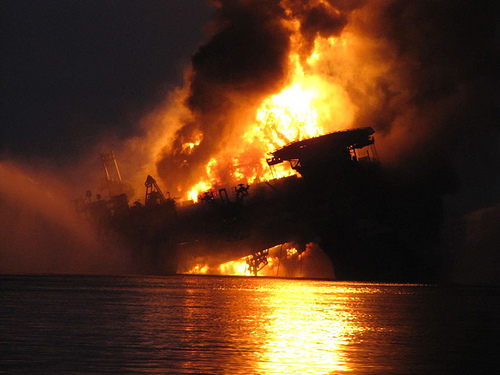
Just two weeks after the Massey Energy coal explosion on April 5 that killed 29 miners in West Virginia, the BP oil rig Deepwater Horizon exploded in the Gulf of Mexico, killing 11 more workers. These back-to-back tragedies have brought attention to the fossil fuel industry’s terrible safety record – in both cases there were known safety violations on site, but the government did nothing to prevent disaster from occurring. See the interview below which explains how the federal government approved this BP rig and many more without conducting the environmental review they are legally obligated to.
Unlike the industry executives attempting to shift blame and avoid responsibility, we must look beneath the surface to discover the deeper meaning of these horrible crises.
Is the universe giving us a warning that fossil fuels are going to destroy us? Because if global climate change continues at the rate it has, in the not-too-distant future we will see many thousands, or even millions more deaths as crops dry up, floods destroy coastal wetlands, and diseases migrate to temperate regions. This is no joke. Families and communities are being destroyed so coal and oil corporations can boost their profit margins.
We need to be open to hearing the lessons that are all around us, especially from those who have been silenced and beaten down by capitalism.
Immediately after the Massey explosion and the BP explosion, was Earth Day – April 22. And on this date, indigenous and poor people from around the globe were meeting in Cochabamba, Bolivia for the World People’s Conference on Climate Change, a grassroots response to the corporate fraud that was the Copenhagen Summit. Bolivian President Evo Morales, who was proclaimed “World Hero of Mother Earth” by the United Nations General Assembly in October, hosted the conference, proclaiming “The capitalist system looks to obtain the maximum possible gain, promoting unlimited growth on a finite planet. Capitalism is the source of asymmetries and imbalance in the world.”
30,000 people from 140 countries convened and approved the “Cochabamba Protocol”, which calls for an International Climate Justice tribunal to prosecute climate criminals, and condemns REDDs which put a price on wild forests and encourage development, along with carbon market schemes. The protocal proposes a Universal Declaration of Mother Earth and demands that industrialized polluting nations cut carbon emissions by 50 percent as part of a new, binding climate agreement.
Global momentum is building towards confronting capitalism in terms of the ecological devastation it is causing. Here in the United States, Rising Tide North America is calling for a “Day of Action, Night of Mourning” this Friday, May 14 to call for BP to pay for all cleanup and long-term ecological effects of their spill, for the abolition of offshore oil drilling, and for “a rapid and just transition away from fossil fuels.”
[alex]
Government Exempted BP from Environmental Review
Video/interview published by Democracy Now!
May 7, 2010
JUAN GONZALEZ: Well now to the Gulf of Mexico where the enormous oil slick in the Gulf continues to expand. Interior Secretary Ken Salazar has ordered a 3-week halt to all new offshore drilling permits. Emphasizing that the companies involved had made “major mistakes,” Salazar spoke to reporters Thursday outside BP’s Houston crisis center. He noted that lifting the moratorium on new permits will depend on the outcome of a federal investigation over the Gulf spill and the recommendations to be delivered to President Obama at the end of the month.
- SECRETARY KEN SALAZAR: Minerals Management Service will not be issuing any permits for the construction of new offshore wells. That process will be concluded here on May the 28th. At that point in time, we’ll make decisions about how we plan on moving forward. There is some very major mistakes that were made by companies that were involved. But today is not really the day to deal with those issues. Today and the days ahead really are about trying to get control of the problem.
JUAN GONZALEZ: Secretary Salazar added that the existing offshore oil and natural gas drilling will continue, even as public meetings to discuss new oil drilling off the Virginia coast have been canceled for this month.
AMY GOODMAN: Salazar’s announcement comes on the heel of a Washington Post exposé revealing that the Minerals Management Service had approved BP’s drilling plan in the Gulf of Mexico without any environmental review. The article notes that the agency under Secretary Salazar had quote “categorically excluded” BP’s drilling as well as hundreds of other offshore drilling permits from environmental review. The agency was able to do this using a loophole in the National Environmental Policy Act created for minimally intrusive actions like building outhouses and hiking trails. Well, for more on this story, we’re joined now from Tucson, Arizona by Kieran Suckling, executive director of the Center for Biological Diversity. Welcome to DEMOCRACY NOW!, Kieran. Explain this loophole, how you found it, and what it means for the Gulf.
KIERAN SUCKLING: Well, when a federal government is going to approve a project, it has to go through an environmental review. But for projects that have very, very little impact like building an outhouse or a hiking trail, they can use something called a categorical exclusion and say there’s no impact here at all so we don’t need to spend energy or time doing a review. Well, we looked at the oil drilling permits being issued by the Minerals Management Service in the Gulf, and we were shocked to find out that they were approving hundreds of massive oil drilling permits using this categorical exclusion instead of doing a full environmental impact study. And then, we found out that BP’s drilling permit—the very one that exploded—was done under this loophole and so it was never reviewed by the federal government at all. It was just rubber-stamped. Read the rest of this entry »
Disobeying the Banks: An Interview with Enric Duran
by Scott Pierpont
Originally published by the Institute for Anarchist Studies
On September 17th, 2008, Barcelona-based anticapitalist Enric Duran announced that he had expropriated 492,000 euros. For several years, Duran took out loans that he never intended to pay back and donated all of the money to social movements constructing alternatives to capitalism. This announcement came with the publication of 200,000 free newspapers called Crisi (Catalan for “Crisis”), with an article explaining Duran’s action, and other pieces offering a systemic critique of the current financial and ecological crises. The action got the attention of tens of thousands of everyday people as well as major media outlets, who soon dubbed Duran the “Robin Hood of the Banks.” Duran left the country to avoid prosecution. The group that published the newspapers formed Podem Viure Sense Capitalisme (We Can Live With Out Capitalism) and began region-wide organizing through their website, http://podem.cat, bringing together debtors, squatters, alternative economy networks, environmentalists, and everyday people to build a large-scale alternative to capitalism.
Duran returned to Spain six months after the announcement to participate in the release of another publication. On March 17th, 300,000 copies of Podem (We Can) were distributed across Spain in Catalan as well as Spanish. Duran announced the publication during a student protest at the University of Barcelona, and was soon after arrested by the Mossos d’Esquadra, the Catalan regional police on charges of “ongoing fraud” that were brought against Duran by 6 of the 39 financial entities he took money from. He spent two months in jail. He is currently free on bail, having had his passport seized and required to present himself before a judge once a week. None of the charges have been formally brought to trial.
Since then, Duran has been organizing with the We Can campaign. Focused on networking and the distribution of information about alternatives to capitalism, We Can connects with thousands of people participating in alternative economy projects. Many use the group’s website, which includes a “Debtors’ Community” where people get practical advice on how to avoid paying their debts. Duran has published a book, Insumisión a la banca (Disobeying the Banks), the proceeds from which go to We Can, and continues to give talks and participate in national networks on degrowth and alternative currencies.
This interview was taped in Barcelona in December 2009.
The announcement of your action (September 17th, 2008, two days after Lehman Brothers went down) coincided with a dramatic moment during the financial crisis. Was the date chosen for that reason?
That was the goal, to coincide with a moment of ferment in the crises. When the action began at the end of 2005, the crisis hadn’t arrived yet. But the question became when to make it public so it would coincide with an important moment in the crisis. The end of my action was part of the plan, my strategy, by the summer of 2007, when the crisis began in the United States. In the end it was made public in September 2008, coinciding with the breakdown of the international financial order. It was a complete stroke of luck because it wasn’t possible to put an exact date, as we needed a month to prepare the publication and organize people to pass it out. It was really a stroke of luck.
And you planned this action for three years?
Planning, no…it was three years of execution. Between 2005 and 2008 I carried out the various parts of this action. There was a period of research at the beginning, of figuring out how to do it, but very quickly I moved on to practice, because practice is the best way of experimenting and learning.
In your book you mentioned that this technique of taking out loans was inspired by someone you met who falsified pay stubs. But you also mentioned Lucio Urtubia and his action against Citibank. Do you consider your action an expropriation, just as Lucio’s action was?
Yes, the principle examples were expropriations carried out in a non-aggressive way, an intellectual way, such as falsification, or taking out loans and not paying them back, as I did. I don’t know of any precedent involving loans in a political way, but I did have the example of that person who had told me about it before. So I guess the example of Lucio inspired my broader conception of expropriation and direct action, as did the examples of civil disobedience like Martin Luther King in the United States, or those in other countries who showed that public, illegal action can have a major impact on social consciousness. Read the rest of this entry »
Chris Hedges, author of American Fascists: The Christian Right and the War on America, has been warning us of the threat of neo-fascism in the United States for a few years now. This is one of his best pieces on the subject, comparing what is happening here and now with the Sarah Palins, Glenn Becks, and Tea Partiers to what happened to Yugoslavia 20 years ago.
However I must disagree with Hedges on the phrase ‘liberal elite’ – the ruling class is hardly liberal, unless it’s liberal to invade countries and kill millions of innocent civilians based on lies, or to plunder the atmosphere and seas, or to torture and spy on Americans and others, or any of the other awful things the government and its corporate cronies are carrying out all the time. Barack Obama may have a liberal streak as an individual, but he is carrying out a violent, imperialistic capitalist agenda for the real rulers. [alex]
Is America ‘Yearning for Fascism’?
Chris Hedges
Originally published by TruthDig, March 29, 2010
Tea Baggers - AP / Jae C. Hong
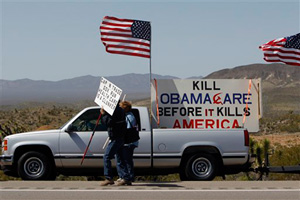
The language of violence always presages violence. I watched it in war after war from Latin America to the Balkans. The impoverishment of a working class and the snuffing out of hope and opportunity always produce angry mobs ready to kill and be killed. A bankrupt, liberal elite, which proves ineffectual against the rich and the criminal, always gets swept aside, in times of economic collapse, before thugs and demagogues emerge to play to the passions of the crowd. I have seen this drama. I know each act. I know how it ends. I have heard it in other tongues in other lands. I recognize the same stock characters, the buffoons, charlatans and fools, the same confused crowds and the same impotent and despised liberal class that deserves the hatred it engenders.
“We are ruled not by two parties but one party,” Cynthia McKinney, who ran for president on the Green Party ticket, told me. “It is the party of money and war. Our country has been hijacked. And we have to take the country away from those who have hijacked it. The only question now is whose revolution gets funded.”
The Democrats and their liberal apologists are so oblivious to the profound personal and economic despair sweeping through this country that they think offering unemployed people the right to keep their unemployed children on their nonexistent health care policies is a step forward. They think that passing a jobs bill that will give tax credits to corporations is a rational response to an unemployment rate that is, in real terms, close to 20 percent. They think that making ordinary Americans, one in eight of whom depends on food stamps to eat, fork over trillions in taxpayer dollars to pay for the crimes of Wall Street and war is acceptable. They think that the refusal to save the estimated 2.4 million people who will be forced out of their homes by foreclosure this year is justified by the bloodless language of fiscal austerity. The message is clear. Laws do not apply to the power elite. Our government does not work. And the longer we stand by and do nothing, the longer we refuse to embrace and recognize the legitimate rage of the working class, the faster we will see our anemic democracy die.
The unraveling of America mirrors the unraveling of Yugoslavia. The Balkan war was not caused by ancient ethnic hatreds. It was caused by the economic collapse of Yugoslavia. The petty criminals and goons who took power harnessed the anger and despair of the unemployed and the desperate. They singled out convenient scapegoats from ethnic Croats to Muslims to Albanians to Gypsies. They set in motion movements that unleashed a feeding frenzy leading to war and self-immolation. There is little difference between the ludicrous would-be poet Radovan Karadzic, who was a figure of ridicule in Sarajevo before the war, and the moronic Glenn Beck or Sarah Palin. There is little difference between the Oath Keepers and the Serbian militias. We can laugh at these people, but they are not the fools. We are.
The longer we appeal to the Democrats, who are servants of corporate interests, the more stupid and ineffectual we become. Sixty-one percent of Americans believe the country is in decline, according to a recent NBC News/Wall Street Journal poll, and they are right. Only 25 percent of those polled said the government can be trusted to protect the interests of the American people. If we do not embrace this outrage and distrust as our own it will be expressed through a terrifying right-wing backlash. Read the rest of this entry »


 The End of Capitalism
Recent Comments