
You are currently browsing the category archive for the ‘Capitalism’ category.
Last night I watched the movie Food Inc., which presents a damning critique of the industrial food system in the United States. The food industry is dominated by a few huge corporations making enormous profits producing non-nutritious, environmentally destructive, farmer-ruining, worker-exploiting, cruel-to-animals and even dangerous food in massive quantities. Worse, the food lobby dominates Washington and with millions of dollars systematically prevents federal regulations which could save lives.
But just as An Inconvenient Truth does, Food Inc. hurts its impressive presentation by missing the landing. The movie tells us exactly what the problem is, but neglects to present an adequate solution to the concerned audience, who by the end of the film is ready to take action. Instead, the makers of Food Inc. tell us that this horrible corrupt system can be undone if we “vote with our dollars” and buy organic yogurt from Wal-Mart, even though Michael Pollan in the film has already told us that organic and healthy foods cost more and many families can’t afford them. Is this film aimed at people who think social change means being more mindful about their personal consumption habits? This might make people feel better, but will it actually stop the machine of destruction that is the industrial food system?
In this essay (below), author Derrick Jensen refutes the logic of this sort of “change” as ineffective – consumers don’t make change, organized citizens/workers/students/communities do. He rightly argues that “moral purity” is a different, and ultimately less noble, goal than “to confront and take down those systems.” This is one of Jensen’s better essays, but I still find it lacking in another crucial measure: Does it inspire hope? Jensen tends towards the apocalyptic, which shuts down people’s ability to see the light at the end of the tunnel, a light which is crucial to help us find our path out of the darkness.
I hope my website provides real solutions to the enormous problems we face, while also inspiring hope that we can achieve those solutions, ourselves. Making better individual consumption/lifestyle decisions is a great thing, and part of the picture, but it’s not enough. We need to work together, to organize, to achieve the social change that is needed, and that we deserve. [alex]
Why personal change does not equal political change
by Derrick Jensen
Published in the July/August 2009 issue of Orion magazine
WOULD ANY SANE PERSON think dumpster diving would have stopped Hitler, or that composting would have ended slavery or brought about the eight-hour workday, or that chopping wood and carrying water would have gotten people out of Tsarist prisons, or that dancing naked around a fire would have helped put in place the Voting Rights Act of 1957 or the Civil Rights Act of 1964? Then why now, with all the world at stake, do so many people retreat into these entirely personal “solutions”?
Part of the problem is that we’ve been victims of a campaign of systematic misdirection. Consumer culture and the capitalist mindset have taught us to substitute acts of personal consumption (or enlightenment) for organized political resistance. An Inconvenient Truth helped raise consciousness about global warming. But did you notice that all of the solutions presented had to do with personal consumption—changing light bulbs, inflating tires, driving half as much—and had nothing to do with shifting power away from corporations, or stopping the growth economy that is destroying the planet? Even if every person in the United States did everything the movie suggested, U.S. carbon emissions would fall by only 22 percent. Scientific consensus is that emissions must be reduced by at least 75 percent worldwide.
Or let’s talk water. We so often hear that the world is running out of water. People are dying from lack of water. Rivers are dewatered from lack of water. Because of this we need to take shorter showers. See the disconnect? Because I take showers, I’m responsible for drawing down aquifers? Well, no. More than 90 percent of the water used by humans is used by agriculture and industry. The remaining 10 percent is split between municipalities and actual living breathing individual humans. Collectively, municipal golf courses use as much water as municipal human beings. People (both human people and fish people) aren’t dying because the world is running out of water. They’re dying because the water is being stolen.
Or let’s talk energy. Kirkpatrick Sale summarized it well: “For the past 15 years the story has been the same every year: individual consumption—residential, by private car, and so on—is never more than about a quarter of all consumption; the vast majority is commercial, industrial, corporate, by agribusiness and government [he forgot military]. So, even if we all took up cycling and wood stoves it would have a negligible impact on energy use, global warming and atmospheric pollution.”
Or let’s talk waste. In 2005, per-capita municipal waste production (basically everything that’s put out at the curb) in the U.S. was about 1,660 pounds. Let’s say you’re a die-hard simple-living activist, and you reduce this to zero. You recycle everything. You bring cloth bags shopping. You fix your toaster. Your toes poke out of old tennis shoes. You’re not done yet, though. Since municipal waste includes not just residential waste, but also waste from government offices and businesses, you march to those offices, waste reduction pamphlets in hand, and convince them to cut down on their waste enough to eliminate your share of it. Uh, I’ve got some bad news. Municipal waste accounts for only 3 percent of total waste production in the United States.
I want to be clear. I’m not saying we shouldn’t live simply. I live reasonably simply myself, but I don’t pretend that not buying much (or not driving much, or not having kids) is a powerful political act, or that it’s deeply revolutionary. It’s not. Personal change doesn’t equal social change. Read the rest of this entry »
 “American Fascists: The Christian Right and the War on America”
Chris Hedges
2006 Free Press
Are right-wing Christians in America developing a potentially fascist movement that would discard democracy for the sake of security and conservative values? This is answered affirmatively by Chris Hedges, author of War is a Force That Gives Us Meaning, in his newest book.
We all know the worst of the evangelical movement, which Hedges calls the “dominionists”: they’re militantly anti-abortion and promote abstinence-only education, they hate queer and trans people, they don’t believe in evolution or environmentalism, they’re racist against immigrants and support US warfare and imperialism, and they can be violent, potentially terroristic. This book explores all of these themes, but it also exposes the frightening strength these people have in our society.
For example, “There are at least 70 million evangelicals in the United States attending more than 240,000 evangelical churches… Polls indicate that about 40 percent of respondents believe the Bible is ‘to be taken literally, word for word.’ .. Almost a third of all respondents say they believe in the Rapture.” Clearly this movement has developed a mass base by hiding behind Christianity.
But are these folks organized? Hedges says yes, quite so. He points to their dominance over the Republican Party, as well as billions of dollars received in the form of “faith-based” grants. This governmental power is matched by media influence, as the Christian Right also owns several national television and radio networks, as well as many local media outlets. Further, right-wing organizations such as Focus on the Family and the Christian Coalition are controlled by wealthy white male elites who claim to be “close to God” and are followed with feverish obedience by millions of supporters.
The best parts of the book are the interview sections which delve into the lives of the people drawn to, and spit out by, this movement. By humanizing the participants, we come to understand that their immersion into this Christian reality is often a flight from an overwhelming sense of meaninglessness and despair, genuine emotions which develop from real-world sufferings like unemployment and abuse.
However, much of the book does not live up to this potential and consists of Chris Hedges sending forth litanies of blanket indictments against the ideology of the Christian Right, and attaching a somewhat monolithic character to what in reality is probably a more scattered and heterogeneous right-wing Christian population. In other words, by attacking them as potentially all-powerful, do we not in fact imbue them with powers they do not actually possess?
Worse, although the author rightly argues we must not tolerate a movement which does not tolerate us, he leaves us with little useful ammunition for that struggle. Condemnations of fundamentalist thinking and similarities to Nazism will only get us so far, we need to locate the weak points in the armor of these Crusaders, and this book unfortunately serves little in developing such a strategy.
In a present and future marked by severe crises of an economic, ecological and social nature, the seductiveness of movements urging apocalyptic violence unfortunately may become quite great, and only an alternative movement that appeals to the best in humanity can prevent the emergence of a dictatorship of fear. That great Christian principle of love must be the guiding force as we address the mounting grievances of those left behind by this society and point towards a better future.
[Good news from the best oil/environment writer, Heinberg. The current economic crisis is easing pressure on the planet and its resources, ecological danger is decreasing. This is hopeful. I particular enjoy this statistic: “in the first four months of 2009, more bicycles were sold in the US than cars and trucks put together (over 2.55 million bicycles were purchased, compared to fewer than 2.4 million cars and trucks).”
Lately i’ve become convinced that hope is our greatest ally in working for a better world. If this article doesn’t inspire you, look at what’s happening in Iran at this moment. – alex]
Richard Heinberg
Originally published by Post Carbon Institute, June 5, 2009.
Recently I’ve begun compiling a list of things to be cheerful about. Here are some items that should bring a smile to any environmentalist’s lips:
- World energy consumption is declining. That’s right: oil consumption is down, coal consumption is down, and the IEA is projecting world electricity consumption to decline by 3.5 percent this year. I’m sure it’s possible to find a few countries where energy use is still growing, but for the US, China, and most of the European countries that is no longer the case. A small army of writers and activists, including me, has been arguing for years now that the world should voluntarily reduce its energy consumption, because current rates of use are unsustainable for various reasons including the fact that fossil fuels are depleting. Yes, we should build renewable energy capacity, but replacing the energy from fossil fuels will be an enormous job, and we can make that job less daunting by reducing our overall energy appetite. Done.
- CO2 emissions are falling. This follows from the previous point. I’m still waiting for confirmation from direct NOAA measurements of CO2 in the atmosphere, but it stands to reason that if world oil and coal consumption is declining, then carbon emissions must be doing so as well. The economic crisis has accomplished what the Kyoto Protocol couldn’t. Hooray!
- Consumption of goods is falling. Every environmentalist I know spends a good deal of her time railing both publicly and privately against consumerism. We in the industrialized countries use way too much stuff — because that stuff is made from depleting natural resources (both renewable and non-renewable) and the Earth is running out of fresh water, topsoil, lithium, indium, zinc, antimony…the list is long. Books have been written trying to convince people to simplify their lives and use less, films have been produced and shown on PBS, and support groups have formed to help families kick the habit, but still the consumer juggernaut has continued — until now. This particular dragon may not be slain, but it’s cowering in its den.
- Globalization is in reverse (global trade is shrinking). Back in the early 1990s, when globalization was a new word, an organization of brilliant activists formed the International Forum on Globalization (IFG) to educate the public about the costs and dangers of this accelerating trend. Corporations were off-shoring their production and pollution, ruining manufacturing communities in formerly industrial rich nations while ruthlessly exploiting cheap labor in less-industrialized poor countries. IFG was able to change the public discourse about globalization enough to stall the expansion of the World Trade Organization, but still world trade continued to mushroom. Not any more. China’s and Japan’s exports are way down, as is the US trade deficit.
- The number of vehicle miles traveled (VMT) is falling. For decades the number of total miles traveled by all cars and trucks on US roads has relentlessly increased. This was a powerful argument for building more roads. People bought more cars and drove them further; trucks restocked factories and stores at an ever-growing pace; and delivery vans brought more packages to consumers who shopped from home. All of this driving entailed more tires, pavement, and fuel — and more environmental damage. Over the past few months the VMT number has declined substantially and continually, to a greater extent than has been the case since records started being kept. That’s welcome news.
- There are fewer cars on the road. People are junking old cars faster than new ones are being purchased. In the US, where there are now more cars on the road than there are licensed drivers, this represents an extraordinary shift in a very long-standing trend. In her wonderful book Divorce Your Car, Katie Alvord detailed the extraordinary environmental costs of widespread automobile use. Evidently her book didn’t stem the tide: it was published in the year 2000, and millions of new cars hit the pavement in the following years. But now the world’s auto manufacturers are desperately trying to steer clear of looming bankruptcy, simply because people aren’t buying. In fact, in the first four months of 2009, more bicycles were sold in the US than cars and trucks put together (over 2.55 million bicycles were purchased, compared to fewer than 2.4 million cars and trucks). How utterly cool.
- The world’s over-leveraged, debt-based financial system is failing. Growth in consumption is killing the planet, but arguing against economic growth is made difficult by the fact that most of the world’s currencies are essentially loaned into existence, and those loans must be repaid with interest. Thus if the economy isn’t growing, and therefore if more loans aren’t being made, thus causing more money to be created, the result will be a cascading series of defaults and foreclosures that will ruin the entire system. It’s not a sustainable system given the fact that the world’s resources (the ultimate basis for all economic activity) are finite; and, as the proponents of Ecological and Biophysical Economics have been saying for years, it’s a system that needs to be replaced with one that can still function in a condition of steady or contracting consumption rates. While that sustainable alternative is not yet being discussed by government leaders, at least they are being forced to consider (if not yet publicly) the possibility that the existing system has serious problems and that it may need a thorough overhaul. That’s a good thing.
- Gardening is going gonzo. According to the New York Times (“College Interns Getting Back to Land,” May 25) thousands of college students are doing summer internships on farms this year. Meanwhile seed companies are having a hard time keeping up with demand, as home gardeners put in an unusually high number of veggie gardens. Urban farmer Will Allen predicts that there will be 8 million new gardeners this year, and the number of new gardens is expected to increase 20 to 40 percent this season. Since world oil production has peaked, there is going to be less oil available in the future to fuel industrial agriculture, so we are going to need more gardens, more small farms, and more farmers. Never mind the motives of all these students and home gardeners — few of them have ever heard of Peak Oil, and many of the gardeners are probably just worried whether they can afford to keep the pantry full next winter; nevertheless, they’re doing the right thing. And that’s something to applaud.
[T]he items outlined above suggest that we’ve turned a corner. Read the rest of this entry »
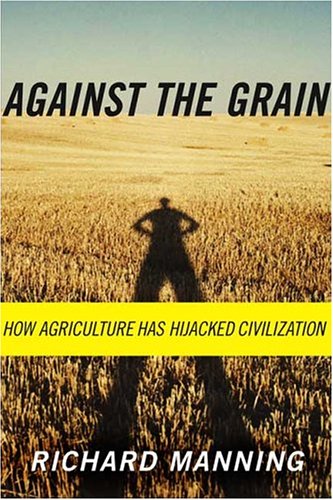 “Against the Grain: How Agriculture Has Hijacked Civilization”
Richard Manning
2004 North Point Press
Agriculture has domesticated humans. This is the argument at the center of Richard Manning’s stunning history of food. Written with journalistic flavor, Manning explores the ways that agriculture has diminished human life and threatens the planet itself.
The book begins by exploring the hunter-gatherer lifestyle, in many ways superior to our own even at the height of industrial capitalism. Hunter-gatherers, it turns out, ate a wider variety of tasty foods, worked far less, and lived much more sensually and connected than “civilized” humans. About 10,000 years ago, certain groups of humans traded all this in for security, namely the ability to stay in one spot and harvest grain to be stored for future food.
What this crop manipulation produced, however, was the first wealth inequality known to the species, as leaders left working the fields to their followers. In time, these stationary and hierarchical societies expanded and conquered/killed their hunter-gatherer neighbors. Soon enough crops like wheat, corn, and rice spread across the globe through violence and disease.
Manning focuses on these three crops because, as he explains, some 2/3 of all calories consumed today originate with them. In the US, corn is especially dominant, made into all kinds of commodities, for example corn syrup which can be found in just about everything we eat now. The dominance of these few grains is a consequence of capitalism, as they lend themselves easily to processing and storage – making them ideal commodities.
But an important plot twist in the story of grain’s dominance lies hidden in the open. Farm subsidies, especially in the US and Europe, distort the market to make these crops extremely cheap at the expense of all other nutrition. This has the added effect of enriching a few large agribusiness corporations (like Archer Daniels Midland) that grow or process them from enormous monocrop fields, although at the cost of ruining millions of small farmers all over the world. Our health, and the health of the planet are likewise jeopardized by the overabundance of these few crops produced with massive inputs of oil and chemicals.
Nevertheless, Richard Manning is able to summon the hope at the end of the book that our food system doesn’t have to be this way. Finding a distinction between agriculture and “simply growing food”, he argues that we can build an economy based on feeding people, and not just accumulating wealth. Organic agriculture, permaculture, intercropping, farmer’s markets and co-ops all point in this more just and sustainable direction, and awareness of the superiority of these more human methods has been growing at a phenomenal rate.
If we can nourish ourselves by reconnecting with the land and our sensual natures, perhaps we can also heal society and the planet. Against the Grain is a big step in educating us for that effort. Highly recommended.
 I’ve recently discovered the brilliance emanating from the pages of Yes! Magazine.
Their latest issue is called The New Economy. Check it out, a lot of the articles are online! It begins with the bold (and correct) declaration:
“This downturn marks the end of an unsustainable economy. Rather than trying to reinflate the old bubble economy, these activists, visionaries, and upstarts are trying something new: an economy that puts people first and works within the carrying capacity of Mother Earth.”
Groundbreaking approaches towards integrating the economy into the fabric of local communities and the ecosystem are presented in extremely accessible language and easy-to-read formats, with lots of great graphs!
Although the magazine shies away from using language like “capitalism”, “socialism”, “anarchism”, etc., the articles overflow with radical prescriptions for social change that challenge the status quo in bold new ways. This is the stuff of revolutions, because it appeals to the masses of Americans without shying away from real solutions, like breaking apart the large banks, investing in local organic gardening, drastically reducing the military budget, and ensuring universal health care.
Most importantly, the magazine fills its pages with a strong current of hope and joy, which is so desperately needed in these times. We need to remember that the collapse of the old system presents myriad opportunities for new grassroots endeavors, and a sense of joy is our strongest ally in this effort at rebuilding a world based on justice and sustainability.
Take a look, you won’t regret it! Yes!
“The End of Capitalism” synopsis , a miniature version of the book-in-progress, has been finished!
The book will put forward the likelihood that the global capitalist system, structured around infinite growth, has reached an endpoint to expansion, both as a result of natural limits, such as peak oil, as well as social limits, manifested by people’s resistance to the system all over the world. The synopsis also explores two possible paths we might take from this momentous turning point: either towards a more militaristic and “fascist” future based on desperately clinging to the past, or a world built by the efforts of hopeful and forward-looking humanity, organizing from the bottom-up. Finally, a “holistic” approach to social change is put forward to inspire readers to imagine and take action for a better world, through the lenses of sustainability, democracy, justice, freedom and love.
I’m looking for responses to the synopsis so i can continue expanding the project for a mass audience, so if you’d like to submit feedback, ideas, comments, or questions, please send them to Alex at activistalex@gmail.com
Thanks. Here is the web version of the full synopsis, and below a link to a (shorter) summary version. If you’d like to receive a microsoft word copy, please email me and I will send it to you.
Happy Reading!
Synopsis Outline:
- Is This the End of Capitalism?
- What is Capitalism?
- Why is it Collapsing?
- What Comes After Capitalism?
- Conclusion: The World We Are Building
And here’s the Summary.
alex
[Below are excerpts from Kevin Carson of the P2P Foundation responding to someone who claimed, “post-capitalism talk is largely Utopian fantasy”. I agree with the thrust of Kevin’s argument, capitalism faces collapse on a global scale – but the key social question of our age will not be “can capitalism survive?” but “what new social system(s) will outlive it?”
There are powerful forces seeking to deny us the possibility of relocalizing and democratizing our own economic networks, and which favor a re-nationalization of economic organization and a more brutal resource imperialism. In short, using the State to protect wealth and privilege from the economic chaos, commonly referred to as fascism. Social change is not deterministic, we are faced with widely diverging paths. How we win this struggle and create a post-capitalist world worth living in is the subject of my work. – alex]
“Is post-capitalism a fantasy?”
P2P Foundation, June 7, 2009.
Quotes by Kevin Carson.
I believe that within a generation we’re going to see a radical shortening of supply and distribution chains from Peak Oil, a combined relocalization of most production and an explosion of LETS and barter networks as official money and wage employment dry up for a major part of the population, and a collapse of the old corporate proprietors in the culture and software industries.
…
The growth of the financial sector compared to physical assets is a major symptom of the problem. Given corporate capitalism’s chronic tendency toward overproduction and overinvestment, you can’t invest the surplus in plant and equipment that will generate even more goods when people can’t consume existing output. So you pile up the surplus investment capital in a FIRE sector that only works until the ponzi scheme collapses.
…
[O]ne reason for the growth of the FIRE economy from the ’90s on was that the export of industrial capital had reached its limits as a strategy for solving the crisis of overinvestment. China is saturated with more industrial capital than there is a market for. And second, there’s not much future in shipping goods overseas from Chinese factories when fuel costs two or three–or more–times what it did this time last year.
…
Had oil stayed at its summer 2008 prices indefinitely, some 20% of airline routes would have shut down and a comparable percentage of long-haul trucks left the market. And this was indeed a “hiccup” compared to what we can expect from Peak Oil in the future. Even a supply shortfall of a few percent can cause prices at the pump to double. What can we expect when supply falls by half or two-thirds over the next generation? I expect we’ll see a total collapse of intercontinental supply chains except in vital minerals, and an order of magnitude of reduction of continental supply chains for most manufactured goods.
The factories in China and Vietnam will become useless for anything but producing goods for people in–well, in China and Vietnam. Production of spare parts and modular accessories will grow massively at the expense of production of new goods, and the growth in such production of spare parts and modular accessories will occur mainly in flexible manufacturing nets in relocalized industrial economies. In-season produce will be almost entirely relocalized by backyard gardening and market gardening, and a much larger percentage of our diets will be either in-season or canned local stuff.
We’re barely two years into the real crisis: two years from when real estate prices began to slide, a year from when Peak Oil first became a household word, and nine months since inventories and employment began a free-fall.
To say “everything’s OK so far” this early in the process is IMO about like saying, immediately after Alaric’s first repulse from the gates of Rome, “Well, the system’s still got a lot of life in it.” Or the old joke about the optimist who fell off a 100-story skyscraper and shouted to the people on the 99th floor, “OK so far!”
To say that things look good for capitalism except for Peak Oil is a bit like saying your uncle is just like your aunt except for his testicles.
This is What Democracy Looks Like is the definitive documentary about the 1999 Seattle protests against the World Trade Organization. Shot from the perspective of organizers, this film shows how the most iconic event of the (successful) movement against corporate globalization was created, day-by-day. We follow students, labor, environmentalists, and everyone seeking global justice as they brave police violence in order to shut down the Seattle Trade Summit, which led eventually to the collapse of the WTO. Creative visuals, hot beats, protest footage and powerful interviews combine into a very inspiring form of art – reminding us that when regular people come together, they can change the course of history. WATCH THIS MOVIE!!!
[This is Part 1 of 11 – make sure to click the Up-Arrow button to watch the rest!]


 The End of Capitalism
Recent Comments