You are currently browsing the category archive for the ‘Barack Obama’ category.
Interesting to see how second-tier nations are facing such dramatic upheaval, it seems the crisis is being somewhat deflected from the United States and other centers of global capitalism. In the long run of course, the US is LEAST prepared to deal with the energy shortage, and will crash hardest. For now though, the coronation of our new fresh president has kept the myth of American exceptionalism alive, at least for a little longer. [alex]
Riots in Iceland, Latvia and Bulgaria are a Sign of Things to Come
Our third global political column explores the start of an age of rebellion over the financial crisis – beginning in Iceland
by Roger Boyes
January 21, 2009
Icelanders all but stormed their Parliament last night. It was the first session of the chamber after what might appear to be an unusually long Christmas break.
Ordinary islanders were determined to vent their fury at the way that the political class had allowed the country to slip towards bankruptcy. The building was splattered with paint and yoghurt, the crowd yelled and banged pans, fired rockets at the windows and lit a bonfire in front of the main door. Riot police moved in.
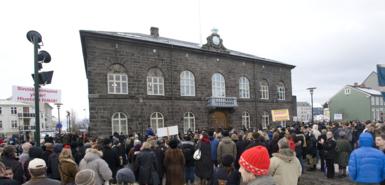
Icelanders vented their fury at the political class's handling of the financial crisis by staging angry protests in Reykjavik
Now in the grand sweep of the current crisis, a riot on a piece of volcanic rock in the north Atlantic may not seem to add up to much. But it is a sign of things to come: a new age of rebellion.
The financial meltdown has become part of the real economy and is now beginning to shape real politics. More and more citizens on the edge of the global crisis are taking to the streets. Bulgaria has been gripped this month by its worst riots since 1997 when street power helped to topple a Socialist government. Now Socialists are at the helm again and are having to fend off popular protests about government incompetence and corruption.
In Latvia – where growth has been in double-digit figures for years – anger is bubbling over at official mismanagement. GDP is expected to contract by 5 per cent this year; salaries will be cut; unemployment will rise. Last week, in a country where demonstrators usually just sing and then go home, 10,000 people besieged parliament.
Iceland, Bulgaria, Latvia: these are not natural protest cultures. Something is going amiss.
The LSE economist Robert Wade – addressing a protest meeting in Reykjavik’s cinema – recently warned that the world was approaching a new tipping point. Starting from March-May 2009, we can expect large-scale civil unrest, he said. “It will be caused by the rise of general awareness throughout Europe, America and Asia that hundreds of millions of people in rich and poor countries are experiencing rapidly falling consumption standards; that the crisis is getting worse not better; and that it has escaped the control of public authorities, national and international.”
Ukraine could be the next to go. The gas pricing deal agreed with Moscow could propel the country towards a serious financial crisis. Russia, too, is looking wobbly. A riot in Vladivostok may have been an omen for things to come. What will happen when the wider economic crisis translates into higher food prices? Or if Gazprom has no choice but to increase domestic gas prices?
Governments have so far managed to deflect attention from their role in the crash, their slipshod monitoring, by declaring themselves to be indispensible to the solution. This may save the skins of politicians in wealthier countries who can credibly and expensively try to prop up banks and sickly industries. But it does not work in countries that are heavily indebted, with bloated and exposed financial sectors. There, the irate crowds are already beginning to demand: why hasn’t a single politician resigned? What has happened to ministerial responsibility? Who will investigate government failure?
Good questions, it seems to me, in these unquiet times.
Richard Heinberg (author of the seminal work The Party’s Over: Oil, War and the Fate of Industrial Societies) lays out a clear program for Obama, to move the US away from its current suicidal path and towards a green economy. However, the danger may be that Obama has surrounded himself with people who are telling him to do the exact opposite of each of these recommendations. Our job, as a movement, is to move the country away from fossil fuels by blocking the construction of more death machines (coal plants, oil-guzzling cars, the military…), and by simultaneously creating irresistible alternatives. [alex]
Memo to the President-elect on Energy Realism and the Green New Deal
MuseLetter 200
December 2008 by Richard Heinberg
Executive Summary
Our continued national dependence on fossil fuels is creating a crippling vulnerability to both long-term fuel scarcity and catastrophic climate change.
The current economic crisis requires substantial national policy shifts and enormous new government injections of capital into the economy. This provides an opportunity for a project whose scope would otherwise be inconceivable: a large-scale, coordinated energy transition away from fossil fuels and toward renewable energy.
This project must happen immediately; indeed, it may already be too late. We have already left behind the era of cheap and plentiful fossil fuels, with a permanent decline of global oil production likely underway within three years. Moreover, the latest research tells us we have less than eight years to bring carbon emissions under control if we hope to avoid catastrophic climate change. Lacking this larger frame of understanding and action, a mere shift away from foreign oil dependence will fail to meet the challenge at hand.
The energy transition must not be limited to building wind turbines and solar panels. It must include the thorough redesign of our economic and societal infrastructure, which today is utterly dependent on cheap fossil fuels. It must address not only our transportation system and our electricity grid, but also our food system and our building stock.
Our 21st century nation’s dependence on 20th century fossil fuels is the greatest threat we face, far more so than the current financial crisis. A coordinated, comprehensive transition to an economy that is no longer dependent on hydrocarbon fuels and no longer emits climate-changing levels of carbon—a Post Carbon Energy Transition—will be the Obama Administration’s greatest opportunity to lead the nation on a path toward sustainable prosperity.
Overview: Need and Scope
As a new Administration prepares to take the reins of power, America’s economy is descending into a recession or, quite possibly, a depression. Read the rest of this entry »
On President-elect Barack Obama’s first trip to the White House yesterday to meet privately with his predecessor, lame duck George W. Bush, reportedly the first and most pressing message Obama delivered to the man in charge was “bail out General Motors.”

Cartoon by The Rag Blog
The American taxpayers are sick and tired of their money being doled out to corporate crooks like the carbon-polluting, oil-guzzling auto industry, or banks like AIG who apparently weren’t satisfied by the first two bailouts and now want another. (They apparently spent too much of their last check on trips to the spa.)
Is this really Obama’s highest priority? Giving public money to private companies that will use it to pollute the planet?
If YOU had the opportunity to sit down with President Bush for an hour and have him actually listen to you, what would YOU ask him to do?
Why not instead bail out homeowners by ending foreclosures to keep people in their houses?
Why not bail out the poor, sick, and elderly, by instituting single-payer universal health care like every other industrialized nation does?
Why not bail out Iraqis, military families and soldiers by pulling U.S. forces out of Iraq and ending a bloody occupation? (or Afghanistan, or the 100+ countries where the US military is stationed)
Why not bail out human rights by ending torture, closing Guantanamo and allowing all prisoners a trial by jury?
Why not bail out civil rights by ending anti-immigrant raids and the criminalizing of immigration?
Why not bail out students, who are suffering from the greatest debt crisis in history as education becomes increasingly unaffordable?
Why not bail out the planet, by investing heavily in renewable energies controlled by local communities, urban gardens, home weatherization and create 5 million new Green Jobs?
Barack, if you’re going to be a president worthy of the immense praise and expectation placed on you, you’re going to need to stop palling around with terroristic industry and corporate lobbyists, and listen to the people.
[alex]
Sources: Obama pressed Bush for auto industry bailout
Originally published by CNN, November 11, 2008
Jessica Yellin, Candy Crowley, CNN’s Ed Henry
(CNN) – At their private Oval Office meeting on Monday, President-elect Barack Obama urged President Bush to support billions of dollars in aid for the struggling auto industry during the upcoming lame-duck session of Congress, according to three officials briefed on the meeting.
The officials said Bush privately expressed skepticism about taxpayer money for automakers on the heels of a string of government bailouts for other industries, and the president also urged Obama to help push through a free trade pact with Colombia Read the rest of this entry »


 The End of Capitalism
Recent Comments