
You are currently browsing the category archive for the ‘Winning’ category.
This essay, written following a listening tour across the US, asks some of the most important questions facing social movements today, including “How Do We Build Intergenerational Movements?”, “What About Multiracial Movement Building?” and “How Do We Develop Strategy?”
I read this when it first came out in the summer of 2006 and it pretty much rocked my socks off and made me excited to get involved in the new SDS, so I figured I’d repost it for folks who never got to read it. [alex]
Ten Questions for Movement Building
by Dan Berger and Andy Cornell
Originally published by Monthly Review Zine.
For five weeks in the late spring of 2006, we toured the eastern half of the United States to promote two books — Letters From Young Activists: Today’s Rebels Speak Out (Nation Books, 2005) and Outlaws of America: The Weather Underground and the Politics of Solidarity (AK Press, 2006) — and to get at least a cursory impression of sectors of the movement in this country. We viewed the twenty-eight events not only as book readings but as conscious political conversations about the state of the country, the world, and the movement.
Of course, such quick visits to different parts of the country can only yield so much information. Because this was May and June, we did not speak on any school campuses and were unable to gather a strong sense of the state of campus-based activism. Further, much of the tour came together through personal connections we’ve developed in anarchist, queer, punk, and white anti-racist communities, and, as with any organizing, the audience generally reflected who organized the event and how they went about it rather than the full array of organizing projects transpiring in each town. Yet several crucial questions were raised routinely in big cities and small towns alike (or, alternately, were elided but lay just beneath the surface of the sometimes tense conversations we were party to). Such commonality of concerns and difficulties demonstrates the need for ongoing discussion of these issues within and between local activist communities. Thus, while we don’t pretend to have an authoritative analysis of the movement, we offer this report as part of a broader dialogue about building and strengthening modern revolutionary movements — an attempt to index some common debates and to offer challenges in the interests of pushing the struggle forward.
Challenges and Debates:
The audiences we spoke with tended to be predominantly white and comprised of people self-identified as being on the left, many of whom are active in one or more organizations locally or nationally. We traveled through the Northeast (including a brief visit to Montreal), the rust belt, the Midwest, parts of the South, and the Mid-Atlantic. Some events tended to draw mostly 60s-generation activists, others primarily people in their 20s, and more than a few were genuinely intergenerational. Not surprisingly, events at community centers and libraries afforded more room for conversation than those at bookstores. Crowds ranged anywhere from 10 to 100 people, although the average event had about 25 people. Even where events were small gatherings of friends, they proved to be useful dialogues about pragmatic work. Our goals for the tour were: establishing a sense of different organizing projects; pushing white people in an anti-racist and anti-imperialist direction while highlighting the interrelationship of issues; and grappling with the difficult issues of organizing, leadership, and intergenerational movement building. The following ten questions emerge from our analysis of the political situation based on our travels and meetings with activists of a variety of ages and range of experiences.
1. What Is Organizing?
Every event we did focused on the need for organizing. This call often fell upon sympathetic ears, but was frequently met with questions about how to actually organize and build lasting radical organizations, particularly in terms of maintaining radical politics while reaching beyond insular communities. There are too few institutions training young or new activists in the praxis of organizing and anti-authoritarian leadership development. Read the rest of this entry »
 “The Shock Doctrine: The Rise of Disaster Capitalism”
by Naomi Klein
2007 Metropolitan Books
I feel confident saying that The Shock Doctrine is one of the most important political non-fiction works of the last decade. This should be a high school textbook, or at least required reading in college. Naomi Klein applies her extensive vision and intellect to present us with a way of seeing our world that is extremely relevant and powerful: in the pursuit of enormous profits, those running the global economy intentionally exploit terrible catastrophes, or even create them, to take things for themselves that only shocked and traumatized populations would give up. This ambulance-chasing strategy of those in power is defined as the “shock doctrine,” and “disaster capitalism”, alternatively known as “neoliberalism” is the dominant social paradigm it has created.
Although there are flaws here, which I will mention, this book is both timely and well-written; Klein carries the reader through a story about grandiose topics like neoliberalism, torture, psychology, and international politics that is fundamentally readable.
The most important contribution made by this book in my view is the dismantling of the myth that capitalism’s global dominance is a function of democracy or destiny. This is the notion that with the defeat of the Soviet Union, all alternatives to “the free market” have naturally faded into history, presumably because capitalism is so irresistible. To the contrary, Naomi Klein provides numerous case studies to show us the exact opposite is true – the temporary triumph of global capitalism has been fertilized by the victims of natural disasters, terrorist attacks, wars, campaigns of torture, and economic calamity. In short, alternatives to capitalism have been shocked into submission wherever they’ve appeared.
This is no accident, it is part of a conscious crusade by market fundamentalists, those devoted to the pseudo-religious belief that “the market solves all.” Klein explains that the shock doctrine was developed (at least in part) by the patron saint of neoliberalism, free-market economist Milton Friedman. In his words, “only a crisis – actual or perceived – produces real change. When that crisis occurs, the actions that are taken depend on the ideas that are lying around.” And he intended to provide those ideas. It was Friedman’s opus “Capitalism and Freedom” that proclaimed neoliberalism’s core edicts: deregulation, privatization and cutbacks to social services.
Since the 1970s, these teachings have been vigorously applied across the globe by the “holy trinity” of the International Monetary Fund (IMF), the World Bank, and the World Trade Organization (WTO). Read the rest of this entry »
[Good news from the best oil/environment writer, Heinberg. The current economic crisis is easing pressure on the planet and its resources, ecological danger is decreasing. This is hopeful. I particular enjoy this statistic: “in the first four months of 2009, more bicycles were sold in the US than cars and trucks put together (over 2.55 million bicycles were purchased, compared to fewer than 2.4 million cars and trucks).”
Lately i’ve become convinced that hope is our greatest ally in working for a better world. If this article doesn’t inspire you, look at what’s happening in Iran at this moment. – alex]
Richard Heinberg
Originally published by Post Carbon Institute, June 5, 2009.
Recently I’ve begun compiling a list of things to be cheerful about. Here are some items that should bring a smile to any environmentalist’s lips:
- World energy consumption is declining. That’s right: oil consumption is down, coal consumption is down, and the IEA is projecting world electricity consumption to decline by 3.5 percent this year. I’m sure it’s possible to find a few countries where energy use is still growing, but for the US, China, and most of the European countries that is no longer the case. A small army of writers and activists, including me, has been arguing for years now that the world should voluntarily reduce its energy consumption, because current rates of use are unsustainable for various reasons including the fact that fossil fuels are depleting. Yes, we should build renewable energy capacity, but replacing the energy from fossil fuels will be an enormous job, and we can make that job less daunting by reducing our overall energy appetite. Done.
- CO2 emissions are falling. This follows from the previous point. I’m still waiting for confirmation from direct NOAA measurements of CO2 in the atmosphere, but it stands to reason that if world oil and coal consumption is declining, then carbon emissions must be doing so as well. The economic crisis has accomplished what the Kyoto Protocol couldn’t. Hooray!
- Consumption of goods is falling. Every environmentalist I know spends a good deal of her time railing both publicly and privately against consumerism. We in the industrialized countries use way too much stuff — because that stuff is made from depleting natural resources (both renewable and non-renewable) and the Earth is running out of fresh water, topsoil, lithium, indium, zinc, antimony…the list is long. Books have been written trying to convince people to simplify their lives and use less, films have been produced and shown on PBS, and support groups have formed to help families kick the habit, but still the consumer juggernaut has continued — until now. This particular dragon may not be slain, but it’s cowering in its den.
- Globalization is in reverse (global trade is shrinking). Back in the early 1990s, when globalization was a new word, an organization of brilliant activists formed the International Forum on Globalization (IFG) to educate the public about the costs and dangers of this accelerating trend. Corporations were off-shoring their production and pollution, ruining manufacturing communities in formerly industrial rich nations while ruthlessly exploiting cheap labor in less-industrialized poor countries. IFG was able to change the public discourse about globalization enough to stall the expansion of the World Trade Organization, but still world trade continued to mushroom. Not any more. China’s and Japan’s exports are way down, as is the US trade deficit.
- The number of vehicle miles traveled (VMT) is falling. For decades the number of total miles traveled by all cars and trucks on US roads has relentlessly increased. This was a powerful argument for building more roads. People bought more cars and drove them further; trucks restocked factories and stores at an ever-growing pace; and delivery vans brought more packages to consumers who shopped from home. All of this driving entailed more tires, pavement, and fuel — and more environmental damage. Over the past few months the VMT number has declined substantially and continually, to a greater extent than has been the case since records started being kept. That’s welcome news.
- There are fewer cars on the road. People are junking old cars faster than new ones are being purchased. In the US, where there are now more cars on the road than there are licensed drivers, this represents an extraordinary shift in a very long-standing trend. In her wonderful book Divorce Your Car, Katie Alvord detailed the extraordinary environmental costs of widespread automobile use. Evidently her book didn’t stem the tide: it was published in the year 2000, and millions of new cars hit the pavement in the following years. But now the world’s auto manufacturers are desperately trying to steer clear of looming bankruptcy, simply because people aren’t buying. In fact, in the first four months of 2009, more bicycles were sold in the US than cars and trucks put together (over 2.55 million bicycles were purchased, compared to fewer than 2.4 million cars and trucks). How utterly cool.
- The world’s over-leveraged, debt-based financial system is failing. Growth in consumption is killing the planet, but arguing against economic growth is made difficult by the fact that most of the world’s currencies are essentially loaned into existence, and those loans must be repaid with interest. Thus if the economy isn’t growing, and therefore if more loans aren’t being made, thus causing more money to be created, the result will be a cascading series of defaults and foreclosures that will ruin the entire system. It’s not a sustainable system given the fact that the world’s resources (the ultimate basis for all economic activity) are finite; and, as the proponents of Ecological and Biophysical Economics have been saying for years, it’s a system that needs to be replaced with one that can still function in a condition of steady or contracting consumption rates. While that sustainable alternative is not yet being discussed by government leaders, at least they are being forced to consider (if not yet publicly) the possibility that the existing system has serious problems and that it may need a thorough overhaul. That’s a good thing.
- Gardening is going gonzo. According to the New York Times (“College Interns Getting Back to Land,” May 25) thousands of college students are doing summer internships on farms this year. Meanwhile seed companies are having a hard time keeping up with demand, as home gardeners put in an unusually high number of veggie gardens. Urban farmer Will Allen predicts that there will be 8 million new gardeners this year, and the number of new gardens is expected to increase 20 to 40 percent this season. Since world oil production has peaked, there is going to be less oil available in the future to fuel industrial agriculture, so we are going to need more gardens, more small farms, and more farmers. Never mind the motives of all these students and home gardeners — few of them have ever heard of Peak Oil, and many of the gardeners are probably just worried whether they can afford to keep the pantry full next winter; nevertheless, they’re doing the right thing. And that’s something to applaud.
[T]he items outlined above suggest that we’ve turned a corner. Read the rest of this entry »
This is What Democracy Looks Like is the definitive documentary about the 1999 Seattle protests against the World Trade Organization. Shot from the perspective of organizers, this film shows how the most iconic event of the (successful) movement against corporate globalization was created, day-by-day. We follow students, labor, environmentalists, and everyone seeking global justice as they brave police violence in order to shut down the Seattle Trade Summit, which led eventually to the collapse of the WTO. Creative visuals, hot beats, protest footage and powerful interviews combine into a very inspiring form of art – reminding us that when regular people come together, they can change the course of history. WATCH THIS MOVIE!!!
[This is Part 1 of 11 – make sure to click the Up-Arrow button to watch the rest!]
Salt of the Earth is a classic organizing movie about striking Mexican-American miners and their wives. Based on an incredible true story, the 1953 film follows the organizing efforts of the town’s women, who must overcome the company’s classism, the sheriff’s racism, as well as their own husband’s sexism, to win the strike (while the men stay at home and take care of the house and children). Highly recommended!
This is just the first segment of the movie, make sure to click the Up-Arrow button to watch the rest!
 “Yes Means Yes! Visions of Female Sexual Power and A World Without Rape”
Jaclyn Friedman & Jessica Valenti
2008 Seal Press
Easily the best book I’ve read this year, if not ever. Yes Means Yes! is an anthology of essays from women and trans folks (and a few men) of all backgrounds, white, black, Latina, Asian, poor, affluent, queer, hetero, sex workers, dominatrices, bloggers, organizers, educators, artists, and survivors, all answering the question, “How can we create a world without rape?”
This book more than any other opened my eyes to the central importance of female sexual power to movement for progressive social change. Through dissecting sexual assault and “rape culture” from ALL angles, the writers articulate that the objectification and control of female bodies is literally the cornerstone of patriarchal society. Therefore efforts to reclaim female body sovereignty and sexual power are at the forefront of revolutionary change.
This book does not just offer women tips on how to avoid sexual assault (although it does encourage self-defense classes!), it courageously directs blame at the male-dominated society that puts women in dangerous situations on a daily basis. Similarly, as should be obvious from the title, this work is not just about teaching men to respect “No”, but showing women (all people really) how to love their bodies and embrace their sexuality, in whatever way it manifests. Enthusiastic consent, responding to “Yes!” and cautious “Maybes”, and taking things one step at a time without assumptions or feelings of entitlement to orgasm, while respecting the ability of a sexual partner to say “Stop.” at any moment, shows a way to the best and most liberatory sex imaginable.
But the book covers so much more than consent. This is a feminist handbook for the masses: well-written, varied, practical, theoretical, yet accessible.
It’s hard to pick a favorite essay, but the one that spoke to me the most was “Killing Misogyny: A Personal Story of Love, Violence, and Strategies for Survival” by Cristina Meztli Tzintún, a personal story about overcoming abusive and controlling male partners. Cristina relates how she got involved with a “radical, feminist” man of color and bonded through activism. Before she knew it she was years into an abusive relationship that gave her STDs and an inability to leave him, despite his cheating on her with his students, half his age. The pattern mirrored her parents’ disastrous marriage, which made it even more depressing that she could not break free of the cycle of abuse.
While it’s easy to demonize her partner, Alan, a more honest reading will recognize some of his patterns in each of us who have been male-socialized. For example, entitlement to women’s bodies and lack of consideration for the emotional damage wrought by selfish actions are things I know I have to struggle against. Cristina’s bravery in leaving Alan and demanding accountability for his assaults should encourage all of us, that misogyny can in fact be beaten and that personal transformation is an incredibly political act.
I can’t recommend this collection highly enough. Everyone needs to read this book.
Grace Lee Boggs is a prominent long-time veteran of civil rights and other movements for justice. An Asian-American woman, now in her 80s, she is active in building urban agriculture systems for the community of Detroit. Their efforts to create a sustainable local economy out of a postindustrial urban shell are an example for all urban American cities. [alex]
Detroit: City of Hope
Building a sustainable economy out of the ashes of industry.
By Grace Lee Boggs
Originally published by In These Times
February 17, 2009.
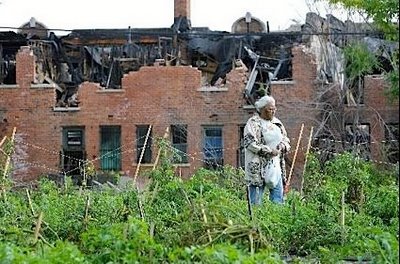
Photographer: Fabrizio Costantini/Bloomberg News. Hazel Williams picks green tomatoes at an Urban Farm off Linwood Avenue in Detroit, on Sept. 22, 2008. Photo by Fabrizio Costantini / Bloomberg.
Detroit is a city of Hope rather than a city of Despair. The thousands of vacant lots and abandoned houses not only provide the space to begin anew but also the incentive to create innovative ways of making our living—ways that nurture our productive, cooperative and caring selves.
The media and pundits keep repeating that today’s economic meltdown is the worst financial crisis since the Great Depression. But in the ’30s, the United States was an overproducing industrial giant, not today’s casino economy.
In the last few decades, once-productive Americans have been transformed into consumers, using more and more of the resources of the earth to foster ways of living that are unsustainable and unsatisfying. This way of life has created suburbs that destroy farmland, wetlands and the natural world, as well as pollute the environment.
The new economy also requires a huge military apparatus to secure global resources and to consume materials for itself, at the same time providing enormous riches for arms merchants and for our otherwise failing auto, air and ship-building sectors.
Instead of trying to resurrect or reform a system whose endless pursuit of economic growth has created a nation of material abundance and spiritual poverty—and instead of hoping for a new FDR to save capitalism with New Deal-like programs—we need to build a new kind of economy from the ground up.
That is what I have learned from 55 years of living and struggling in Detroit, the city that was once the national and international symbol of the miracle of industrialization and is now the national and international symbol of the devastation of deindustrialization.
When I arrived in Detroit in 1953, the population was 2 million, the majority white. Today, it is less than 900,000, majority black. Back then, racism was blatant and overt. Many bars, restaurants and hotels refused service to blacks. Blacks could buy homes in inner city neighborhoods but could not rent apartments in buildings right next door to these homes.
Meanwhile, freeways were enabling white flight to the suburbs, and technology was replacing human beings with robots.
In 1973, we elected our first black mayor, Coleman Young. Young was a gifted politician who was able to eliminate the most egregious examples of racism, especially in the police and fire departments and City Hall. But he was unable to imagine a post-industrial society. So, for 14 years, he tried in vain to woo industrial jobs back to Detroit.
In 1988, toward the end of his fourth term, Young decided that the factories weren’t coming back and that Detroit’s salvation depended on casino gambling, which he said would create 50,000 jobs.
To defeat his proposal, we organized Detroiters Uniting, a coalition of community groups, blue-collar, white-collar and cultural workers, clergy, political leaders and professionals.
Our concern was with how our city had been disintegrating socially, economically, politically, morally and ethically. We were convinced that we could not depend upon one industry or one large corporation to provide us with jobs. It was now up to us—the citizens of Detroit—to create meaningful jobs and income for all citizens.
We needed a new kind of city where citizens take responsibility for their decisions instead of leaving them to politicians or the marketplace.
Greening the Motor City
Read the rest of this entry »
One of Philadelphia’s larger newspapers puts Paul Glover, local currency and mutual aid-based health care advocate, on its cover story. As always, Paul makes wise and witty proposals to help us solve our economic and ecological woes, and now people are finally listening!
My favorite solution: “Neighborhood watch instead of neighborhood watch TV.” [alex]
Prepare for the Best
A guide to surviving — and thriving in — Philadelphia’s new green future.
Published: Jan 28, 2009
CityPaper
The Dark Season closes around Philadelphia. Wolves howl, “Tough times coming!” Young professionals with good jobs study budget cuts, watch stocks flail. Career bureaucrats are laid off; college students wonder who’s hiring. Old-timers remember when Philadelphia staggered through the terrible Depression years without jobs or dollars, while crime and hunger rose. Some districts here never escaped that Depression — they’re still choosing between heating and eating.
 |
As usual, the future will be different. Philadelphia’s responses to global warming and market cooling, high fuel and food prices, health unsurance, mortgages, student debt and war will decide whether our future here becomes vastly better or vastly worse. Whether we’re the Next Great City or Next Great Medieval Village. Imagine Philadelphia with one-tenth the oil and natural gas.
But to hell with tragedy. Let’s quit dreading news. Take the Rocky road. There are Philadelphia solutions for every Philadelphia problem.
Imagine instead that, 20 years from now, Philadelphia’s green economy enables everyone to work a few hours creatively daily, then relax with family and friends to enjoy top-quality local, healthy food. To enjoy clean low-cost warm housing, clean and safe transport, high-quality handcrafted clothes and household goods. To enjoy creating and playing together, growing up and growing old in supportive neighborhoods where everyone is valuable. And to do this while replenishing rather than depleting the planet. Pretty wild, right?
Entirely realistic. Not a pipe dream. And more practical than cynical. The tools, skills and wealth exist.
Mayor Michael Nutter foresees we’ll become the “Greenest City in the United States.” So it’s common-sensible to ask, “What are the tools of such a future?” “What jobs will be created?” “Who has the money?” “Where are the leaders?” “How will Philadelphia look?” “What can we learn from other cities?”
Some of the proposals sketched here can be easily ridiculed, because they disturb comfortable work habits, ancient traditions and sacred hierarchies. Yet they open more doors than are closing. They help us get ready for the green economy, and get there first. Big changes are coming so we might as well enjoy the ride. You have good ideas, too — bring ’em on.
From “Yes We Can” to “Now We Do”
As President Barack Obama says, “Change comes not from the top down, but from the bottom up.” Philadelphia’s chronic miseries suggest that primary dependence on legislators, regulators, police, prisons, bankers and industry won’t save us. They’re essential partners, but the people who will best help us are us. Read the rest of this entry »


 The End of Capitalism
Recent Comments