
You are currently browsing the category archive for the ‘Racism’ category.
Wonderful essay by Stephanie Guilloud on the shifting sands of movement strategy in the wake of the high-tide of the Global Justice Movement, which in Seattle articulated a world beyond capitalism that was not controlled by corporate giants and corrupt governments, but built by democratic cooperation of communities all around the world.
The Seattle direct actions shut down the World Trade Organization for a weekend in 1999, because the WTO had been spreading the corporate agenda across the planet, and this began a string of movement victories that shut down the WTO permanently – by delegitimizing the organization and emboldening Global South nations to refuse rich countries’ poverty-spreading deals and abandon its negotiations.
Now, as Global South nations lead the call for justice in Copenhagen and as we gear up for the US Social Forum in Detroit next summer, it’s a great time to look back at the lessons the movement for justice, democracy and sustainability has learned in the past decade. [alex]
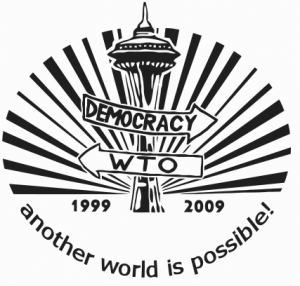 From Seattle to Detroit: 10 Lessons for Movement Building on the 10th Anniversary of the WTO Shutdown
By Stephanie Guilloud November 30, 2009 | Reposted from the Indypendent
For five days in 1999, 80,000 people from Seattle and from all over the country stopped the World Trade Organization from meeting. Despite extreme police and state violence, students, organizers, workers, and community members participated in a public uprising using direct actions, marches, rallies, and mass convergences. Longshoremen shut down every port on the West Coast. Global actions of solidarity happened from India to Italy. Trade ministers, heads of state, and corporate hosts were forced to abandon their agenda and declare the Millenium Ministerial a complete failure. We said we would shut it down, and we did.
“The fact is that the Social Forum and Peoples Movement Assembly process actually started in Seattle. The Social Forum took off from the experience of the ‘Battle of Seattle’ when the Brazilian organizing committee formed in 2000 and held the first World Social Forum in 2001. Ten years later, we come back to where this started. What has been accomplished in the last 10 years? How have our social movements developed to build the power towards real social systemic change in the US? How do we map the new forces and what is the power of the social movement assembly?”
– Ruben Solis, Southwest Workers Union, participant in the Seattle shutdown, and one of the founders of the Grassroots Global Justice Alliance
As one of the founders and leaders of the Direct Action Network and a resident of Olympia, Washington, I offer personal and political reflections on the WTO shutdown as a major turning point in my life as an organizer and in our lives working to build movements in the US. As an organizer with the US Social Forum process and a co-lead to develop the People’s Movement Assembly, I carry these lessons with me on a daily basis. I offer these stories with humility and a sense of responsibility. When I refer to “we” in this brief article, I refer to my community of young people in their early twenties, living in Seattle, Olympia, Portland, and the Bay Area, who, with many others, mobilized, organized, and implemented the direct action strategies we had planned for months.
1.) Know your history: Seattle was a turning point
Seattle was a historic turning point in our movements for racial, economic and gender justice for a few reasons. On a global scale, the demonstrations and effective shutdown of the World Trade Organization’s ministerial was historic because of our position and location in the US. Seattle did not mark the beginning of a movement, it marked the beginning of a significant connection between the US and the rest of the world. Global movements had and have been challenging and confronting financial institutions and their systemic effects for decades. The demonstrations – the five days of direct action, the massive and violent state response, and the subsequent alliances – accomplished a few major shifts in historic directions. The demonstrations exposed to the US public the tangible affects of globalization on regular people’s lives. The effectiveness of the actions and stalling of the meetings allowed for delegates from the global South to challenge the policies and procedures of the WTO. And for the first time in history, the decision-making rounds of a global financial institution collapsed.
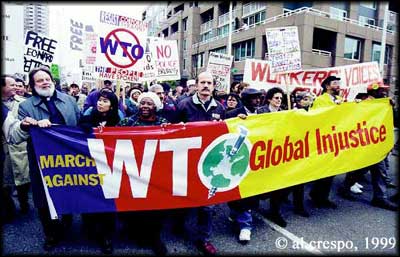
Seattle also opened a door on a new era for movement in the US. The strengths and weaknesses of our organizing efforts served as a spark for new work, new alliances, new conversations, and a new generational drive. It opened the possibility for a generation of people to understand action, movement, and strategy as effective. It also offered an opportunity to see the strengths of innovation and mass organizing, as well as the weaknesses of underdeveloped leadership and lack of connection to long-term transformative practices.
2.) Claim your victories and evaluate your mistakes. Read the rest of this entry »
Review by Dana Barnett
Originally published by Toward Freedom.
Nov. 25, 2009.
Reviewed: Arm the Spirit: A Woman’s Journey Underground and Back, by Diana Block. Published by AK Press, 2009.
“We had gone underground in the early eighties, not a high-tide period for revolutionary activity in the US. Unlike the people who had formed the Weather Underground Organization in the sixties, we were not swept into clandestinity as a response to the Vietnam War or the militancy of the Black Panthers…As we saw it, armed struggle was still a necessary component of every revolutionary movement, and the movement within the US was no exception.” – Diana Block
How do we decide where to put our political energy? For many of us on the left our politicization began with critiques of the dominant ideology. Our critiques may have been a result of formal education, though for many our critiques were lifeboats we clung to keep from drowning in the chasm between what we were told and what we experienced. Upon confronting contradictions we look for explanations. We attempt to deconstruct the world and then reconstruct it to make sense of it and find our place in it. We make our underlying ideologies conscious. We develop our analysis and principles and then attempt to act in a way that is aligned with their logical conclusions.
As leftist revolutionaries we ask ourselves the same questions at different times in our history. What is to be done? What does revolutionary work look like in our time and what is my role within it?
Diana Block’s memoir, Arm the Spirit: A Woman’s Journey Underground and Back, is an example of a leftist making sense of the world around her, attempting to act with integrity, and searching for political strategy and home. The memoir moves easily back and forth between two aspects of her story. The book begins with Block’s partner, Claude Marks, finding a bug in their car in 1985 after several years of organizing and living clandestinely, and only two months after she gave birth to their first child. This main narrative details her life underground and her re-emergence and re-engagement with organizing from 1995 to the present. It is interspersed with the back story of Block’s experiences, politics, and the context that led to her decision to form a clandestine revolutionary collective to support Third World anti-colonialist armed struggles. Block’s book is her answer to the question of what it means to be a revolutionary in one’s own time. In particular, Block analyzes her role as a white person in the US with feminist, lesbian/queer, anti-imperialist, and anti-racist politics.
I do not feel compelled to use this book, or this review, as a site to evaluate the usefulness of clandestine work, or the question of armed struggle. Read the rest of this entry »
Also published by The Rag Blog and OpEdNews.
 “We stand at a critical moment in Earth’s history, a time when humanity must choose its future. As the world becomes increasingly interdependent and fragile, the future at once holds great peril and great promise. To move forward we must recognize that in the midst of a magnificent diversity of cultures and life forms we are one human family and one Earth community with a common destiny. We must join together to bring forth a sustainable global society founded on respect for nature, universal human rights, economic justice, and a culture of peace. Towards this end, it is imperative that we, the peoples of Earth, declare our responsibility to one another, to the greater community of life, and to future generations. – The Earth Charter” (pg. 1).
David Korten, long-time global justice activist, co-founder of Yes! Magazine, and author of such books as When Corporations Rule the World, lays out the fundamental crossroads facing the world in his 2006 book The Great Turning: From Empire to Earth Community. In response to global climate change, war, oil scarcity, persistent racism and sexism and many other mounting crises, Korten argues we must recognize these as symptoms of a larger system of Empire, so that we might move in a radically different direction of equality, ecological sustainability, and cooperation, which he terms Earth Community. This is a powerful and important book, which excels in overviewing the big picture of threats facing our ecosphere and our communities at the hands of global capitalism1, and translating this into the simplest and most accessible language so we might all do something about it. It’s pretty much anti-capitalism for the masses. And it has the power to inspire many of us to transform our lives and work towards the transformation of society.
Capitalism and Empire
Of course, Korten has made the strategic decision to avoid pointing the finger at “capitalism” as such in order to speak to an American public which largely still confuses the term as equivalent to “freedom” or “democracy.” In fact the “C” word is rarely mentioned in the book, almost never without some sort of modifier as in “corporate capitalism” or “predatory capitalism”, as if those weren’t already features of the system as a whole. Instead, Korten names “Empire” as the culprit responsible for our global economic and ecological predicament, which is defined as a value-system that promotes the views that “Humans are flawed and dangerous”, “Order by dominator hierarchy”, “Compete or die”, “Masculine dominant”, etc. (32).
Korten explains that Empire, “has been a defining feature of the most powerful and influential human societies for some five thousand years, [and] appropriates much of the productive surplus of society to maintain a system of dominator power and elite competition. Racism, sexism, and classism are endemic features” (25). In this way the anarchist concept of the State is repackaged as a transcendent human tendency, which has more to do with conscious decision-making and maturity level than it does with political power. While this compromise does limit the book’s effectiveness in offering solutions later on, it does speak in a language more familiar to the vast non-politicized majority of Americans, and may have the potential to unify a larger movement for change.
Whatever you want to call the system, the danger it presents to the planet is now clear. Korten spells out the grim statistics: “Fossil fuel use is five times what it was [in 1950], and global use of freshwater has tripled… the [Arctic] polar ice cap has thinned by 46 percent over twenty years… [while we’ve seen] a steady increase over the past five decades in severe weather events such as major hurricanes, floods, and droughts. Globally there were only thirteen severe events in the 1950s. By comparison, seventy-two such events occurred during the first nine years of the 1990s” (59-60). If this destruction continues, it’s uncertain if the Earth will survive.
This ecological damage is considered alongside the social damage of billions living without clean water or adequate food, as well as the immense costs of war and genocide. But Korten understands that the danger is relative to where you stand in the social hierarchy – the system creates extreme poverty for many, and an extreme wealth for a few others. He explains how the system is based on a deep inequality that is growing ever worse, “In the 1990s, per capita income fell in fifty-four of the world’s poorest countries… At the other end of the scale, the number of billionaires worldwide swelled from 274 in 1991 to 691 in 2005” (67). The critical point that these few wealthy elites wield excessive power and influence within the system to stop or slow necessary reform could be made more clearly, but at least the book exposes the existence of this upper class, who are usually quite effective at hiding from public scrutiny and outrage over the suffering they are causing.2
Earth Community – Growing a Revolution
Standing at odds with the bastions of Empire is what David Korten calls “Earth Community,” a “higher-order” value-system promoting the views of, “Cooperate and live,” “Love life”, “Defend the rights of all”, “Gender balanced”, etc. (32). Read the rest of this entry »
This essay, written following a listening tour across the US, asks some of the most important questions facing social movements today, including “How Do We Build Intergenerational Movements?”, “What About Multiracial Movement Building?” and “How Do We Develop Strategy?”
I read this when it first came out in the summer of 2006 and it pretty much rocked my socks off and made me excited to get involved in the new SDS, so I figured I’d repost it for folks who never got to read it. [alex]
Ten Questions for Movement Building
by Dan Berger and Andy Cornell
Originally published by Monthly Review Zine.
For five weeks in the late spring of 2006, we toured the eastern half of the United States to promote two books — Letters From Young Activists: Today’s Rebels Speak Out (Nation Books, 2005) and Outlaws of America: The Weather Underground and the Politics of Solidarity (AK Press, 2006) — and to get at least a cursory impression of sectors of the movement in this country. We viewed the twenty-eight events not only as book readings but as conscious political conversations about the state of the country, the world, and the movement.
Of course, such quick visits to different parts of the country can only yield so much information. Because this was May and June, we did not speak on any school campuses and were unable to gather a strong sense of the state of campus-based activism. Further, much of the tour came together through personal connections we’ve developed in anarchist, queer, punk, and white anti-racist communities, and, as with any organizing, the audience generally reflected who organized the event and how they went about it rather than the full array of organizing projects transpiring in each town. Yet several crucial questions were raised routinely in big cities and small towns alike (or, alternately, were elided but lay just beneath the surface of the sometimes tense conversations we were party to). Such commonality of concerns and difficulties demonstrates the need for ongoing discussion of these issues within and between local activist communities. Thus, while we don’t pretend to have an authoritative analysis of the movement, we offer this report as part of a broader dialogue about building and strengthening modern revolutionary movements — an attempt to index some common debates and to offer challenges in the interests of pushing the struggle forward.
Challenges and Debates:
The audiences we spoke with tended to be predominantly white and comprised of people self-identified as being on the left, many of whom are active in one or more organizations locally or nationally. We traveled through the Northeast (including a brief visit to Montreal), the rust belt, the Midwest, parts of the South, and the Mid-Atlantic. Some events tended to draw mostly 60s-generation activists, others primarily people in their 20s, and more than a few were genuinely intergenerational. Not surprisingly, events at community centers and libraries afforded more room for conversation than those at bookstores. Crowds ranged anywhere from 10 to 100 people, although the average event had about 25 people. Even where events were small gatherings of friends, they proved to be useful dialogues about pragmatic work. Our goals for the tour were: establishing a sense of different organizing projects; pushing white people in an anti-racist and anti-imperialist direction while highlighting the interrelationship of issues; and grappling with the difficult issues of organizing, leadership, and intergenerational movement building. The following ten questions emerge from our analysis of the political situation based on our travels and meetings with activists of a variety of ages and range of experiences.
1. What Is Organizing?
Every event we did focused on the need for organizing. This call often fell upon sympathetic ears, but was frequently met with questions about how to actually organize and build lasting radical organizations, particularly in terms of maintaining radical politics while reaching beyond insular communities. There are too few institutions training young or new activists in the praxis of organizing and anti-authoritarian leadership development. Read the rest of this entry »
The following is an editorial from The Philadelphia Inquirer, Sept. 2, 2009. For more information about Troy’s case, see Amnesty International and the NAACP.
Editorial: The risk in getting it wrong
If justice is served, Troy Davis won’t become another Cameron Willingham. Davis is facing execution in Georgia for the 1989 murder of an off-duty Savannah police officer, but whether he actually committed the crime is questionable. Questions were also raised about the guilt of Willingham, but he was executed in Texas five years ago for murder in an alleged arson fire that killed his three children. Now, there is new scientific evidence that Willingham was innocent.
An arson expert hired by the Texas Forensic Science Commission has issued a report that says there was no basis for a conclusion that arson caused the 1991 fire. He said the blaze that killed the three children may have been accidentally set.
“I have been persecuted 12 years for something I didn’t do,” were Willingham’s last words.
His case epitomizes why capital punishment must end. Even if it happens only once, that’s too often when the result might be the execution of an innocent person.
Davis received a last-minute reprieve last month, when the U.S. Supreme Court ordered his case reheard to consider new evidence that might clear him. It was the first time in half a century that the high court took such a step.
“The substantial risk of putting an innocent man to death clearly provides an adequate justification for holding an evidentiary hearing,” said Justice John Paul Stevens in the majority opinion.
Until the Supreme Court’s ruling, lower federal and state courts had repeatedly denied Davis’ appeal for a new trial.
Georgia prosecutors maintain they convicted the right person. But they have presented neither physical evidence nor a weapon linking Davis to the crime. And seven of the nine witnesses who testified that Davis was the killer have since either recanted or changed their stories.
Pope Benedict XVI, former President Jimmy Carter, and Archbishop Desmond Tutu are among those who have called for clemency for Davis.
States such as Pennsylvania, which remain committed to the death penalty, should take note.
Davis’ and Willingham’s cases again raise strong questions about capital punishment and whether it can ever be fairly administered, especially when the defendant is poor or a minority, like Davis, and statistically more likely to get a death sentence.
Two men sent to Pennsylvania’s death row were later exonerated. The risk of a wrongful execution is simply too great to continue with capital punishment.
 “American Fascists: The Christian Right and the War on America”
Chris Hedges
2006 Free Press
Are right-wing Christians in America developing a potentially fascist movement that would discard democracy for the sake of security and conservative values? This is answered affirmatively by Chris Hedges, author of War is a Force That Gives Us Meaning, in his newest book.
We all know the worst of the evangelical movement, which Hedges calls the “dominionists”: they’re militantly anti-abortion and promote abstinence-only education, they hate queer and trans people, they don’t believe in evolution or environmentalism, they’re racist against immigrants and support US warfare and imperialism, and they can be violent, potentially terroristic. This book explores all of these themes, but it also exposes the frightening strength these people have in our society.
For example, “There are at least 70 million evangelicals in the United States attending more than 240,000 evangelical churches… Polls indicate that about 40 percent of respondents believe the Bible is ‘to be taken literally, word for word.’ .. Almost a third of all respondents say they believe in the Rapture.” Clearly this movement has developed a mass base by hiding behind Christianity.
But are these folks organized? Hedges says yes, quite so. He points to their dominance over the Republican Party, as well as billions of dollars received in the form of “faith-based” grants. This governmental power is matched by media influence, as the Christian Right also owns several national television and radio networks, as well as many local media outlets. Further, right-wing organizations such as Focus on the Family and the Christian Coalition are controlled by wealthy white male elites who claim to be “close to God” and are followed with feverish obedience by millions of supporters.
The best parts of the book are the interview sections which delve into the lives of the people drawn to, and spit out by, this movement. By humanizing the participants, we come to understand that their immersion into this Christian reality is often a flight from an overwhelming sense of meaninglessness and despair, genuine emotions which develop from real-world sufferings like unemployment and abuse.
However, much of the book does not live up to this potential and consists of Chris Hedges sending forth litanies of blanket indictments against the ideology of the Christian Right, and attaching a somewhat monolithic character to what in reality is probably a more scattered and heterogeneous right-wing Christian population. In other words, by attacking them as potentially all-powerful, do we not in fact imbue them with powers they do not actually possess?
Worse, although the author rightly argues we must not tolerate a movement which does not tolerate us, he leaves us with little useful ammunition for that struggle. Condemnations of fundamentalist thinking and similarities to Nazism will only get us so far, we need to locate the weak points in the armor of these Crusaders, and this book unfortunately serves little in developing such a strategy.
In a present and future marked by severe crises of an economic, ecological and social nature, the seductiveness of movements urging apocalyptic violence unfortunately may become quite great, and only an alternative movement that appeals to the best in humanity can prevent the emergence of a dictatorship of fear. That great Christian principle of love must be the guiding force as we address the mounting grievances of those left behind by this society and point towards a better future.
Salt of the Earth is a classic organizing movie about striking Mexican-American miners and their wives. Based on an incredible true story, the 1953 film follows the organizing efforts of the town’s women, who must overcome the company’s classism, the sheriff’s racism, as well as their own husband’s sexism, to win the strike (while the men stay at home and take care of the house and children). Highly recommended!
This is just the first segment of the movie, make sure to click the Up-Arrow button to watch the rest!
 “Yes Means Yes! Visions of Female Sexual Power and A World Without Rape”
Jaclyn Friedman & Jessica Valenti
2008 Seal Press
Easily the best book I’ve read this year, if not ever. Yes Means Yes! is an anthology of essays from women and trans folks (and a few men) of all backgrounds, white, black, Latina, Asian, poor, affluent, queer, hetero, sex workers, dominatrices, bloggers, organizers, educators, artists, and survivors, all answering the question, “How can we create a world without rape?”
This book more than any other opened my eyes to the central importance of female sexual power to movement for progressive social change. Through dissecting sexual assault and “rape culture” from ALL angles, the writers articulate that the objectification and control of female bodies is literally the cornerstone of patriarchal society. Therefore efforts to reclaim female body sovereignty and sexual power are at the forefront of revolutionary change.
This book does not just offer women tips on how to avoid sexual assault (although it does encourage self-defense classes!), it courageously directs blame at the male-dominated society that puts women in dangerous situations on a daily basis. Similarly, as should be obvious from the title, this work is not just about teaching men to respect “No”, but showing women (all people really) how to love their bodies and embrace their sexuality, in whatever way it manifests. Enthusiastic consent, responding to “Yes!” and cautious “Maybes”, and taking things one step at a time without assumptions or feelings of entitlement to orgasm, while respecting the ability of a sexual partner to say “Stop.” at any moment, shows a way to the best and most liberatory sex imaginable.
But the book covers so much more than consent. This is a feminist handbook for the masses: well-written, varied, practical, theoretical, yet accessible.
It’s hard to pick a favorite essay, but the one that spoke to me the most was “Killing Misogyny: A Personal Story of Love, Violence, and Strategies for Survival” by Cristina Meztli Tzintún, a personal story about overcoming abusive and controlling male partners. Cristina relates how she got involved with a “radical, feminist” man of color and bonded through activism. Before she knew it she was years into an abusive relationship that gave her STDs and an inability to leave him, despite his cheating on her with his students, half his age. The pattern mirrored her parents’ disastrous marriage, which made it even more depressing that she could not break free of the cycle of abuse.
While it’s easy to demonize her partner, Alan, a more honest reading will recognize some of his patterns in each of us who have been male-socialized. For example, entitlement to women’s bodies and lack of consideration for the emotional damage wrought by selfish actions are things I know I have to struggle against. Cristina’s bravery in leaving Alan and demanding accountability for his assaults should encourage all of us, that misogyny can in fact be beaten and that personal transformation is an incredibly political act.
I can’t recommend this collection highly enough. Everyone needs to read this book.


 The End of Capitalism
Recent Comments