
You are currently browsing the category archive for the ‘Organizing’ category.
Second in the holiday movie series, The Take journals the Argentinian workers who seized their factories after the economy collapsed in 2001, and the corporations fled the scene. The parallels between Argentina 2001 and the United States 2008 are incredible, first the financial system collapsed, and now in Chicago we see the workers occupying a factory their bosses tried to illegally close. Hopefully next we’ll see the delegitimization of the government and mass popular uprisings against capitalism.
(This is just the first segment of the movie, make sure to click the Up-Arrow button to watch the rest! And you might need to do some Spanish-to-English translating!)
Originally published on my friend Will’s blog, March 23, 2008.
To be organized is to do the following:
1. Keeping your word. When you say you will do something, do it. This will give you a good reputation and inherently further your goals.
2. Hard work. Cliche as it is, hard work will get things done. And in the world of activism where it feels like not much gets done, this is a crucial attribute.
3. Coordination. Stay in contact with people and coordinate your efforts. Avoid duplicate tasks and work out a system by which everyone can be working toward a goal, and know what they need to do to make sure the whole group gets it done.
4. Community. Help, protect, care for, and love each other. No other facet of being organized will motivate people more than being a part of a strong caring community. It will also provide an unparalleled sense of security that is very hard to find in life.
5. Courage. Acknowledge and accept your fears, but do not let them interfere with your activities. Change takes the courage to fight (ever non-violently) despite the seemingly insurmountable odds. Of course, courage must be partnered with understanding and vision to prevent brave but pointless acts.
6. Understanding. To be organized, we need to understand the cause and effect relationships or our actions, and how our actions will impact different audiences. Understanding other people, and how they think is also crucial. Also, a general understanding of the world is important. Overall, the more knowledge and problem solving skills you can fit into your brain, the better. It is much better to build a sturdy net to catch fish than to try to catch them with your hands.
7. Mass numbers. To truly be organized, you need lots of people working toward a common goal. They do not necessarily have to all be coordinated, but it helps.
8. Planning. Use all of your understanding to plan a campaign to actually reach the goal. Make contingency plans and make sure everyone knows what the plan is.
9. Love. By far the most important. This one encompasses everything we seek to change in the world. It can remake our entire world if we have the courage to embrace it. Love everyone, and only denounce actions. Forgive and give whenever there is the chance.
There is a strength to this outline that may not be obvious at first. It will bring people in by the droves. Having an effective and loving group actively seeking change, one that fulfills its members deep need to care for each other will be an earth-shaking movement that will fundamentally remake civilization. I have tried to outline my view on organizing, that couples the “professionalism” of corporate America with the love, courage and community that I have found to be amazingly effective at motivating and improving people.
I hope to see a movement that embraces all 9 factors, because, I believe, if I do see it, then we will be able to heal the world.
Below is an email circulating the SDS listservs that I’m reposting (I’m not the author). Workers, mostly Latin@s, have seized their workplace from management who was trying to take away their jobs and severance pay. Hopefully this is just the beginning of increased militance and organization by the working class as economic conditions in this country deteriorate and the contradictions – of bosses and banks being bailed out while we lose our jobs – become more glaring and visible.
Here is a news article about the takeover. [alex]
Chicago factory occupied
Lee Sustar reports from Chicago on an occupation by workers who want what’s theirs from management and the Bank of America.
December 6, 2008
WORKERS OCCUPYING the Republic Windows & Doors factory slated for closure are vowing to remain in the Chicago plant until they win the $1.5 million in severance and vacation pay owed them by management.
In a tactic rarely used in the U.S. since the labor struggles of the 1930s, the
workers, members of United Electrical, Radio and Machine Workers of America (UE) Local 1110, refused to leave the plant on December 5, its last scheduled day of operation.
“We decided to do it because this is money that belongs to us,” said Maria
Roman, who’s worked at the plant for eight years. “These are our rights.”
Word of the occupation spread quickly both among labor and immigrant rights activists–the overwhelming majority of the workers are Latinos. Seven local TV news stations showed up to do interviews and live reports, and a steady stream of activists arrived to bring donations of food and money and to plan solidarity actions.
Management claims that it can’t continue operations because its main creditor, Bank of America (BoA), refuses to make any more loans to the company. After workers picketed BoA headquarters December 3, bank officials agreed to sit down with Republic management and UE to discuss the matter at a December 5 meeting arranged by U.S. Rep. Luis Gutierrez (D-Ill), said UE organizer Leah Fried.
BoA had said that it couldn’t discuss the matter with the union directly without written approval from Republic’s management. But Republic representatives failed to show up at the meeting, and plant managers prepared to close the doors for good–violating the federal WARN Act that requires 60 days notice of a plant closure.
The workers decided this couldn’t go unchallenged. “The company and Bank of America are throwing the ball to one another, and we’re in the middle,” said Vicente Rangel, a shop steward and former vice president of Local 1110.
Many workers had suspected the company was planning to go out of business–and perhaps restart operations elsewhere. Several said managers had removed both production and office equipment in recent days.
Furthermore, while inventory records indicated there were plenty of parts in the plant, workers on the production line found shortages. And the order books, while certainly down from the peak years of the housing boom, didn’t square with management’s claims of a total collapse. “Where did all those windows go?” one worker asked.
Workers were especially outraged that Bank of America, which recently received a bailout in taxpayer money, won’t provide credit to Republic. “They get $25 billion from the government, and won’t loan a few million to this company so workers can keep their jobs?” said Ricardo Caceres, who has worked at the plant for six years. Read the rest of this entry »
[Following on the heels of another majority victory with Burger King, the Coalition of Immokalee Workers (CIW), and their student allies in the Student-Farmworker Alliance (SFA) have succeeded in pressuring Subway to pay an extra 1 cent per pound for their tomatoes so that workers who pick those tomatoes will get a fair wage. CIW/SFA have also reached similar agreements with McDonalds and Taco Bell, which means all the major fast food industry titans have now given in! This is another great example of the power of democratic social movements to achieve change. – alex]
Originally published by the Coalition of Immokalee Workers’ website.

Miami, FL, 12/2/08: Gerardo Reyes (seated, right) of the Coalition of Immokalee Workers and Jan Risi (also seated), President and CEO of Subway’s Miami-based purchasing arm, the Independent Purchasing Cooperative, commemorate the signing of the CIW’s newest agreement with a fast-food industry leader to improve wages and working conditions in Florida’s tomato fields.
SUBWAY SIGNS!…
December 2, 2008: Subway, the third largest fast-food chain in the world and the biggest fast-food buyer of Florida tomatoes, reached an agreement today with the CIW to help improve wages and working conditions for the workers who pick their tomatoes!
What they’re saying about the Subway agreement:
- “This agreement between Subway and the Coalition of Immokalee Workers is yet another blow to the scourge of slavery that continues to exist in the tomato fields of Florida,” Senator Bernie Sanders said in a statement. “Subway is to be congratulated for moving to ensure that none of its products are harvested by slave or near-slave labor. Sadly, too many other companies continue to tolerate this travesty.”
- “Subway strongly supports the farmworkers’ rights and has entered in an agreement with the (Coalition of Immokalee Workers) to pay the additional 1 cent per pound for tomatoes grown in the Immokalee region of Florida,” Subway spokesman Les Winograd said.
- “Today, the fast-food industry has spoken with one voice,” said Gerardo Reyes of the CIW. “With this agreement, the four largest restaurant companies in the world have now joined their voices to the growing call for a more modern, more humane agricultural industry in Florida.” (read the joint press release in its entirety)
- But Sherri Daye Scott, who edits QSR, a North Carolina-based food-service industry magazine, noted consumers spoke first – by supporting the coalition’s petition drives, protests and boycotts.
“Until the college students and then the consumers got involved, it was not that big a deal,” Scott said.
Will fair food become an industry watchword?
“It could,” Scott said. “I haven’t heard any rumblings yet beyond the tomato pickers yet, but it could gain traction. Look at food safety – five, 10 years ago, you didn’t hear much about it; now it’s everywhere. The same thing could happen with transparency in the food supply chain.“
- “Subway’s agreement could yield as much money as all the other deals combined. That’s because Subway is the largest user of tomatoes and has 24,000 stores in the United States. Burger King’s agreement is expected to yield about $250,000 for workers, numbers relatively comparable to the Taco Bell and McDonald’s agreement.” (Miami Herald)
Meanwhile, the Northeast Fair Food Tour continues, spreading the news of the Subway agreement and meeting with allies to discuss plans for the road ahead in the Campaign for Fair Food, including a growing focus on the other leading buyers of Florida tomatoes, the supermarket and foodservice industries.
Click here for a revised list of planned public events on the tour
[This is a huge victory, Mountaintop Removal is a horrible destructive practice of coal mining in Appalachia that destroys communities and the environment. Organizers, including Rainforest Action Network and many members and chapters of Students for a Democratic Society (SDS), have been fighting this for a long time through creative nonviolent actions and pressure, and today we can celebrate a major victory as Bank of America caves to our demands! – alex]
From Bank of America’s website:
“Bank of America is particularly concerned about surface mining conducted through mountain top removal in locations such as central Appalachia. We therefore will phase out financing of companies whose predominant method of extracting coal is through mountain top removal. While we acknowledge that surface mining is economically efficient and creates jobs, it can be conducted in a way that minimizes environmental impacts in certain geographies.”
We are thrilled that just two and a half weeks after RAN’s day of action against coal and coal finance, Bank of America has made a public commitment to stop financing the devastating practice of mountaintop removal mining. This has been a major demand of the banks for the Global Finance campaign and we applaud Bank of America as it takes a step in the right direction – a step away from coal. Congratulations to everyone who has helped to pressure Bank of America to end it’s financing of coal and mountaintop removal – this is a truly incredible grassroots victory!
We will have more information about Bank of America’s announcement soon, as we work with our team and our allies to respond. For now, let’s celebrate!
Originally posted by Annie on Rainforest Action Network’s website.
 “Defying Dixie: The Radical Roots of Civil Rights (1919-1950)”
by Glenda Gilmore
2008 W.W. Norton
I picked up this book randomly when I saw it in the library, and it turned out to be a worthwhile read. Gilmore, a white female professor from North Carolina, surveys the “radical roots of civil rights” through the efforts of the Communist Party in the South during the 1920s through 1940s.
Gilmore tells the story by focusing on a few individual black radicals who have been forgotten by history, especially Lovett Fort-Whiteman and Pauli Murray.
Whiteman, an extravagant early supporter of the Soviet Union, founded some of the first communist organizations for African Americans, before being scared out of the country by the feds, becoming a darling in the Soviet Union, then ultimately winding up in one of Stalin’s gulags in Siberia, where he worked/starved to death.
Murray had more luck, despite being a transgendered black woman in the South in the 1940s. With a bold attitude, she attempted to integrate various institutions, like the University of North Carolina Law program, and although she herself was not successful in these efforts, her example paved the way for future victories within the Black Freedom Movement.
We also learn quite a bit about Langston Hughes, Thurgood Marshall, A. Philip Randolph, Max Yergan, and many other heroic characters who fought early and often for equality in the apartheid South.
More interesting to me though was what I learned about movement strategy, for example we explore how the first integrated unions in the South scared the bejesus out of the capitalists, or what it meant for the Communist Party to bring the country’s attention to the case of the Scottsboro “Boys”, or how the “Popular Front” strategy of allying with liberals succeeded, and failed.
The writing is interesting, but could be more purposeful. Defying Dixie focuses probably too much on the Communists, and not on other radicals, but still this book really clarified for me important stuff like the Depression, the South in the 1930s, and the early Civil Rights Movement, and how once-radical ideas like social equality of the races is now accepted fact (even though still not fully realized).
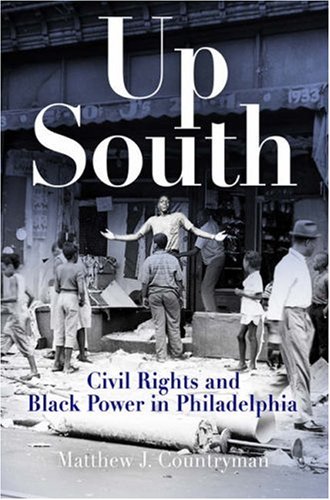
“Up South: Civil Rights and Black Power in Philadelphia”
by Matthew J. Countryman
2007 University of Pennsylvania
This book was not quite what I expected, but I’m not sure what I was expecting. The strength of Up South is that it gives a broad overview of the 1940s-60s civil rights/black power movement in Philadelphia, which was very helpful for me as someone who wanted to learn more about the history of the city I’m living in, especially about the work against racism in one of the most racially divided cities in America.
The book captures a really interesting narrative from postwar liberalism to early-60s protest, to late-60s radicalism, to 70s electoral politics. Along the way we meet some of the most important players, like Cecil B. Moore, Philadelphia Welfare Rights Organization, and Council of Organizations Philadelphia Police Accountability and Responsibility (COPPAR). We learn a bit about their strategies, we learn about the white backlash and Frank Rizzo, and attempts by the system to co-opt and dilute the movement through politics and money.
However, the book also lacks in some substantial ways. For one thing, the author is a professor in Michigan, who as far as I know is not from Philadelphia and is not black. This doesn’t mean he has nothing valuable to contribute from his research, but it does mean the writing is overly academic and emotionally detached.
My other major complaint is that while the book doesn’t heat up until about pg. 120 with chapter 4, the conclusion is way too short and very unsatisfying. It’s only 1 page, front and back, and only hints at the issues which are crying out to be examined.
For example, did the huge protests and deep radicalism of the late 60s really get co-opted into pointless electoral campaigns? How is that possible, and why did it happen?
Why wasn’t there sustained grassroots pressure to hold the newly-elected black politicans accountable, or if there was, why did it fail?
How did the Rizzo Mayorship of the 70s affect the black freedom movement in Philly? In what ways did Rizzo gain greater power in moving from his position as Police Commissioner, and in what ways was he held more accountable as Mayor? More generally, how much did it matter who was in charge of the city government, as far as the movements were concerned?
These are just a few questions that I wish had been addressed in the book more substantially, but I think the fact that the book left me wanting to know more actually points to the success of the book in captivating my interest.
This wasn’t the holistic and movement-centered study that I was looking for, but it helped me clarify my questions on the subject so I recommend it for anyone living in Philadelphia and wanting to know more about the history of their city.
This is a new article written by my friend and mentor, Jerry Silberman. I helped him edit it, so if anyone wants to discuss these issues, i’m available! [alex]
The Last Recession? Or Our Best Opportunity for Hope?
by Jerry Silberman
Originally published by Energy Bulletin, November 7, 2008.
As the drama of the bursting bubble of Wall St. gives way to a slower, but steady and painful, economic decline, the first and most important question we should ask is “Should we try to blow another bubble, or should we reject bubble culture values for something entirely different?”
If we agree that we need a new culture, this leads to the question “Can we take advantage of the opportunity afforded by this collapse, by the exposure of a failed system, to establish new “rules for the house” (the root meaning of “economy” from the Greek)?”
If the house, metaphorically, is Planet Earth the way we have enjoyed it for millennia, then making the choice now to change to a sustainable economy is the best way to turn the apparent lemon of this economic contraction into the best lemonade in history. Read the rest of this entry »


 The End of Capitalism
Recent Comments