
You are currently browsing the category archive for the ‘Oil’ category.
The following article runs in the May 12, 2008 issue of The Nation magazine, one of the largest progressive publications in the United States. -alex
http://www.thenation.com/doc/20080512/hertsgaard
“Running on Empty”
by Mark Hertsgaard
The Nation‘s environment correspondent
It used to be that only environmentalists and paranoids warned about running out of oil. Not anymore. As climate change did over the past few years, peak oil seems poised to become the next big idea commanding the attention of governments, businesses and citizens the world over. The arrival of $119-a-barrel crude and $4-a-gallon gasoline this spring are but the most obvious signs that global oil production has or soon will peak. With global demand inexorably rising, a limited supply will bring higher, more volatile prices and eventually shortages that could provoke–to quote the title of the must-see peak oil documentary–the end of suburbia. If the era of cheap, abundant oil is indeed coming to a close, the world’s economy and, paradoxically, the fight against climate change could be in deep trouble. Read the rest of this entry »
This week, food riots are erupting in the poorest countries of the world, such as Haiti, where the majority of the population lives on under $2 a day. The protesters are calling for the resignation of their government, for its inability to provide basic necessities to the population. See this BBC News short video.
The price of grains, especially wheat (which has doubled in the past year), has been on a steady uphill trend for the past few years, causing major food shortages across much of the Global South.
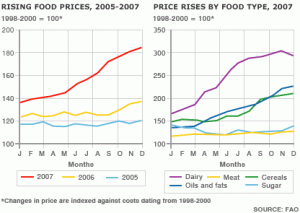
(image from BBC)
I want to highlight 4 underlying causes of this global food shortage:
1) Growing Inequality between the wealthiest and poorest people. Greater affluence in industrializing countries is driving larger levels of meat consumption, which requires far more wheat, other grains, and water to be consumed in order to produce the same amount of food. In fact, the majority of grains produced in the world are now fed to animals for meat. Meanwhile, hundreds of millions of people in the Global South are on the brink of starvation, or literally already starving.
2) Global Warming is causing unreliable and chaotic weather patterns across much of the food-producing regions of the world. Arable lands are turning into deserts as droughts worsen, while other regions are flooding with unseasonable downpours. These combine to create massive agricultural loss.
3) Biofuels like ethanol from corn production in the U.S. are quite literally food being used to fuel industry and automobiles. This manifests in driving up the cost of food for everyone, especially the poor, so that the largest agribusiness firms can earn huge profits, and the illusion of American prosperity surrounding large cars and wasteful consumerism can be maintained at all costs.
4) Most fundamental, The Global Oil Production Peak, which took place in 2006, is causing declining supplies of oil while demand surges across the industrial and industrializing world. We have seen a drastic and increasing rise in the price of oil over this period, which most Americans recognize in the high cost of gasoline. But for the poor of the world, a much more dire situation is emerging with food, because oil and other fossil fuels are the sources for most industrial fertilizers and pesticides, and because the modern system of food production and distribution are heavily dependent on oil for transportation, processing, packaging, refrigeration and cooking. In fact, the average American consumes over 10 calories of fossil fuels for every calorie of food eaten! Most people in the world can’t continue to afford this oil subsidy, and the crisis will only deepen as oil production declines in the coming years.
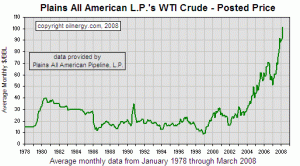
(Image courtesy OILNERGY)
See this awesome Graph-Presentation.
Originally published in the Wall Street Journal.
Boom Cuts U.S. Clout,
Revives Middle East;
Dark Days for Detroit
By NEIL KING JR. , CHIP CUMMINS and RUSSELL GOLD
January 3, 2008; Page A1
The surging price of oil, from just over $10 a barrel a decade ago to $100 yesterday, is altering the wealth and influence of nations and industries around the world.
These power shifts will only widen if prices keep climbing, as many analysts predict. Costly oil already is forcing sweeping changes in the airline and auto sectors. It is intensifying the politics of climate change and adding urgency to the search both for fresh sources of crude and for oil alternatives once deemed fringe.
![[Go to graphic.]](https://i0.wp.com/s.wsj.net/public/resources/images/OB-AW546_oil100_20080102152434.jpg)
The long oil-price boom is posing wrenching challenges for the world’s poorest nations, while enriching and emboldening producers in the Middle East, Russia and Venezuela. Their increasing muscle has a flip side: a decline of U.S. clout in many parts of the world.
Steep gasoline prices also threaten America’s long love affair with the automobile, while putting strains on many lower-income people outside big cities, who must spend an increasing share of their budgets just on fuel to get to work. Read the rest of this entry »
“Steep decline in oil production brings risk of war and unrest, says new study”
originally published by The Guardian.
Ashley Seager
Monday October 22, 2007
· Output peaked in 2006 and will fall by several[%] a year
· Decline in gas, coal and uranium also predicted

Oil platform in the Gulf of Mexico at sunset. Photo: Larry Lee/Corbis
World oil production has already peaked and will fall by half as soon as 2030, according to a report which also warns that extreme shortages of fossil fuels will lead to wars and social breakdown.The German-based Energy Watch Group will release its study in London today saying that global oil production peaked in 2006 – much earlier than most experts had expected. The report, which predicts that production will now fall by several percent a year, comes after oil prices set new records almost every day last week, on Friday hitting more than $90 (£44) a barrel.
“The world soon will not be able to produce all the oil it needs as demand is rising while supply is falling. This is a huge problem for the world economy,” Read the rest of this entry »
[This is only one person’s perspective, and not meant to be an authoritative report. Other SDSers, especially womyn and trans folks are encouraged to step up and write about No War, No Warming. -ed.]
“War Pollutes Our Democracy; Sexism Militarizes Our Bodies”
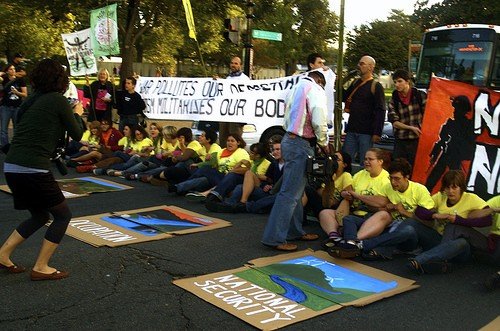
26 members of SDS (Students for a Democratic Society) blocked traffic next to the House of Representatives Monday morning, October 22, as part of No War, No Warming, which drew hundreds to the Capitol. Traffic was stopped on Independence Ave. for over an hour. After the initial wave of 27 people was pulled off the street by cops, a second wave, which included minors, jumped into the street and linked arms, halting traffic once again. The goal of the protest was to dramatize that Congress has failed to stop the war and failed to address global warming, and to show that the two issues are deeply connected by Oil.
Nearby, polar bears rapped, giant Condaleeza and giant Bush danced, Iraq Veterans Against the War staged a Blackwater mission, Billionaires for Bush whined, a bike brigade did Critical Mass, and Oil Change International demonstrated for the “Separation of Oil and State.” 61 were arrested overall.
The most fun part was in prison, when we integrated the holding cell across gender (or perceived gender) lines. Starting on opposite sides of the room based on what gender the cops considered us, we sneakily inched together over the course of hours, until we ended up in a big circle and had a meeting! The power dynamic was flipped and the cops were stunned.
Everyone is out of jail, healthy and safe.
“No War! No Warming! Resistance! is Forming!”
some good coverage:
Democracy Now! video coverage (requires Realplayer)
Youtube video #1 (skip the weird 1:00 intro)
more pics: Read the rest of this entry »
By William M. H. Kötke
13 September, 2007
Countercurrents
The planetary elite are compelled to continue on their path of growth leading toward planetary domination. The international bankers through their control of the industrial world’s privately owned central banks maintain a tether on the money system through their control of the U.S. dollar as the currency of international trade. One important mechanism that allows this is that the largest item in international trade – oil – is sold in dollars. In order to insure the continuance of the dollar economy, they must be able to choose which currency oil is sold for or control the oil – or both. The center of the empire, the U.S., is maintained by debt as the petrodollars and other dollars come into the U.S. at the rate of at least two and a half billion per day (purchasing U.S. government bonds) in order to continue the cycle, which keeps the empire and its military power expanding As the elite carry out their strategies of domination they are racing against time. The monster trends of Peak Oil and energy exhaustion, climate change which will severely disrupt the seasons of growth in the food supply system, the weakness of the dollar and ecological collapse are pursuing them. An exponentially growing world population with growing material consumption based on dwindling resources and a dying planet won’t work, but they have no other option to maintain their power and profit.
Seeds of Change
As the industrial system spins toward exhaustion, seeds of change are sprouting at the base. The people at the base are not revolting in order to take the power that the elite have but are revolting to take power over their own lives. Read the rest of this entry »
From TomDispatch, September 25, 2007
Before the invasion of Iraq in March 2003, discussion of Iraqi oil was largely taboo in the American mainstream, while the “No Blood for Oil” signs that dotted antiwar demonstrations were generally derisively dismissed as too simpleminded for serious debate. American officials rarely even mentioned the word “oil” in the same sentence with “Iraq.” When President Bush referred to Iraqi oil, he spoke only of preserving that country’s “patrimony” for its people, a sentiment he and Great Britain’s Prime Minister Tony Blair emphasized in a statement they issued that lacked either the words “oil” or “energy” just as Baghdad fell: “We reaffirm our commitment to protect Iraq’s natural resources, as the patrimony of the people of Iraq, which should be used only for their benefit.”
That May, not long after the President declared “major combat” at an end in Iraq, Deputy Secretary of Defense Paul Wolfowitz did point out the obvious — that Iraq was a country that “floats on a sea of oil.” He also told a Congressional panel: “The oil revenue of that country could bring between 50 and 100 billion dollars over the course of the next two or three years. Read the rest of this entry »
by Carolyn Baker, Ph.D.
May 16, 2006
Two years ago when I was invited to watch the jaw-dropping DVD, The End Of Suburbia, I came away feeling terrified about the ramifications of Peak Oil, but only later did I reflect on the fact that there are virtually no women in the documentary – except the ditzy fifties caricatures who consumed everything that wasn’t nailed down. Subsequently, I began researching Peak Oil and then informing the students in my college history classes about what I consider the stellar historical event of the modern world, the end of hydrocarbon energy and probably the end of Western civilization. Yet consistently in the process of informing myself about Peak Oil, I encountered very academic charts, graphs, geological and economic studies, and lots of male voices. I had almost come to believe that the issue was exclusively a masculine concept when a female friend commented that the Peak Oil bell curve seemed to her rather phallic. My response was entirely the opposite: I had been perceiving it as a giant breast. Well, all Roschach testing and the dearth of women in the Peak Oil movement aside, what does the phenomenon have to do not only with women but the feminine principle itself? My answer: Everything! Read the rest of this entry »


 The End of Capitalism

Recent Comments