
You are currently browsing the category archive for the ‘New World’ category.
 “Flying Close to the Sun: My Life and Times as a Weatherman”
by Cathy Wilkerson
2007 by Seven Stories
This is probably the most important book on the Weathermen written by one of its participants, tackling the many difficult inner complexities and questions that haunted the explosive project while remaining deeply committed to progressive social change and anti-racist organizing. In the end, this book taught me quite directly how and why the WUO went astray, and how a lack of open and participatory democracy can distort even the brightest of movements. Read the rest of this entry »
Check out this awesome essay by Paul Kivel – it really helped me understand my class background (as a member of the “buffer zone”) and how I can relate to others in an accountable way to achieve social change! – Alex
Social Service or Social Change?
Who Benefits from your Work
by Paul Kivel
copyright 2000
MY FIRST ANSWER TO THE QUESTION POSED IN THE TITLE is that we need both, of course. We need to provide services for those most in need, for those trying to survive, for those barely making it. We need to work for social change so that we create a society in which our institutions and organizations are equitable and just and all people are safe, adequately fed, adequately housed, well educated, able to work at safe, decent jobs, and able to participate in the decisions that affect their lives. Although the title of this article may be misleading in contrasting social service provision and social change work, the two do not necessarily go together easily and in many instances do not go together at all. There are some groups working for social change that are providing social service; there are many more groups providing social services that are not working for social change. In fact, many social service agencies may be intentionally or inadvertently working to maintain the status quo.
The Economic Pyramid
I want to begin by providing a context for this discussion: the present political/economic system here in the United States. Currently our economic structure looks like the pyramid in Figure One in which 1% of the population controls about 47% of the net financial wealthii of the country, and the next 19% of the population controls another 44%. That leaves 80% of the population struggling to gain a share of just 9% of the remaining financial wealth. That majority of 80% doesn’t divide very easily into 9% of resources, which means that many of us spend most of our time trying to get enough money to feed, house, clothe, and otherwise support ourselves and our families.
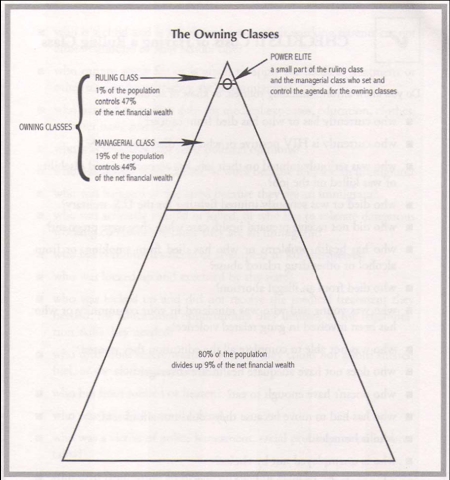
Illustration by Alberto Ledesma Read the rest of this entry »
Part 1 of 9 – a brilliant and vivid look at Neoliberalism and those who struggle against it on all parts of the globe. bilingual (English/Spanish).

This great, short essay “Against School” targets modern, mass, mandatory schooling as an educational fraud, arguing that the real purpose of school is to divide, demoralize, and train youth for lifetimes as workers and consumers. In other words, to produce obedience and helplessness on an industrial scale. I think a second function, which the author does not address, is that mass mandatory schooling takes children away from their parents for the entire day, freeing up the adults for higher levels of work and consumption. Thus the “daycare prisons” we send our kids to every day help facilitate the “daily grind” that imprisons our parents in the rat-race of toil and buying that powers industrial production and profits.
How public education cripples our kids, and why
By John Taylor Gatto
John Taylor Gatto is a former New York State and New York City Teacher of the Year and the author, most recently, of The Underground History of American Education. He was a participant in the Harper’s Magazine forum “School on a Hill,” which appeared in the September 2003 issue.
I taught for thirty years in some of the worst schools in Manhattan, and in some of the best, and during that time I became an expert in boredom. Boredom was everywhere in my world, and if you asked the kids, as I often did, why they felt so bored, they always gave the same answers: The said the work was stupid, that it made no sense, that they already knew it. They said they wanted to be doing something real, not just sitting around. They said teachers didn’t seem to know much about their subjects and clearly weren’t interested in learning more. And the kids were right: their teachers were every bit as bored as they were.
Reposted from Indymedia UK.
by David Graeber
The biggest problem facing direct action movements is that we don’t know how to handle victory.
This might seem an odd thing to say because of a lot of us haven’t been feeling particularly victorious of late. Most anarchists today feel the global justice movement was kind of a blip: inspiring, certainly, while it lasted, but not a movement that succeeded either in putting down lasting organizational roots or transforming the contours of power in the world. The anti-war movement was even more frustrating, since anarchists and anarchist tactics were largely marginalized. The war will end, of course, but that’s just because wars always do. No one is feeling they contributed much to it.
I want to suggest an alternative interpretation. Let me lay out three initial propositions here:
1) Odd though it may seem, the ruling classes live in fear of us. They appear to still be haunted by the possibility that, if average Americans really get wind of what they’re up to, they might all end up hanging from trees. It know it seems implausible but it’s hard to come up with any other explanation for the way they go into panic mode the moment there is any sign of mass mobilization, and especially mass direct action, and usually try to distract attention by starting some kind of war.
2) In a way this panic is justified. Mass direct action—especially when organized on democratic lines—is incredibly effective. Over the last thirty years in America, there have been only two instances of mass action of this sort: the anti-nuclear movement in the late ‘70s, and the so called “anti-globalization” movement from roughly 1999-2001. In each case, the movement’s main political goals were reached far more quickly than almost anyone involved imagined possible.
3) The real problem such movements face is that they always get taken by surprise by the speed of their initial success. We are never prepared for victory. It throws us into confusion. We start fighting each other. The ratcheting of repression and appeals to nationalism that inevitably accompanies some new round of war mobilization then plays into the hands of authoritarians on every side of the political spectrum. As a result, by the time the full impact of our initial victory becomes clear, we’re usually too busy feeling like failures to even notice it. Read the rest of this entry »
“Bakunin on Anarchy”
Mikhail Bakunin
1972 A.A. Knopf
Collection of some of Bakunin’s most important writings and essays. Having not really read much Bakunin before, I’m a little disappointed, I must say. Not for what he says, but what he doesn’t.
He tended to repeat his own ideas a lot, which are of course valid (the state must be destroyed, not reformed; revolution must be decentralized and spontaneous by the masses of people, not handed down by a privileged elite), but also simplistic and formulaic. Overall, Bakunin’s writings are not very useful in contexts beyond the theoretical and philosophical, and you can take them more as guiding and grounding principles rather than any kind of program for revolutionary action.
Then again, there’s some important stuff here, especially about Bakunin’s relationship with Marx and other socialists of his day, the nature of the First International being especially interesting. Recommended but not by much.
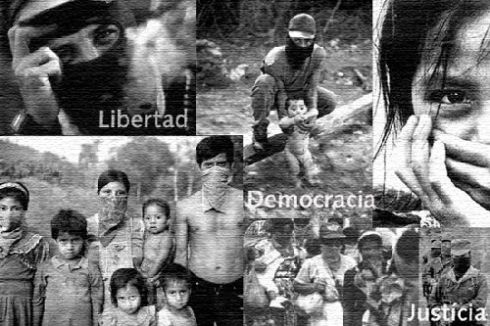
Watch this documentary! It’s only 48 minutes long, a very heartfelt and inspirational documentary of the Zapatista movement of poor indigenous Mexicans against capitalism.
By William M. H. Kötke
13 September, 2007
Countercurrents
The planetary elite are compelled to continue on their path of growth leading toward planetary domination. The international bankers through their control of the industrial world’s privately owned central banks maintain a tether on the money system through their control of the U.S. dollar as the currency of international trade. One important mechanism that allows this is that the largest item in international trade – oil – is sold in dollars. In order to insure the continuance of the dollar economy, they must be able to choose which currency oil is sold for or control the oil – or both. The center of the empire, the U.S., is maintained by debt as the petrodollars and other dollars come into the U.S. at the rate of at least two and a half billion per day (purchasing U.S. government bonds) in order to continue the cycle, which keeps the empire and its military power expanding As the elite carry out their strategies of domination they are racing against time. The monster trends of Peak Oil and energy exhaustion, climate change which will severely disrupt the seasons of growth in the food supply system, the weakness of the dollar and ecological collapse are pursuing them. An exponentially growing world population with growing material consumption based on dwindling resources and a dying planet won’t work, but they have no other option to maintain their power and profit.
Seeds of Change
As the industrial system spins toward exhaustion, seeds of change are sprouting at the base. The people at the base are not revolting in order to take the power that the elite have but are revolting to take power over their own lives. Read the rest of this entry »


 The End of Capitalism
Recent Comments