
You are currently browsing the category archive for the ‘Democracy’ category.
 “Defying Dixie: The Radical Roots of Civil Rights (1919-1950)”
by Glenda Gilmore
2008 W.W. Norton
I picked up this book randomly when I saw it in the library, and it turned out to be a worthwhile read. Gilmore, a white female professor from North Carolina, surveys the “radical roots of civil rights” through the efforts of the Communist Party in the South during the 1920s through 1940s.
Gilmore tells the story by focusing on a few individual black radicals who have been forgotten by history, especially Lovett Fort-Whiteman and Pauli Murray.
Whiteman, an extravagant early supporter of the Soviet Union, founded some of the first communist organizations for African Americans, before being scared out of the country by the feds, becoming a darling in the Soviet Union, then ultimately winding up in one of Stalin’s gulags in Siberia, where he worked/starved to death.
Murray had more luck, despite being a transgendered black woman in the South in the 1940s. With a bold attitude, she attempted to integrate various institutions, like the University of North Carolina Law program, and although she herself was not successful in these efforts, her example paved the way for future victories within the Black Freedom Movement.
We also learn quite a bit about Langston Hughes, Thurgood Marshall, A. Philip Randolph, Max Yergan, and many other heroic characters who fought early and often for equality in the apartheid South.
More interesting to me though was what I learned about movement strategy, for example we explore how the first integrated unions in the South scared the bejesus out of the capitalists, or what it meant for the Communist Party to bring the country’s attention to the case of the Scottsboro “Boys”, or how the “Popular Front” strategy of allying with liberals succeeded, and failed.
The writing is interesting, but could be more purposeful. Defying Dixie focuses probably too much on the Communists, and not on other radicals, but still this book really clarified for me important stuff like the Depression, the South in the 1930s, and the early Civil Rights Movement, and how once-radical ideas like social equality of the races is now accepted fact (even though still not fully realized).
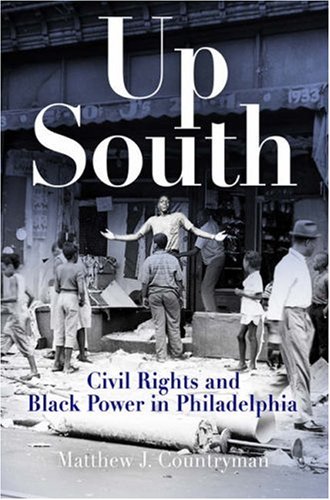
“Up South: Civil Rights and Black Power in Philadelphia”
by Matthew J. Countryman
2007 University of Pennsylvania
This book was not quite what I expected, but I’m not sure what I was expecting. The strength of Up South is that it gives a broad overview of the 1940s-60s civil rights/black power movement in Philadelphia, which was very helpful for me as someone who wanted to learn more about the history of the city I’m living in, especially about the work against racism in one of the most racially divided cities in America.
The book captures a really interesting narrative from postwar liberalism to early-60s protest, to late-60s radicalism, to 70s electoral politics. Along the way we meet some of the most important players, like Cecil B. Moore, Philadelphia Welfare Rights Organization, and Council of Organizations Philadelphia Police Accountability and Responsibility (COPPAR). We learn a bit about their strategies, we learn about the white backlash and Frank Rizzo, and attempts by the system to co-opt and dilute the movement through politics and money.
However, the book also lacks in some substantial ways. For one thing, the author is a professor in Michigan, who as far as I know is not from Philadelphia and is not black. This doesn’t mean he has nothing valuable to contribute from his research, but it does mean the writing is overly academic and emotionally detached.
My other major complaint is that while the book doesn’t heat up until about pg. 120 with chapter 4, the conclusion is way too short and very unsatisfying. It’s only 1 page, front and back, and only hints at the issues which are crying out to be examined.
For example, did the huge protests and deep radicalism of the late 60s really get co-opted into pointless electoral campaigns? How is that possible, and why did it happen?
Why wasn’t there sustained grassroots pressure to hold the newly-elected black politicans accountable, or if there was, why did it fail?
How did the Rizzo Mayorship of the 70s affect the black freedom movement in Philly? In what ways did Rizzo gain greater power in moving from his position as Police Commissioner, and in what ways was he held more accountable as Mayor? More generally, how much did it matter who was in charge of the city government, as far as the movements were concerned?
These are just a few questions that I wish had been addressed in the book more substantially, but I think the fact that the book left me wanting to know more actually points to the success of the book in captivating my interest.
This wasn’t the holistic and movement-centered study that I was looking for, but it helped me clarify my questions on the subject so I recommend it for anyone living in Philadelphia and wanting to know more about the history of their city.
I recently posted Dmitry Orlov’s great essay ‘Closing the Collapse Gap‘, and here is his latest piece, which he delivered to the 5th Conference on Peak Oil and Community Solutions. I am only reposting excerpts, because the original is very long and somewhat repetitive. I also must warn that although I find Orlov’s insight useful, I have a much more positive view of the collapse of US Imperialism, mainly because I think he is overlooking the benefits of this process for the planet’s ecosystem as well as the possibility of freedom for the majority of the world’s people who are currently suffering under US dominance. Iraqis certainly will have a different view of the collapse of the US Empire than those in the Pentagon.
How about for Americans? Is the collapse of the US better for people who live here? Orlov’s conclusion actually indicates that it may be, especially in terms of rebuilding the social fabric that has been worn away by individualism and consumerism. But he also overlooks the reality of social oppression in the US. Not everyone lives the same “middle class” lifestyle he seems to be taking for granted. There are already millions of Americans on the brink of poverty, or deep in poverty, who don’t worry about losing their SUVs.
The best outcome is for not just a collapse, but a transformation, so that nobody has to go hungry or work their life away just so that the wealthy can take cruises or visit the spa. The current Bailouts are the most striking example of the government having the exactly opposite priorities. Instead of bailing out homeowners, or the poor who lack access to public transportation, they are dumping money into the hands of the real estate and automaking profiteers! We must continue to oppose this nonsense, from Obama or anyone, and make sure that our money is used for the benefit of the majority, not the wealthy few. In a world of shrinking wealth, there should be no rich, and there doesn’t have to be any poor either. [alex]
The Five Stages of Collapse
by Dmitry Orlov
Originally published by Energy Bulletin, Nov. 11, 2008.

1.
Hello, everyone! […] My specialty is in thinking about and, unfortunately, predicting collapse. My method is based on comparison: I watched the Soviet Union collapse, and, since I am also familiar with the details of the situation in the United States, I can make comparisons between these two failed superpowers.
I was born and grew up in Russia, and I traveled back to Russia repeatedly between the late 80s and mid-90s. This allowed me to gain a solid understanding of the dynamics of the collapse process as it unfolded there. By the mid-90s it was quite clear to me that the US was headed in the same general direction. But I couldn’t yet tell how long the process would take, so I sat back and watched.
I am an engineer, and so I naturally tended to look for physical explanations for this process, as opposed to economic, political, or cultural ones. It turns out that one could come up with a very good explanation for the Soviet collapse by following energy flows. What happened in the late 80s is that Russian oil production hit an all-time peak. This coincided with new oil provinces coming on stream in the West – the North Sea in the UK and Norway, and Prudhoe Bay in Alaska – and this suddenly made oil very cheap on the world markets. Soviet revenues plummeted, but their appetite for imported goods remained unchanged, and so they sank deeper and deeper into debt. What doomed them in the end was not even so much the level of debt, but their inability to take on further debt even faster. Once international lenders balked at making further loans, it was game over.
What is happening to the United States now is broadly similar, with certain polarities reversed. The US is an oil importer, burning up 25% of the world’s production, and importing over two-thirds of that. Back in mid-90s, when I first started trying to guess the timing of the US collapse, the arrival of the global peak in oil production was scheduled for around the turn of the century. It turned out that the estimate was off by almost a decade, but that is actually fairly accurate as far as such big predictions go. So here it is the high price of oil that is putting the brakes on further debt expansion. As higher oil prices trigger a recession, the economy starts shrinking, and a shrinking economy cannot sustain an ever-expanding level of debt. At some point the ability to finance oil imports will be lost, and that will be the tipping point, after which nothing will ever be the same.
This is not to say that I am a believer in some sort of energy determinism. If the US were to cut its energy consumption by an order of magnitude, it would still be consuming a staggeringly huge amount, but an energy crisis would be averted. But then this country, as we are used to thinking of it, would no longer exist. Oil is what powers this economy. In turn, it is this oil-based economy that makes it possible to maintain and expand an extravagant level of debt. So, a drastic cut in oil consumption would cause a financial collapse (as opposed to the other way around). A few more stages of collapse would follow, which we will discuss next.[…]
I don’t mean to imply that every part of the country will suddenly undergo a spontaneous existence failure, reverting to an uninhabited wilderness. I agree with John-Michael Greer that the myth of the Apocalypse is not the least bit helpful in coming to terms with the situation. The Soviet experience is very helpful here, because it shows us not only that life goes on, but exactly how it goes on. But I am quite certain that no amount of cultural transformation will help us save various key aspects of this culture: car society, suburban living, big box stores, corporate-run government, global empire, or runaway finance. Read the rest of this entry »
On President-elect Barack Obama’s first trip to the White House yesterday to meet privately with his predecessor, lame duck George W. Bush, reportedly the first and most pressing message Obama delivered to the man in charge was “bail out General Motors.”

Cartoon by The Rag Blog
The American taxpayers are sick and tired of their money being doled out to corporate crooks like the carbon-polluting, oil-guzzling auto industry, or banks like AIG who apparently weren’t satisfied by the first two bailouts and now want another. (They apparently spent too much of their last check on trips to the spa.)
Is this really Obama’s highest priority? Giving public money to private companies that will use it to pollute the planet?
If YOU had the opportunity to sit down with President Bush for an hour and have him actually listen to you, what would YOU ask him to do?
Why not instead bail out homeowners by ending foreclosures to keep people in their houses?
Why not bail out the poor, sick, and elderly, by instituting single-payer universal health care like every other industrialized nation does?
Why not bail out Iraqis, military families and soldiers by pulling U.S. forces out of Iraq and ending a bloody occupation? (or Afghanistan, or the 100+ countries where the US military is stationed)
Why not bail out human rights by ending torture, closing Guantanamo and allowing all prisoners a trial by jury?
Why not bail out civil rights by ending anti-immigrant raids and the criminalizing of immigration?
Why not bail out students, who are suffering from the greatest debt crisis in history as education becomes increasingly unaffordable?
Why not bail out the planet, by investing heavily in renewable energies controlled by local communities, urban gardens, home weatherization and create 5 million new Green Jobs?
Barack, if you’re going to be a president worthy of the immense praise and expectation placed on you, you’re going to need to stop palling around with terroristic industry and corporate lobbyists, and listen to the people.
[alex]
Sources: Obama pressed Bush for auto industry bailout
Originally published by CNN, November 11, 2008
Jessica Yellin, Candy Crowley, CNN’s Ed Henry
(CNN) – At their private Oval Office meeting on Monday, President-elect Barack Obama urged President Bush to support billions of dollars in aid for the struggling auto industry during the upcoming lame-duck session of Congress, according to three officials briefed on the meeting.
The officials said Bush privately expressed skepticism about taxpayer money for automakers on the heels of a string of government bailouts for other industries, and the president also urged Obama to help push through a free trade pact with Colombia Read the rest of this entry »
Originally published by Common Ground Magazine.
By Daniel Pinchbeck
Witnessing the unraveling of the global financial system, I find myself gripped by contrasting emotions. While part of me feels like heading for the hills and hoarding cans of sardines, another part of me is giddy, almost celebratory. The tyrannical rule of Wall Street is ending, along with the self-serving free market ideology of Neoconservatives. The massive amounts of fictitious capital created by our corrupt financial system must be destroyed, so we can address our immediate situation on this planet.
I feel sorry for the millions of people who may suffer during a transition that will be extremely difficult. On the other hand, our rapacious economic system is destroying the integrity of the biosphere, threatening our future as a species. Taking a wider perspective, we can see a new social structure that creates sustainable patterns of behavior is necessary, if we want our descendents to continue on the earth.
In my last book, I looked at many predictions of systemic financial dissolution at this time. I discussed the possibility that a financial H-bomb could melt down the economic system while leaving the “tangible assets” — people, infrastructure, land — still standing. I suggested this could be the best thing to happen to our world. Such a systemic collapse is a tremendous opportunity to change the direction of our society. Those who believe civilization can be run according to different principles — humane, equitable, and collaborative ones — need to step forward now with concrete proposals and put ideals into practice.
Several factors made the collapse of the global financial system inevitable. One problem with capitalism is that it is not self-sufficient, but depends on the constant availability of new markets, forcing expansion by creating ever-increasing amounts of debt. We now have a globalized world market, so exploitation of new territories can no longer take place. As Naomi Klein analyzed in The Shock Doctrine, this led to a policy of “disaster capitalism,” where cataclysms like hurricanes and terrorist acts were seized as opportunities to redevelop internal markets. Such a practice is inherently unsustainable.
Another crucial element that is rarely discussed in the media is the connection between the current financial meltdown and peak oil. Just as our debt-based economic system needed new markets to penetrate, it also required an ever-increasing supply of cheap energy to fuel its expansion. The decreasing supply of fossil fuels relative to global demand has brought the second law of thermodynamics into play, breaking the delusionary spell cast by the financier-sorcerers, who decoupled financial value from real value back in the early 1970s. When we consider the permanent reduction in the supply of cheap energy combined with the lack of new markets, it is obvious the amassed debts will never be repaid. Read the rest of this entry »
A petition by Friends of the RNC 8 has been put together calling for the Ramsey County Attorney Susan Gaertner to drop all the charges against the RNC 8. Defend The RNC8! Dismiss the Charges! : http://www.thepetitionsite.com/1/defendthernc8
The goal is 100,000 signatures. Please take a moment to sign the petition. Then help get the word out by forwarding the petition to friends and family.
For updates on the case visit: http://rnc8.org . To get automatic email updates, sign up here: http://rnc8.org/get-updates/
The legal costs for the RNC 8 are estimated at $250,000. Donations can be made via PayPal or you can mail in a check (there is even a tax deductible option). All the information you need is at: http://rnc8.org/donations/ Donations of all sizes are greatly appreciated.
Recent article:
RNC Terrorists? Or just young people speaking their minds?
Three activists nabbed in pre-convention raid deny any plans for violence
At times, they laugh at how ridiculous it seems.
But Monica Bicking and Garrett Fitzgerald weren’t laughing when police broke down the door of their South Minneapolis house before 8 a.m. Aug. 30, stormed inside and pointed guns in their faces.
“I was woken up out of a deep sleep to screaming and banging,” Bicking said. “It’s scary.”
Max Specktor was not there when police came to his house two miles away. But he was arrested two days later, on Sept. 1. “I was leaving in a car, and they pulled the car over right away,” he said.
Bicking, Fitzgerald and Specktor are three of eight young Minneapolis residents charged in Ramsey County with conspiracy to commit riot “in furtherance of terrorism,” allegedly to disrupt last month’s Republican National Convention in St. Paul.
The unusual charge stems from a 2002 Minnesota terrorism law, a version of the federal Patriot Act passed after the Sept. 11 terrorist attacks.
“These charges are an effort to equate publicly stated plans to blockade traffic and disrupt the RNC as being the same as acts of terrorism,” said Bruce Nestor, an attorney with the National Lawyers Guild who is representing Bicking, in a recent statement. Read the rest of this entry »


 The End of Capitalism
Recent Comments