
You are currently browsing the category archive for the ‘Climate Crisis’ category.
Also published by The Rag Blog and OpEdNews.
 “We stand at a critical moment in Earth’s history, a time when humanity must choose its future. As the world becomes increasingly interdependent and fragile, the future at once holds great peril and great promise. To move forward we must recognize that in the midst of a magnificent diversity of cultures and life forms we are one human family and one Earth community with a common destiny. We must join together to bring forth a sustainable global society founded on respect for nature, universal human rights, economic justice, and a culture of peace. Towards this end, it is imperative that we, the peoples of Earth, declare our responsibility to one another, to the greater community of life, and to future generations. – The Earth Charter” (pg. 1).
David Korten, long-time global justice activist, co-founder of Yes! Magazine, and author of such books as When Corporations Rule the World, lays out the fundamental crossroads facing the world in his 2006 book The Great Turning: From Empire to Earth Community. In response to global climate change, war, oil scarcity, persistent racism and sexism and many other mounting crises, Korten argues we must recognize these as symptoms of a larger system of Empire, so that we might move in a radically different direction of equality, ecological sustainability, and cooperation, which he terms Earth Community. This is a powerful and important book, which excels in overviewing the big picture of threats facing our ecosphere and our communities at the hands of global capitalism1, and translating this into the simplest and most accessible language so we might all do something about it. It’s pretty much anti-capitalism for the masses. And it has the power to inspire many of us to transform our lives and work towards the transformation of society.
Capitalism and Empire
Of course, Korten has made the strategic decision to avoid pointing the finger at “capitalism” as such in order to speak to an American public which largely still confuses the term as equivalent to “freedom” or “democracy.” In fact the “C” word is rarely mentioned in the book, almost never without some sort of modifier as in “corporate capitalism” or “predatory capitalism”, as if those weren’t already features of the system as a whole. Instead, Korten names “Empire” as the culprit responsible for our global economic and ecological predicament, which is defined as a value-system that promotes the views that “Humans are flawed and dangerous”, “Order by dominator hierarchy”, “Compete or die”, “Masculine dominant”, etc. (32).
Korten explains that Empire, “has been a defining feature of the most powerful and influential human societies for some five thousand years, [and] appropriates much of the productive surplus of society to maintain a system of dominator power and elite competition. Racism, sexism, and classism are endemic features” (25). In this way the anarchist concept of the State is repackaged as a transcendent human tendency, which has more to do with conscious decision-making and maturity level than it does with political power. While this compromise does limit the book’s effectiveness in offering solutions later on, it does speak in a language more familiar to the vast non-politicized majority of Americans, and may have the potential to unify a larger movement for change.
Whatever you want to call the system, the danger it presents to the planet is now clear. Korten spells out the grim statistics: “Fossil fuel use is five times what it was [in 1950], and global use of freshwater has tripled… the [Arctic] polar ice cap has thinned by 46 percent over twenty years… [while we’ve seen] a steady increase over the past five decades in severe weather events such as major hurricanes, floods, and droughts. Globally there were only thirteen severe events in the 1950s. By comparison, seventy-two such events occurred during the first nine years of the 1990s” (59-60). If this destruction continues, it’s uncertain if the Earth will survive.
This ecological damage is considered alongside the social damage of billions living without clean water or adequate food, as well as the immense costs of war and genocide. But Korten understands that the danger is relative to where you stand in the social hierarchy – the system creates extreme poverty for many, and an extreme wealth for a few others. He explains how the system is based on a deep inequality that is growing ever worse, “In the 1990s, per capita income fell in fifty-four of the world’s poorest countries… At the other end of the scale, the number of billionaires worldwide swelled from 274 in 1991 to 691 in 2005” (67). The critical point that these few wealthy elites wield excessive power and influence within the system to stop or slow necessary reform could be made more clearly, but at least the book exposes the existence of this upper class, who are usually quite effective at hiding from public scrutiny and outrage over the suffering they are causing.2
Earth Community – Growing a Revolution
Standing at odds with the bastions of Empire is what David Korten calls “Earth Community,” a “higher-order” value-system promoting the views of, “Cooperate and live,” “Love life”, “Defend the rights of all”, “Gender balanced”, etc. (32). Read the rest of this entry »
This essay, written following a listening tour across the US, asks some of the most important questions facing social movements today, including “How Do We Build Intergenerational Movements?”, “What About Multiracial Movement Building?” and “How Do We Develop Strategy?”
I read this when it first came out in the summer of 2006 and it pretty much rocked my socks off and made me excited to get involved in the new SDS, so I figured I’d repost it for folks who never got to read it. [alex]
Ten Questions for Movement Building
by Dan Berger and Andy Cornell
Originally published by Monthly Review Zine.
For five weeks in the late spring of 2006, we toured the eastern half of the United States to promote two books — Letters From Young Activists: Today’s Rebels Speak Out (Nation Books, 2005) and Outlaws of America: The Weather Underground and the Politics of Solidarity (AK Press, 2006) — and to get at least a cursory impression of sectors of the movement in this country. We viewed the twenty-eight events not only as book readings but as conscious political conversations about the state of the country, the world, and the movement.
Of course, such quick visits to different parts of the country can only yield so much information. Because this was May and June, we did not speak on any school campuses and were unable to gather a strong sense of the state of campus-based activism. Further, much of the tour came together through personal connections we’ve developed in anarchist, queer, punk, and white anti-racist communities, and, as with any organizing, the audience generally reflected who organized the event and how they went about it rather than the full array of organizing projects transpiring in each town. Yet several crucial questions were raised routinely in big cities and small towns alike (or, alternately, were elided but lay just beneath the surface of the sometimes tense conversations we were party to). Such commonality of concerns and difficulties demonstrates the need for ongoing discussion of these issues within and between local activist communities. Thus, while we don’t pretend to have an authoritative analysis of the movement, we offer this report as part of a broader dialogue about building and strengthening modern revolutionary movements — an attempt to index some common debates and to offer challenges in the interests of pushing the struggle forward.
Challenges and Debates:
The audiences we spoke with tended to be predominantly white and comprised of people self-identified as being on the left, many of whom are active in one or more organizations locally or nationally. We traveled through the Northeast (including a brief visit to Montreal), the rust belt, the Midwest, parts of the South, and the Mid-Atlantic. Some events tended to draw mostly 60s-generation activists, others primarily people in their 20s, and more than a few were genuinely intergenerational. Not surprisingly, events at community centers and libraries afforded more room for conversation than those at bookstores. Crowds ranged anywhere from 10 to 100 people, although the average event had about 25 people. Even where events were small gatherings of friends, they proved to be useful dialogues about pragmatic work. Our goals for the tour were: establishing a sense of different organizing projects; pushing white people in an anti-racist and anti-imperialist direction while highlighting the interrelationship of issues; and grappling with the difficult issues of organizing, leadership, and intergenerational movement building. The following ten questions emerge from our analysis of the political situation based on our travels and meetings with activists of a variety of ages and range of experiences.
1. What Is Organizing?
Every event we did focused on the need for organizing. This call often fell upon sympathetic ears, but was frequently met with questions about how to actually organize and build lasting radical organizations, particularly in terms of maintaining radical politics while reaching beyond insular communities. There are too few institutions training young or new activists in the praxis of organizing and anti-authoritarian leadership development. Read the rest of this entry »
 The Ecology of Freedom: The Emergence and Dissolution of Hierarchy
by Murray Bookchin
1982 Cheshire Books
Murray Bookchin (R.I.P., 2006) was one of the most important American theorists of the 20th century. He is most known for pioneering and promoting social ecology, which holds that “the very notion of the domination of nature by man stems from the very real domination of human by human.” In other words, the only way to resolve the ecological crisis is to create a free and democratic society.
The Ecology of Freedom is one of Bookchin’s classic works, in which he not only outlines social ecology, but exposes hierarchy, “the cultural, traditional and psychological systems of obedience and command”, from its emergence in pre-‘civilized’ patriarchy all the way to capitalism today. The book explains that hierarchy is exclusively a human phenomena, one which has only existed for a relatively short period of time in humanity’s 2 million year history. For that reason, and also because he finds examples of people resisting and overturning hierarchies ever since their emergence, Bookchin believes we can create a world based on social equality, direct democracy and ecological sustainability.
It seems to me this fundamental hope in human possibility is the most essential contribution of this book. In discussing healthier forms of life than we currently inhabit, Bookchin makes a distinction between “organic societies”, which were pre-literate, hunter-gatherer human communities existing before hierarchy took over, and “ecological society”, which he hopes we will create to bring humanity back into balance with nature, but without losing the intellectual and artistic advances of “civilization” (his quote-marks).
Of ‘organic society’ he says “I use the term to denote a spontaneously formed, noncoercive, and egalitarian society – a ‘natural’ society in the very definite sense that it emerges from innate human needs for association, interdependence, and care.” This, he explains, is where we come from. Not a utopia free of problems, but a real society based on the principle of “unity of diversity,” meaning respect for each member of the community, regardless of sex, age, etc. – an arrangement that is free of domination. Read the rest of this entry »
In a dispute which perfectly represents the struggle for “Green Jobs”, workers at the Vestas wind energy plant in the UK have occupied their factory to save 600 jobs and one of the largest wind turbine manufacturing sites in the country. A coalition of labor and environmental groups have organized to support them with daily rallies, while the workers inside wait for the government to step in and start production again. “Now I’m not sure about you but we think it’s about time that if the government can spend billions bailing out the banks – and even nationalise them – then surely they can do the same at Vestas.”
For background and updates, see the workers’ blog: http://savevestas.wordpress.com or this article: Vestas Protest, What’s it All About?
Send messages of support to savevestas@googlemail.com
The events at Vestas have been just one in a series of worker occupations around the world in the wake of the current economic crisis. Workers are not allowing their jobs to be closed down, when corporations and banks are receiving large financial bailouts. This article gives some of the highlights of the new wave of worker militancy. [alex]
Global Trend for Sit-ins and Occupations as Mass Redundancies Continue
Terry Macalister
Originally published by The Guardian, UK – July 24, 2009
Trade union leaders warned tonight that the direct action seen at the Vestas factory was likely to be repeated elsewhere as workers refused to “bend their knee and accept their fate” in the face of mass redundancies caused by recession.
The sit-in at the Isle of Wight wind turbine plant was the latest in Britain, they said, and was part of a wider trend of militant tactics being used as far afield as the US, South Korea and China.
In France, where such tactics have been more common, the manager of a British company was taken hostage by workers today in a dispute over redundancies. About 60 workers at Servisair Cargo at Roissy airport in Paris prevented the director, Abderrahmane El-Aouffir, from leaving the firm’s offices after he refused to meet their demands in the latest case of so-called “boss-napping” to hit France.
The four day Vestas sit-in, which is an embarrassment both to the world’s biggest turbine manufacturer and a government trying to launch a low-carbon jobs revolution, follows a similar occupation in April at three Visteon (car parts manufacturer) plants in the UK in addition to action at Waterford Crystal in Ireland and Prisme Packaging in Dundee.
Tony Woodley, the joint general secretary of the Unite union, whose members were involved at Visteon, said: “I think it is absolutely understandable and justified for workers to fight back where they feel there are no other alternatives and employers act badly.” Read the rest of this entry »
[The tremendous waste and planned destruction that is inherent to capitalism is really quite astounding, but acknowledging this opens a great doorway for all those concerned about social justice and protecting the environment. Rational production, organized by society rather than for profit, would allow a great reduction in environmental damage, without sacrificing social welfare. In fact, as Don Fitz points out, economic production scaled to meet human and ecological needs would be so much more efficient than capitalist production that we could produce far less, while simultaneously increasing quality of life dramatically.
This brief overview of the military, food, health care, etc. industries suggests ways to completely transform and down-scale the economy, which would actually make us all richer. Worth the read! -alex]
We Can Produce Less and Consume More
by Don Fitz
Originally published by ZNet, July 15, 2009.
A major gulf between environmental and social justice activists is “stuff.” Environmentalists (or at least serious ones) say “less.” Social justice organizers have the habit of saying “more.”
This divisive question cuts to the edge of the sort of society we want to build. Deep greens envision a world with much less stuff. A great outline is Annie Leonard’s The Story of Stuff. [1] An excess of human-produced objects destroys species habitat, poisons communities with toxins, depletes oil and intensifies climate change.
Social justice activists, however, have devoted centuries to denouncing capitalism as placing fetters on the expansion of production. Whether the struggle is against racism, for labor rights, or resistance to imperialism, the cry is for the oppressed to have a much bigger piece of the pie.
In response to the current economic crisis, a near-unanimous chorus sings “There must be a stimulus package.” There is considerable debate over the size of the stimulus and what should be stimulated but not a whimper asking whether growth is really a good idea. It is a rare Michael Moore suggesting that auto plants should not produce autos, but rather solar panels and windmills for a society without privately owned cars. [2] It is even more rare to hear suggestions that auto plants should manufacture less and that unemployment could be resolved by shortening the work week.
A shorter work week is not exactly of the top of most environmental agendas. In fact, environmentalists often shoot themselves in the foot when they call for “sacrifices” from those who have already done more than their fair share of doing without.
Production and consumption: A broken connection
These conceptual problems stem from progressives using corporate economic frameworks. The error is believing that there is a connection between the amount of production and the amount of consumption. The common misperception is that an increase in consumption requires increased production, and, conversely, a fall in production means there will be less available to consume.
Accepting corporate economics, environmentalists make the false conclusion that if CO2 levels are to drop, then people must consume less. Social justice activists mistakenly believe that putting people back to work and providing basic necessities for all requires an increase in production. Neither of these are true. The greatest decrease in CO2 levels would come with a change in production and requires no personal sacrifice. Increasing production would not guarantee enough jobs; but, changing production could.
The mistake in economic thinking is hardly surprising since there was a direct link between production and consumption during more than 99% of human history. In pre-capitalist societies, if people wanted more, they produced more of what they wanted. This characterized the first few centuries of capitalism.
But between WWI and WWII, something happened that could only be considered a problem within the capitalist mode of production: Industry had the ability to produce enough to satisfy everyone’s basic needs. The first capitalists to realize this were aghast.
Jeffrey Kaplan chronicles their dismay at the discovery “that the industrial capacity for turning out goods seemed to be increasing at a pace greater than people’s sense that they needed them.” [3] Though a tiny handful of business leaders thought that America should switch to a four hour workday, most concluded that such leisure could breed radicalism and that a failure to increase production would threaten profits.
In 1929 President Herbert Hoover’s Committee on Recent Economic Changes announced the growing corporate consensus that capitalism could best survive by creating artificial needs. The Committee gleefully announced that “Economically we have a boundless field before us; that there are new wants which will make way endlessly for newer wants, as fast as they are satisfied.” [4] Read the rest of this entry »
Last night I watched the movie Food Inc., which presents a damning critique of the industrial food system in the United States. The food industry is dominated by a few huge corporations making enormous profits producing non-nutritious, environmentally destructive, farmer-ruining, worker-exploiting, cruel-to-animals and even dangerous food in massive quantities. Worse, the food lobby dominates Washington and with millions of dollars systematically prevents federal regulations which could save lives.
But just as An Inconvenient Truth does, Food Inc. hurts its impressive presentation by missing the landing. The movie tells us exactly what the problem is, but neglects to present an adequate solution to the concerned audience, who by the end of the film is ready to take action. Instead, the makers of Food Inc. tell us that this horrible corrupt system can be undone if we “vote with our dollars” and buy organic yogurt from Wal-Mart, even though Michael Pollan in the film has already told us that organic and healthy foods cost more and many families can’t afford them. Is this film aimed at people who think social change means being more mindful about their personal consumption habits? This might make people feel better, but will it actually stop the machine of destruction that is the industrial food system?
In this essay (below), author Derrick Jensen refutes the logic of this sort of “change” as ineffective – consumers don’t make change, organized citizens/workers/students/communities do. He rightly argues that “moral purity” is a different, and ultimately less noble, goal than “to confront and take down those systems.” This is one of Jensen’s better essays, but I still find it lacking in another crucial measure: Does it inspire hope? Jensen tends towards the apocalyptic, which shuts down people’s ability to see the light at the end of the tunnel, a light which is crucial to help us find our path out of the darkness.
I hope my website provides real solutions to the enormous problems we face, while also inspiring hope that we can achieve those solutions, ourselves. Making better individual consumption/lifestyle decisions is a great thing, and part of the picture, but it’s not enough. We need to work together, to organize, to achieve the social change that is needed, and that we deserve. [alex]
Why personal change does not equal political change
by Derrick Jensen
Published in the July/August 2009 issue of Orion magazine
WOULD ANY SANE PERSON think dumpster diving would have stopped Hitler, or that composting would have ended slavery or brought about the eight-hour workday, or that chopping wood and carrying water would have gotten people out of Tsarist prisons, or that dancing naked around a fire would have helped put in place the Voting Rights Act of 1957 or the Civil Rights Act of 1964? Then why now, with all the world at stake, do so many people retreat into these entirely personal “solutions”?
Part of the problem is that we’ve been victims of a campaign of systematic misdirection. Consumer culture and the capitalist mindset have taught us to substitute acts of personal consumption (or enlightenment) for organized political resistance. An Inconvenient Truth helped raise consciousness about global warming. But did you notice that all of the solutions presented had to do with personal consumption—changing light bulbs, inflating tires, driving half as much—and had nothing to do with shifting power away from corporations, or stopping the growth economy that is destroying the planet? Even if every person in the United States did everything the movie suggested, U.S. carbon emissions would fall by only 22 percent. Scientific consensus is that emissions must be reduced by at least 75 percent worldwide.
Or let’s talk water. We so often hear that the world is running out of water. People are dying from lack of water. Rivers are dewatered from lack of water. Because of this we need to take shorter showers. See the disconnect? Because I take showers, I’m responsible for drawing down aquifers? Well, no. More than 90 percent of the water used by humans is used by agriculture and industry. The remaining 10 percent is split between municipalities and actual living breathing individual humans. Collectively, municipal golf courses use as much water as municipal human beings. People (both human people and fish people) aren’t dying because the world is running out of water. They’re dying because the water is being stolen.
Or let’s talk energy. Kirkpatrick Sale summarized it well: “For the past 15 years the story has been the same every year: individual consumption—residential, by private car, and so on—is never more than about a quarter of all consumption; the vast majority is commercial, industrial, corporate, by agribusiness and government [he forgot military]. So, even if we all took up cycling and wood stoves it would have a negligible impact on energy use, global warming and atmospheric pollution.”
Or let’s talk waste. In 2005, per-capita municipal waste production (basically everything that’s put out at the curb) in the U.S. was about 1,660 pounds. Let’s say you’re a die-hard simple-living activist, and you reduce this to zero. You recycle everything. You bring cloth bags shopping. You fix your toaster. Your toes poke out of old tennis shoes. You’re not done yet, though. Since municipal waste includes not just residential waste, but also waste from government offices and businesses, you march to those offices, waste reduction pamphlets in hand, and convince them to cut down on their waste enough to eliminate your share of it. Uh, I’ve got some bad news. Municipal waste accounts for only 3 percent of total waste production in the United States.
I want to be clear. I’m not saying we shouldn’t live simply. I live reasonably simply myself, but I don’t pretend that not buying much (or not driving much, or not having kids) is a powerful political act, or that it’s deeply revolutionary. It’s not. Personal change doesn’t equal social change. Read the rest of this entry »
[Good news from the best oil/environment writer, Heinberg. The current economic crisis is easing pressure on the planet and its resources, ecological danger is decreasing. This is hopeful. I particular enjoy this statistic: “in the first four months of 2009, more bicycles were sold in the US than cars and trucks put together (over 2.55 million bicycles were purchased, compared to fewer than 2.4 million cars and trucks).”
Lately i’ve become convinced that hope is our greatest ally in working for a better world. If this article doesn’t inspire you, look at what’s happening in Iran at this moment. – alex]
Richard Heinberg
Originally published by Post Carbon Institute, June 5, 2009.
Recently I’ve begun compiling a list of things to be cheerful about. Here are some items that should bring a smile to any environmentalist’s lips:
- World energy consumption is declining. That’s right: oil consumption is down, coal consumption is down, and the IEA is projecting world electricity consumption to decline by 3.5 percent this year. I’m sure it’s possible to find a few countries where energy use is still growing, but for the US, China, and most of the European countries that is no longer the case. A small army of writers and activists, including me, has been arguing for years now that the world should voluntarily reduce its energy consumption, because current rates of use are unsustainable for various reasons including the fact that fossil fuels are depleting. Yes, we should build renewable energy capacity, but replacing the energy from fossil fuels will be an enormous job, and we can make that job less daunting by reducing our overall energy appetite. Done.
- CO2 emissions are falling. This follows from the previous point. I’m still waiting for confirmation from direct NOAA measurements of CO2 in the atmosphere, but it stands to reason that if world oil and coal consumption is declining, then carbon emissions must be doing so as well. The economic crisis has accomplished what the Kyoto Protocol couldn’t. Hooray!
- Consumption of goods is falling. Every environmentalist I know spends a good deal of her time railing both publicly and privately against consumerism. We in the industrialized countries use way too much stuff — because that stuff is made from depleting natural resources (both renewable and non-renewable) and the Earth is running out of fresh water, topsoil, lithium, indium, zinc, antimony…the list is long. Books have been written trying to convince people to simplify their lives and use less, films have been produced and shown on PBS, and support groups have formed to help families kick the habit, but still the consumer juggernaut has continued — until now. This particular dragon may not be slain, but it’s cowering in its den.
- Globalization is in reverse (global trade is shrinking). Back in the early 1990s, when globalization was a new word, an organization of brilliant activists formed the International Forum on Globalization (IFG) to educate the public about the costs and dangers of this accelerating trend. Corporations were off-shoring their production and pollution, ruining manufacturing communities in formerly industrial rich nations while ruthlessly exploiting cheap labor in less-industrialized poor countries. IFG was able to change the public discourse about globalization enough to stall the expansion of the World Trade Organization, but still world trade continued to mushroom. Not any more. China’s and Japan’s exports are way down, as is the US trade deficit.
- The number of vehicle miles traveled (VMT) is falling. For decades the number of total miles traveled by all cars and trucks on US roads has relentlessly increased. This was a powerful argument for building more roads. People bought more cars and drove them further; trucks restocked factories and stores at an ever-growing pace; and delivery vans brought more packages to consumers who shopped from home. All of this driving entailed more tires, pavement, and fuel — and more environmental damage. Over the past few months the VMT number has declined substantially and continually, to a greater extent than has been the case since records started being kept. That’s welcome news.
- There are fewer cars on the road. People are junking old cars faster than new ones are being purchased. In the US, where there are now more cars on the road than there are licensed drivers, this represents an extraordinary shift in a very long-standing trend. In her wonderful book Divorce Your Car, Katie Alvord detailed the extraordinary environmental costs of widespread automobile use. Evidently her book didn’t stem the tide: it was published in the year 2000, and millions of new cars hit the pavement in the following years. But now the world’s auto manufacturers are desperately trying to steer clear of looming bankruptcy, simply because people aren’t buying. In fact, in the first four months of 2009, more bicycles were sold in the US than cars and trucks put together (over 2.55 million bicycles were purchased, compared to fewer than 2.4 million cars and trucks). How utterly cool.
- The world’s over-leveraged, debt-based financial system is failing. Growth in consumption is killing the planet, but arguing against economic growth is made difficult by the fact that most of the world’s currencies are essentially loaned into existence, and those loans must be repaid with interest. Thus if the economy isn’t growing, and therefore if more loans aren’t being made, thus causing more money to be created, the result will be a cascading series of defaults and foreclosures that will ruin the entire system. It’s not a sustainable system given the fact that the world’s resources (the ultimate basis for all economic activity) are finite; and, as the proponents of Ecological and Biophysical Economics have been saying for years, it’s a system that needs to be replaced with one that can still function in a condition of steady or contracting consumption rates. While that sustainable alternative is not yet being discussed by government leaders, at least they are being forced to consider (if not yet publicly) the possibility that the existing system has serious problems and that it may need a thorough overhaul. That’s a good thing.
- Gardening is going gonzo. According to the New York Times (“College Interns Getting Back to Land,” May 25) thousands of college students are doing summer internships on farms this year. Meanwhile seed companies are having a hard time keeping up with demand, as home gardeners put in an unusually high number of veggie gardens. Urban farmer Will Allen predicts that there will be 8 million new gardeners this year, and the number of new gardens is expected to increase 20 to 40 percent this season. Since world oil production has peaked, there is going to be less oil available in the future to fuel industrial agriculture, so we are going to need more gardens, more small farms, and more farmers. Never mind the motives of all these students and home gardeners — few of them have ever heard of Peak Oil, and many of the gardeners are probably just worried whether they can afford to keep the pantry full next winter; nevertheless, they’re doing the right thing. And that’s something to applaud.
[T]he items outlined above suggest that we’ve turned a corner. Read the rest of this entry »
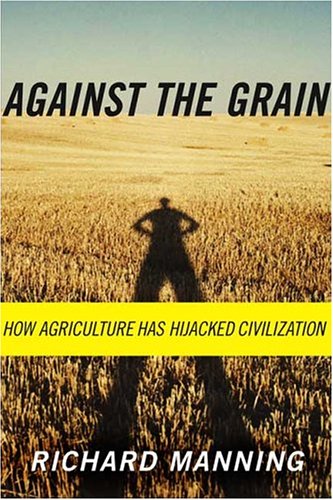 “Against the Grain: How Agriculture Has Hijacked Civilization”
Richard Manning
2004 North Point Press
Agriculture has domesticated humans. This is the argument at the center of Richard Manning’s stunning history of food. Written with journalistic flavor, Manning explores the ways that agriculture has diminished human life and threatens the planet itself.
The book begins by exploring the hunter-gatherer lifestyle, in many ways superior to our own even at the height of industrial capitalism. Hunter-gatherers, it turns out, ate a wider variety of tasty foods, worked far less, and lived much more sensually and connected than “civilized” humans. About 10,000 years ago, certain groups of humans traded all this in for security, namely the ability to stay in one spot and harvest grain to be stored for future food.
What this crop manipulation produced, however, was the first wealth inequality known to the species, as leaders left working the fields to their followers. In time, these stationary and hierarchical societies expanded and conquered/killed their hunter-gatherer neighbors. Soon enough crops like wheat, corn, and rice spread across the globe through violence and disease.
Manning focuses on these three crops because, as he explains, some 2/3 of all calories consumed today originate with them. In the US, corn is especially dominant, made into all kinds of commodities, for example corn syrup which can be found in just about everything we eat now. The dominance of these few grains is a consequence of capitalism, as they lend themselves easily to processing and storage – making them ideal commodities.
But an important plot twist in the story of grain’s dominance lies hidden in the open. Farm subsidies, especially in the US and Europe, distort the market to make these crops extremely cheap at the expense of all other nutrition. This has the added effect of enriching a few large agribusiness corporations (like Archer Daniels Midland) that grow or process them from enormous monocrop fields, although at the cost of ruining millions of small farmers all over the world. Our health, and the health of the planet are likewise jeopardized by the overabundance of these few crops produced with massive inputs of oil and chemicals.
Nevertheless, Richard Manning is able to summon the hope at the end of the book that our food system doesn’t have to be this way. Finding a distinction between agriculture and “simply growing food”, he argues that we can build an economy based on feeding people, and not just accumulating wealth. Organic agriculture, permaculture, intercropping, farmer’s markets and co-ops all point in this more just and sustainable direction, and awareness of the superiority of these more human methods has been growing at a phenomenal rate.
If we can nourish ourselves by reconnecting with the land and our sensual natures, perhaps we can also heal society and the planet. Against the Grain is a big step in educating us for that effort. Highly recommended.


 The End of Capitalism
Recent Comments