
You are currently browsing the daily archive for April 6, 2008.
Check out this awesome essay by Paul Kivel – it really helped me understand my class background (as a member of the “buffer zone”) and how I can relate to others in an accountable way to achieve social change! – Alex
Social Service or Social Change?
Who Benefits from your Work
by Paul Kivel
copyright 2000
MY FIRST ANSWER TO THE QUESTION POSED IN THE TITLE is that we need both, of course. We need to provide services for those most in need, for those trying to survive, for those barely making it. We need to work for social change so that we create a society in which our institutions and organizations are equitable and just and all people are safe, adequately fed, adequately housed, well educated, able to work at safe, decent jobs, and able to participate in the decisions that affect their lives. Although the title of this article may be misleading in contrasting social service provision and social change work, the two do not necessarily go together easily and in many instances do not go together at all. There are some groups working for social change that are providing social service; there are many more groups providing social services that are not working for social change. In fact, many social service agencies may be intentionally or inadvertently working to maintain the status quo.
The Economic Pyramid
I want to begin by providing a context for this discussion: the present political/economic system here in the United States. Currently our economic structure looks like the pyramid in Figure One in which 1% of the population controls about 47% of the net financial wealthii of the country, and the next 19% of the population controls another 44%. That leaves 80% of the population struggling to gain a share of just 9% of the remaining financial wealth. That majority of 80% doesn’t divide very easily into 9% of resources, which means that many of us spend most of our time trying to get enough money to feed, house, clothe, and otherwise support ourselves and our families.
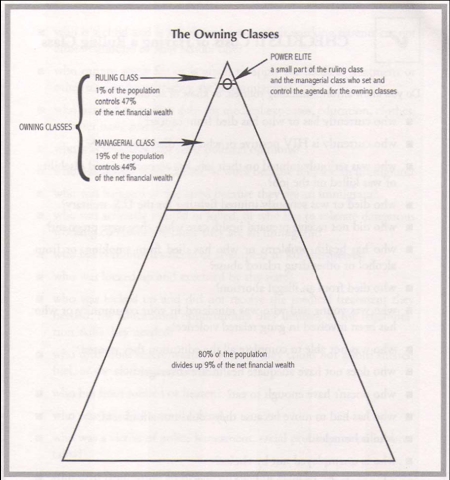
Illustration by Alberto Ledesma Read the rest of this entry »


 The End of Capitalism
Recent Comments