
You are currently browsing the category archive for the ‘Resistance’ category.
This is one of the most striking and intelligent articles I’ve ever read, encouraging a total reconfiguring of how to view capitalism and revolution. Russell Means was a leader in the American Indian Movement (AIM) of the 1960s and 70s, and remains one of the most outspoken Native Americans in the U.S.
I came across this essay while researching for my upcoming critique of Marxism, and was blown away by its clarity. This is Means’ most famous essay. It was published in Ward Churchill’s book “Marxism and Native Americans”, under the title “The Same Old Song”, and has appeared elsewhere under the names “Marxism is a European Tradition,” and “For America to Live, Europe Must Die.” Yet, it is actually not very available on the internet. I hope by republishing it I will raise some much-needed debate on the nature of the revolutionary project today.
I want to point out one difference I have with the essay, namely that the “European culture” Russell Means criticizes is capitalism, and before it could commit genocide and ecocide on the rest of the planet, this social system had to be imposed upon Europe first. Silvia Federici’s book Caliban and the Witch is key to my understanding of these violent origins of capitalism. The importance of this distinction is to clarify what Means says at the end of the essay, that he is not making a racial argument, but a cultural argument. For me, we need more than that, we need a political/economic argument which cuts to the core of why capitalism is destroying the planet and making us all miserable. Only then does revolutionary change appear possible. [alex]
“For America to Live, Europe Must Die”

Russell Means
Russell Means
Russell Means
Reproduced from Black Hawk Productions.
The following speech was given by Russell Means in July 1980, before several thousand people who had assembled from all over the world for the Black Hills International Survival Gathering, in the Black Hills of South Dakota. It is Russell Means’s most famous speech.
“The only possible opening for a statement of this kind is that I detest writing. The process itself epitomizes the European concept of “legitimate” thinking; what is written has an importance that is denied the spoken. My culture, the Lakota culture, has an oral tradition, so I ordinarily reject writing. It is one of the white world’s ways of destroying the cultures of non-European peoples, the imposing of an abstraction over the spoken relationship of a people.
So what you read here is not what I’ve written. It’s what I’ve said and someone else has written down. I will allow this because it seems that the only way to communicate with the white world is through the dead, dry leaves of a book. I don’t really care whether my words reach whites or not. They have already demonstrated through their history that they cannot hear, cannot see; they can only read (of course, there are exceptions, but the exceptions only prove the rule). I’m more concerned with American Indian people, students and others, who have begun to be absorbed into the white world through universities and other institutions. But even then it’s a marginal sort of concern. It’s very possible to grow into a red face with a white mind; and if that’s a person’s individual choice, so be it, but I have no use for them. This is part of the process of cultural genocide being waged by Europeans against American Indian peoples’ today. My concern is with those American Indians who choose to resist this genocide, but who may be confused as to how to proceed.
(You notice I use the term American Indian rather than Native American or Native indigenous people or Amerindian when referring to my people. There has been some controversy about such terms, and frankly, at this point, I find it absurd. Primarily it seems that American Indian is being rejected as European in origin–which is true. But all the above terms are European in origin; the only non-European way is to speak of Lakota–or, more precisely, of Oglala, Brule, etc.–and of the Dineh, the Miccousukee, and all the rest of the several hundred correct tribal names.
(There is also some confusion about the word Indian, a mistaken belief that it refers somehow to the country, India. When Columbus washed up on the beach in the Caribbean, he was not looking for a country called India. Europeans were calling that country Hindustan in 1492. Look it up on the old maps. Columbus called the tribal people he met “Indio,” from the Italian in dio, meaning “in God.”)
It takes a strong effort on the part of each American Indian not to become Europeanized. The strength for this effort can only come from the traditional ways, the traditional values that our elders retain. It must come from the hoop, the four directions, the relations: it cannot come from the pages of a book or a thousand books. No European can ever teach a Lakota to be Lakota, a Hopi to be Hopi. A master’s degree in “Indian Studies” or in “education” or in anything else cannot make a person into a human being or provide knowledge into traditional ways. It can only make you into a mental European, an outsider.
I should be clear about something here, because there seems to be some confusion about it. When I speak of Europeans or mental Europeans, I’m not allowing for false distinctions. I’m not saying that on the one hand there are the by-products of a few thousand years of genocidal, reactionary, European intellectual development which is bad; and on the other hand there is some new revolutionary intellectual development which is good. I’m referring here to the so-called theories of Marxism and anarchism and “leftism” in general. I don’t believe these theories can be separated from the rest of the of the European intellectual tradition. It’s really just the same old song.
The process began much earlier. Newton, for example, “revolutionized” physics and the so-called natural sciences by reducing the physical universe to a linear mathematical equation. Descartes did the same thing with culture. John Locke did it with politics, and Adam Smith did it with economics. Each one of these “thinkers” took a piece of the spirituality of human existence and converted it into code, an abstraction. They picked up where Christianity ended: they “secularized” Christian religion, as the “scholars” like to say–and in doing so they made Europe more able and ready to act as an expansionist culture. Each of these intellectual revolutions served to abstract the European mentality even further, to remove the wonderful complexity and spirituality from the universe and replace it with a logical sequence: one, two, three. Answer!
This is what has come to be termed “efficiency” in the European mind. Whatever is mechanical is perfect; whatever seems to work at the moment–that is, proves the mechanical model to be the right one–is considered correct, even when it is clearly untrue. This is why “truth” changes so fast in the European mind; the answers which result from such a process are only stopgaps, only temporary, and must be continuously discarded in favor of new stopgaps which support the mechanical models and keep them (the models) alive.
Hegel and Marx were heirs to the thinking of Newton, Descartes, Locke and Smith. Hegel finished the process of secularizing theology–and that is put in his own terms–he secularized the religious thinking through which Europe understood the universe. Then Marx put Hegel’s philosophy in terms of “materialism,” which is to say that Marx despiritualized Hegel’s work altogether. Again, this is in Marx’ own terms. And this is now seen as the future revolutionary potential of Europe. Europeans may see this as revolutionary, but American Indians see it simply as still more of that same old European conflict between being and gaining. The intellectual roots of a new Marxist form of European imperialism lie in Marx’–and his followers’–links to the tradition of Newton, Hegel and the others. Read the rest of this entry »

Also published by OpEdNews, Countercurrents, and The Rag Blog.
Take Back the Land: Land, Gentrification and the Umoja Village Shantytown
by Max Rameau
Nia Press, 2008
Review by Alex Knight, endofcapitalism.com
I first heard about a group called Take Back the Land, which was illegally moving homeless families into empty homes in Miami, in a study group about the Civil Rights movement and the grassroots organizing that made it so powerful. The reference was highly appropriate. In many ways, Take Back the Land is a direct heir of that bottom-up, Black self-empowerment, civil disobedient, movement-building tradition, and is one of the most inspiring examples of a group renewing and developing that tradition today.
In our moment of crisis and stagnation, here is a group full of creativity, improvisation, and highly potent political analysis. Through its actions, the group proclaims: ‘Families are being foreclosed on and kicked out onto the street? We’re not going to lobby Washington and hope for some crumbs to come down. We’ll take matters into our own hands and move people directly into homes!’ This is precisely the spirit of direct action and participatory democracy that kick-started the Civil Rights movement, and the spirit that we need if we are to escape the human suffering that the elite are imposing on the poor and working class in this economic crisis.
Max Rameau, author of this book and a principal organizer in Take Back the Land Miami, came and spoke in Philadelphia a few months ago. I was struck not only by how charismatic and effective a speaker he was (something I could say about many smooth-talking political or corporate salesmen of our age), but by how Max was able to break down complex, abstract theoretical questions into common language that was easily understood. In this way, he demystifies politics and translates concepts usually reserved for academics or professionals in such a way that average, everyday people can take away something new and useful from the exchange. It’s clear that his primary goal is not an ego-trip to show off his brilliance, or to sell books and make money, but to do something much more difficult and meaningful: to spark movement to force the US government to recognize housing as a human right.
This book is written in that same frank style. In fact, it’s basically a how-to on grassroots housing organizing. It’s short – only 132 pages – but all you need to know is laid out here: the political context of Miami and nationally in terms of lack of affordable housing and gentrification that drives poor and Black people out of their homes, the strategic decisions and organizing that go into launching a new organization and campaign, the challenges and joys of working with homeless people, and the difficult and deceptive terrain of interacting with politicians, who are often agents of larger and more powerful corporate forces. Max Rameau just tells the story of his group, but in such a provocatively specific way. He explains to us exactly how things were done, who did them, who interfered and how, and he’s not at all afraid to name names.
The book centers on the incredible story of the Umoja Village, a shantytown built by Take Back the Land and allies on a vacant lot in a poor Black section of Miami. Because “In South Florida… local governments responded to the [housing] crisis by actively decreasing the number of low-income housing units” (pg. 23), Take Back the Land took the initiative to seize land and invite homeless people to take up residence there. The purpose of the action was not only to house people, an immediate need, but to draw attention to the crisis and to the government’s inaction, thereby hopefully shaming them into creating more low-income housing. Read the rest of this entry »
Learning about the exploitation of the factory workers of China is important not only because, as Johann Hari describes, their brutish toil produces most of our cheap consumer goods in the West. As I argued in my recent interview (Part 2B: Social Limits and the Crisis), we have an even more important connection to these Chinese workers – the hope that their liberation offers the possibility of our own.
Organizing outside the Chinese Communist Party’s official union, workers have initiated a series of crippling strikes that repeatedly shut down factories, among other forms of rebellion. They are openly defying the totalitarian state-capitalist government of China, as well as the Western corporations whose factories they are closing. And they are winning. Wages are being increased by 40, 60, even 100% at some plants.
If the Chinese workers’ movement continues to disrupt the sweatshops pumping out our electronics and car parts, they could throw a wrench into the China->U.S. cheap goods conveyor belt that has carried global capitalist growth for more than a decade. The destruction of this global trade alliance will not only free the Chinese workers from the abominable conditions Hari describes, but potentially free the entire planet from an economic system hell-bent on relentless growth and plunder.

image from The Economist
In short, capitalism relies on China’s absurdly cheap labor for its profit margins. This unsanctioned frenzy of Chinese labor organizing is striking a blow in the heart of the system. More power to ’em! We should support these workers however possible. [alex]
And the Most Inspiring Good News Story of the Year is…
by Johann Hari, August 6, 2010
At first, this isn’t going to sound like a good news story, never mind one of the most inspiring stories in the world today. But trust me: it is.
Yan Li spent his life tweaking tiny bolts, on a production line, for the gadgets that make our lives zing and bling. He might have pushed a crucial component of the laptop I am writing this article on, or the mobile phone that will interrupt your reading of it. He was a typical 27-year old worker at the gigantic Foxconn factory in Shenzen, Southern China, which manufactures i-Pads and Playstations and mobile phone batteries.
Li was known to the company by his ID number: F3839667. He stood at a whirring line all day, every day, making the same tiny mechanical motion with his wrist, for 20 pence an hour. According to his family, sometimes his shifts lasted for 24 hours; sometimes they stretched to 35. If he had tried to form a free trade union to change these practices, he would have been imprisoned for twelve years. On the night of May 27th, after yet another marathon-shift, Li dropped dead.
Deaths from overwork are so common in Chinese factories they have a word for it: guolaosi. China Daily estimates 600,000 people are killed this way every year, mostly making goods for us. Li had never experienced any health problems, his family says, until he started this work schedule; Foxconn say he died of asthma and his death had nothing to do with them. The night Li died, yet another Foxconn worker committed suicide – the tenth this year.
For two decades now, you and I have shopped until Chinese workers dropped. Business has bragged about the joys of the China Price. They have been less keen for us to see the Human Price. KYE Systems Corp run a typical factory in Donguan in southern mainland China, and one of their biggest clients is Microsoft – so in 2009 the US National Labour Committee sent Chinese investigators undercover there. On the first day a teenage worker whispered to them: “We are like prisoners here.”
The staff work and live in giant factory-cities that they almost never leave. Each room sleeps ten workers, and each dorm houses 5000. There are no showers; they are given a sponge to clean themselves with. A typical shift begins at 7.45am and ends at 10.55pm. Workers must report to their stations fifteen minutes ahead of schedule for a military-style drill: “Everybody, attention! Face left! Face right!” Once they begin, they are strictly forbidden from talking, listening to music, or going to the toilet. Anybody who breaks this rule is screamed at and made to clean the toilets as punishment. Then it’s back to the dorm.
It’s the human equivalent to battery farming. Read the rest of this entry »
hey all,
check out this podcast of me being interviewed by Todd Curl. I’m excited to have my views recorded on audio for the first time. in this extensive 2-hour interview, I discuss:
- my hometown of Ambler, PA and its history with asbestos
- my life story of becoming politically aware and active
- peak oil and its interpretations
- the end of capitalism theory
- the nature of capitalism and enclosure
- resistance in China, Arizona, and around the world
- how radicals can use language to speak to everyday people
- healing from abuse and empowering ourselves to live better lives
here it is (click to play audio): Alex Knight Podcast
[alex]
Is Capitalism Approaching the Darkness of Knight?
Todd Curl
The Pigeon Post, August 2, 2010

Here is the interview I did with Alex Knight on Friday, July 30, 2010 at Alex’s home in Philadelphia:
At just 27 years old, Alex is already an accomplished writer and a full time activist for social justice. His site, The End of Capitalism, explores the theory of the unsustainable nature of a profit-driven global system that continues to exploit all of the earth’s resources for the sake of greed and power.
Having grown up in Ambler, Pennsylvania — the ‘Asbestos Capital of the World’ — Alex saw first hand the devastation of his home town through the greed of Keasbey and Mattison Corporation who continued to manufacture Asbestos through the 1970s despite the evidence that had existed for years that Asbestos causes Mesothelioma, a serious form of Lung Cancer.
Seeing the sickness of his community first hand eventually built the foundation for Alex’s future environmental and social activism. While at Lehigh University studying Electrical Engineering, Alex became more intellectually aware of the systemic patterns of exploitation and human/environmental devastation brought on by a long history of a Capitalist system concerned only with profit. Alex went on to get his Master’s in Political Science from Lehigh and now is a full-time activist in the Philadelphia area fighting for real and meaningful progressive change.
As Alex will tell you, there is nothing extraordinary about him. Being the quintessential “All American Boy” — he was born on the 4th of July — Alex discovered that real social change is ameliorated when we decide to join forces and fight the powers that are determined to keep us placated and in a constant state of fear so we will not question our own imprisonment of thought and continue to consume without thought or premeditation. For Alex, grassroots organizing and activism is the key to a sustainable future and when we define ourselves as left, right, Marxist, Anarchist, etc.. we just perpetuate petty semantic divides. Alex is proud to call himself “Progressive” as he is a tireless fighter for justice.
Republished by Energy Bulletin, Countercurrents and OpEdNews.
The following exchange between Michael Carriere and Alex Knight occurred via email, July 2010. Alex Knight was questioned about the End of Capitalism Theory, which states that the global capitalist system is breaking down due to ecological and social limits to growth and that a paradigm shift toward a non-capitalist future is underway.
This is the final part of a four-part interview. Scroll to the bottom for links to the other sections.
Part 3. Life After Capitalism
MC: Moving forward, how would you ideally envision a post-capitalist world? And if capitalism manages to survive (as it has in the past), is there still room for real change?
AK: First let me repeat that even if my theory is right that capitalism is breaking down, it doesn’t suggest that we’ll automatically find ourselves living in a utopia soon. This crisis is an opportunity for us progressives but it is also an opportunity for right-wing forces. If the right seizes the initiative, I fear they could give rise to neo-fascism – a system in which freedoms are enclosed and violated for the purpose of restoring a mythical idea of national glory.
I think this threat is especially credible here in the United States, where in recent years we’ve seen the USA PATRIOT Act, the Supreme Court’s decision that corporations are “persons,” and the stripping of constitutional rights from those labeled “terrorists,” “enemy combatants”, as well as “illegals.” Arizona’s attempt to institute a racial profiling law and turn every police officer into an immigration official may be the face of fascism in America today. Angry whites joining together with the repressive forces of the state to terrorize a marginalized community, Latino immigrants. While we have a black president now, white supremacist sentiment remains widespread in this country, and doesn’t appear to be going away anytime soon. So as we struggle for a better world we may also have to contend with increasing authoritarianism.
I should also state up front that I have no interest in “writing recipes for the cooks of the future.” I can’t prescribe the ideal post-capitalist world and I wouldn’t try. People will create solutions to the crises they face according to what makes most sense in their circumstances. In fact they’re already doing this. Yet, I would like to see your question addressed towards the public at large, and discussed in schools, workplaces, and communities. If we have an open conversation about what a better world would look like, this is where the best solutions will come from. Plus, the practice of imagination will give people a stronger investment in wanting the future to turn out better. So I’ll put forward some of my ideas for life beyond capitalism, in the hope that it spurs others to articulate their visions and initiate conversation on the world we want.
My personal vision has been shaped by my outrage over the two fundamental crises that capitalism has perpetrated: the ecological crisis and the social crisis. I see capitalism as a system of abuse. The system grows by exploiting people and the planet as means to extract profit, and by refusing to be responsible for the ecological and social trauma caused by its abuse. Therefore I believe any real solutions to our problems must be aligned to both ecological justice and social justice. If we privilege one over the other, we will only cause more harm. The planet must be healed, and our communities must be healed as well. I would propose these two goals as a starting point to the discussion.
How do we heal? What does healing look like? Let me expand from there.
Five Guideposts to a New World
I mentioned in response to the first question that I view freedom, democracy, justice, sustainability and love as guideposts that point towards a new world. This follows from what I call a common sense radical approach, because it is not about pulling vision for the future from some ideological playbook or dogma, but from lived experience. Rather than taking pre-formed ideas and trying to make reality fit that conceptual blueprint, ideas should spring from what makes sense on the ground. The five guideposts come from our common values. It doesn’t take an expert to understand them or put them into practice.
In the first section I described how freedom at its core is about self-determination. I said that defined this way it presents a radical challenge to capitalist society because it highlights the lack of power we have under capitalism. We do not have self-determination, and we cannot as long as huge corporations and corrupt politicians control our destinies.
I’ll add that access to land is fundamental to a meaningful definition of freedom. The group Take Back the Land has highlighted this through their work to move homeless and foreclosed families directly into vacant homes in Miami. Everyone needs access to land for the basic security of housing, but also for the ability to feed themselves. Without “food sovereignty,” or the power to provide for one’s own family, community or nation with healthy, culturally and ecologically appropriate food, freedom cannot exist. The best way to ensure that communities have food sovereignty is to ensure they have access to land.
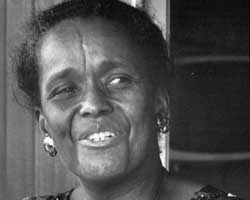
Ella Baker championed the idea of participatory democracy
Similarly, a deeper interpretation of democracy would emphasize participation by an individual or community in the decisions that affect them. For this definition I follow in the footsteps of Ella Baker, the mighty civil rights organizer who championed the idea of participatory democracy. With a lifelong focus on empowering ordinary people to solve their own problems, Ella Baker is known for saying “Strong people don’t need strong leaders.” This was the philosophy of the black students who sat-in at lunch counters in the South to win their right to public accommodations. They didn’t wait for the law to change, or for adults to tell them to do it. The students recognized that society was wrong, and practiced non-violent civil disobedience , becoming empowered by their actions. Then with Ms. Baker’s support they formed the Student Non-violent Coordinating Committee (SNCC) and organized poor blacks in Mississippi to demand their right to vote, passing on the torch of empowerment.
We need to be empowered to manage our own affairs on a large scale. In a participatory democracy, “we, the people” would run the show, not representatives who depend on corporate funding to get elected. “By the people, for the people, of the people” are great words. What if we actually put those words into action in the government, the economy, the media, and all the institutions that affect our lives? Institutions should obey the will of the people, rather than the people obeying the will of institutions. It can happen, but only through organization and active participation of the people as a whole. We must empower ourselves, not wait for someone else to do it. Read the rest of this entry »
Republished by Energy Bulletin, OpEdNews, and Countercurrents, and translated into Turkish for Hafif.org.
The following exchange between Michael Carriere and Alex Knight occurred via email, July 2010. Alex Knight was questioned about the End of Capitalism Theory, which states that the global capitalist system is breaking down due to ecological and social limits to growth and that a paradigm shift toward a non-capitalist future is underway.
This is the third part of a four-part interview. This part is a continuation of Alex’s response to the second question. Click here for Part 2A. Scroll to the bottom for links to the other sections.
Part 2B. Social Limits and the Crisis
MC: Capitalism has faced many moments of crisis over time. Is there something different about the present crisis? What makes the end of capitalism a possibility now?
AK: As I described in the last section, the current crisis can be understood as resulting from a massive collision between capitalism’s relentless need for growth and the world’s limits in capacity to sustain that growth. These limits to growth are both ecological and social. In this section I’ll discuss the concept of social limits to growth.
The Extraordinary Power of Social Movements
Social limits to growth function alongside the ecological limits but are drawn from a different source. By social limits we mean the inability, or unwillingness, of human communities, and humankind as a whole, to support the expansion of capitalism. This broadly includes all forms of resistance to capitalism, a resistance that has arguably been increasing around the world through innumerable forms of alternative lifestyles, refusal to cooperate, protest, and outright rebellion.
As a disclaimer it’s important to recognize that not all resistance is progressive. There are right-wing, fundamentalist, and undemocratic forces that also resist capitalism, for example the Taliban, or North Korea. These are not our allies. They do not share progressive values, we cannot condone their attacks on women, or on freedom more generally, and I don’t see anything to be gained by working with them. However it is important to recognize how these forces are aligned against capitalism and U.S. imperialism, in addition to being aware of the danger they present to our own hopes and dreams.
Progressive resistance, on the other hand, has always taken its strength from grassroots social movements. Silvia Federici writes about the immense and varied peasant movements in medieval Europe that fought for religious and sexual freedom, challenging both feudal lords and emerging capitalist elites. I like to think of these rebels as my European ancestors – they were just commoners but they rose up to fight for a better world. This is the nature of social movements. Ordinary folks, daring to pursue their deepest aspirations, interests and dreams, join together with others who share those desires, and thereby create something extraordinary. The magic exists in the joining-together. Isolated individuals lack the power to accomplish what a group can achieve.
We can appreciate this extraordinary power if we look at how social movements have transformed our lives. A century ago, millions of American workers joined the labor movement and won the 8-hour day, Social Security, and workplace safety. Regular folks carried forward the Civil Rights Movement and broke Southern segregation. The feminist and LGBT movements have transformed the way gender and sexuality are viewed all over the world. It’s hard to overstate how dramatically these and other social movements have improved society. While capitalism has invented ways to co-opt social movements and redirect them into outlets that do not challenge the system on a deep level (like the “non-profit industrial complex”), movements have remained alive and vibrant by empowering people to reach towards a different world.
Have social movements limited capitalist oppression recently? To answer this we need to learn the story of the Global Justice Movement.

Demonstrators tear down a section of security fence in the Mexican resort city of Cancun to confront the World Trade Organization’s Fifth Ministerial summit on Sept. 10, 2003.
The Global Justice Movement
David Graeber, anarchist anthropologist, wrote a remarkable essay called “The Shock of Victory” in which he looks at this movement that suddenly flared up at the turn of the millennium and seemed to disappear just as quickly. Although most Americans may not remember the Global Justice Movement, and those who participated in it may feel demoralized by the fact that capitalism still exists, Graeber points out that many of the movement’s ambitious goals were accomplished. Read the rest of this entry »
The tar sands are an abomination. In a desperate move to counteract peak oil, Canada and the United States are waging war on Alberta’s ecosystem and indigenous communities, as well as on the planet as a whole. This crime must be stopped.
Clayton Thomas-Muller also recently spoke on Democracy Now!, see the video. [alex]

greenpeace.org
Tar Sands: The World’s Largest Climate Crime
By Clayton Thomas-Muller
Published originally in Left Turn Magazine, Jan/Feb 2010
Often when one looks at the global climate crisis and the critical necessity of forests as carbon storehouses, we have visions of the Amazon rainforest in South America, or the vast rainforest cover in places like Malaysia, Indonesia, across south East Asia and Africa. What many don’t envision is the second largest carbon storehouse on Mother Earth located in Canada’s northern region known as the Boreal Forest.
This soggy, wet, biologically diverse region spreads across the continent east to west. It is home to hundreds of First Nations/Indigenous communities that have utilized these ecologically diverse regions for their livelihood from time immemorial. Many also do not know that the Boreal Forest is second only to the Amazon region in terms of daily forest loss due to industrial expansion. This tree loss is further exacerbated by an infestation of the spruce pine beetle, brought on by milder winters in the north, which has been destroying millions of hectares of trees from southeast Alaska all the way to western Alberta.
Also found beneath the pine-covered ground are vast stores of minerals and fossil fuel deposits, the most famous of which is known as Canada’s Athabasca Tar Sands in Northern Alberta. Second only to Saudi Arabia in terms of recoverable oil reserves, Canada’s tar sands have an estimated 177 billion barrels of recoverable oil. The main difference between these two sources is the fact that the tar sands in Canada are not a conventional form of oil; they are a tarry clay and sand like mixture that at room temperature is hard as a hockey puck.
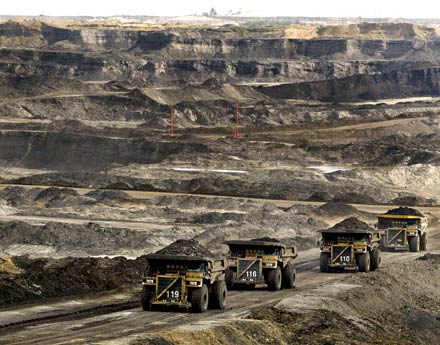
To remove this oil, one of two methods must be used. The first is surface mining, where industry removes the top layer of muskeg, trees, clay and sand as well as lakes, streams and even rivers to depths of up to 300 feet. They then use the world’s largest steam shovels, earth movers and dump trucks (300 tons per load) to strip mine out the mix that is then hauled off to industrial upgrader facilities and processed into synthetic oil. In the end it works out to around 5 tons of earth for every barrel of oil. Every day they move enough earth to fill the famous home of the Toronto Blue Jays, the Rogers Sky Dome.
ran.org
If the deposits are more than a depth of 300 feet, producers must use a deep well injection process called “In Situ” or Steam Assisted Gravity Drainage (SAG-D). This process is six times more carbon and water intensive then conventional oil extraction. The industry must also utilize vast amounts of natural gas to superheat fresh water to be injected into Mother Earth to “melt” the bitumen that then is sucked out of the ground with uptake pipes for upgrading.
Thanks to the 600 million cubic feet of natural gas is burned every day for this type of extraction, the tar sands is the single largest source of carbon dioxide emissions in Canada, and the primary reason Canada is not fulfilling its legally binding emission reduction targets under the Kyoto Protocol. By 2030 at the current rate of expansion, the tar sands will be responsible for an emission level between 100-187 million tons of CO2 every year.
Probably most disturbing part of this extraction process are the runoff streams created by the use of water in the separation process. Once water is no longer usable it is dumped into a vast network of ten tailings ponds that can be seen from outer space. Every day these tailings ponds leak eleven million liters of contaminated water into the Athabasca River and ground water in the surrounding area. By the year 2030 if the tar sands continue to grow at the current rate of expansion these tailings ponds volume combined will represent a body of water as large as Lake Ontario.
Frontline Nightmares
As a result of this “Tarmageddon,” many local Indigenous communities have seen an increase in the presence of deadly forms of cancers and other autoimmune diseases in their populations. Many have observed the negative effects on critical traditional food sources such as the fish, moose, muskrat, beaver and plants that they depend on for sustenance and cultural needs. Moose have been found to have levels of arsenic 400 times the acceptable level as well as sores and tumors. Muskrat have been found with bloody noses and their homes smelling of petroleum. Fish with lesions and deformities are a common thing for fisherman in the region. The effect this has on First Nations/Indigenous communities is amplified when considering our fundamental connection to the sacredness of Mother Earth expressed through our reliance on traditional hunting, fishing and gathering practices. Read the rest of this entry »
A short article I wrote for local Philly paper The Defenestrator, with a few tips on how to avoid paying back student loans. Student debt functions as an enclosure on youth – it keeps post-college youth from pursuing their dreams or working with others for a better world, because they feel pressured to pay their debt back. This affects students even before they graduate – rather than study what they care about, students feel immense pressure to study a subject that will land them a good job.
A few statistics:
- By 2008 average college tuition had increased by 439% since the 1980s, meaning it’s over 5 times as expensive as a generation ago. This doesn’t include books, housing, meal plans, etc.
- Graduating college seniors in 2008 had an average debt of $23,200. 67% of seniors graduated with student debt. (Project on Student Debt)
- As recently as 1993, less than half of seniors graduated with debt.
- Prior to 1980, 80% of government financial aid was given in the form of grants and scholarships that did not have to be repaid. Today, 80% of gov’t financial aid comes in the form of loans.
- 78% of undergraduates worked full or part-time jobs while taking classes in 2003-04. In 1984, it was 49%.
- In 1970, 40% of new college students considered “being very well-off financially” to be very important, and about 70% considered “developing a meaningful philosophy of life” to be very important. In 2005, 70% considered “being very well-off financially” to be very important, and about 40% considered “developing a meaningful philosophy of life” very important.
Please comment if you have other suggestions on how to break free of student debt! [alex]
Break the Chains of Student Debt!
Alex Knight, June 3, 2010
Paying back student loans can be a real downer. Loans can make organizing after college virtually impossible as they force debtors to work a full-time corporate or nonprofit job, or join the military just to pay them off. When I graduated from college, I had $50,000 worth of student loan debt. I felt I was forced to get a full-time job, and pay them off as quickly as possible so in the future I could finally dedicate myself to social change work. Luckily I didn’t have to make this choice, as there are other options available! Here are a few worth knowing about.
First, you can defer or get a forbearance, to delay payments. Often with these you can delay paying your loans for years, although interest may accrue during that time, and you may be forced to make special payments. For example Sallie Mae used to require you to pay $100 for a 6-month forbearance on private loans, but now they’ve chopped this to $200 for only a 3-month forbearance, which often makes it almost pointless. Nevertheless, you can often easily qualify for an “unemployment” deferment, even if you are working part-time.
Second, you can try to run from your loans altogether and go into default. The only problem with this, besides destroying your credit rating, is if you have co-signers on your loans, such as parents. If you go into default, you’d also be screwing them over.
A third option has recently emerged, which should be taken advantage of as much as possible. It’s called Income-Based Repayment, and it can be used to reduce or eliminate your monthly payments for most Federal loans (not those pesky private ones, unfortunately). Through the federal government’s Direct Loan program, which was recently enlarged by Obama’s Health Care reform, you can consolidate your federal loans into an IBR (or Income-Contigent Repayment – ICR) plan. Payments then become “based” or “contingent” on your income, so if you work part-time and don’t make a lot of money, you won’t have to pay a lot, and you could even eliminate your monthly payments entirely if you earn less than 150% of the poverty line. If you’re a full-time activist like me, you almost certainly qualify. And after 25 years, your debt will be forgiven.
So check out IBR, and don’t let student loans stop you from dedicating your life to building the social movements our communities and world so desperately need!
Income-Based Repayment
 Income-Based Repayment (IBR) is a new payment option for federal student loans. It can help borrowers keep their loan payments affordable with payment caps based on their income and family size. For most eligible borrowers, IBR loan payments will be less than 10 percent of their income – and even smaller for borrowers with low earnings. IBR will also forgive remaining debt, if any, after 25 years of qualifying payments.
Who can use IBR? IBR is available to federal student loan borrowers in both the Direct and Guaranteed (or FFEL) loan programs, and covers most types of federal loans made to students, but not those made to parents. To enter IBR, you have to have enough debt relative to your income to qualify for a reduced payment. That means it would take more than 15 percent of whatever you earn above 150% of poverty level to pay off your loans on a standard 10-year payment plan. Use our calculator to see if you’re likely to be eligible.
How does IBR make payments more affordable? IBR uses a kind of sliding scale to determine how much you can afford to pay on your federal loans. If you earn below 150% of the poverty level for your family size, your required loan payment will be $0. If you earn more, your loan payment will be capped at 15 percent of whatever you earn above that amount.
Except for the highest earners, that usually works out to less than 10 percent of your total income. Read the rest of this entry »


 The End of Capitalism
Recent Comments