You are currently browsing the category archive for the ‘Resistance’ category.
[This is a huge victory, Mountaintop Removal is a horrible destructive practice of coal mining in Appalachia that destroys communities and the environment. Organizers, including Rainforest Action Network and many members and chapters of Students for a Democratic Society (SDS), have been fighting this for a long time through creative nonviolent actions and pressure, and today we can celebrate a major victory as Bank of America caves to our demands! – alex]
From Bank of America’s website:
“Bank of America is particularly concerned about surface mining conducted through mountain top removal in locations such as central Appalachia. We therefore will phase out financing of companies whose predominant method of extracting coal is through mountain top removal. While we acknowledge that surface mining is economically efficient and creates jobs, it can be conducted in a way that minimizes environmental impacts in certain geographies.”
We are thrilled that just two and a half weeks after RAN’s day of action against coal and coal finance, Bank of America has made a public commitment to stop financing the devastating practice of mountaintop removal mining. This has been a major demand of the banks for the Global Finance campaign and we applaud Bank of America as it takes a step in the right direction – a step away from coal. Congratulations to everyone who has helped to pressure Bank of America to end it’s financing of coal and mountaintop removal – this is a truly incredible grassroots victory!
We will have more information about Bank of America’s announcement soon, as we work with our team and our allies to respond. For now, let’s celebrate!
Originally posted by Annie on Rainforest Action Network’s website.
 “Defying Dixie: The Radical Roots of Civil Rights (1919-1950)”
by Glenda Gilmore
2008 W.W. Norton
I picked up this book randomly when I saw it in the library, and it turned out to be a worthwhile read. Gilmore, a white female professor from North Carolina, surveys the “radical roots of civil rights” through the efforts of the Communist Party in the South during the 1920s through 1940s.
Gilmore tells the story by focusing on a few individual black radicals who have been forgotten by history, especially Lovett Fort-Whiteman and Pauli Murray.
Whiteman, an extravagant early supporter of the Soviet Union, founded some of the first communist organizations for African Americans, before being scared out of the country by the feds, becoming a darling in the Soviet Union, then ultimately winding up in one of Stalin’s gulags in Siberia, where he worked/starved to death.
Murray had more luck, despite being a transgendered black woman in the South in the 1940s. With a bold attitude, she attempted to integrate various institutions, like the University of North Carolina Law program, and although she herself was not successful in these efforts, her example paved the way for future victories within the Black Freedom Movement.
We also learn quite a bit about Langston Hughes, Thurgood Marshall, A. Philip Randolph, Max Yergan, and many other heroic characters who fought early and often for equality in the apartheid South.
More interesting to me though was what I learned about movement strategy, for example we explore how the first integrated unions in the South scared the bejesus out of the capitalists, or what it meant for the Communist Party to bring the country’s attention to the case of the Scottsboro “Boys”, or how the “Popular Front” strategy of allying with liberals succeeded, and failed.
The writing is interesting, but could be more purposeful. Defying Dixie focuses probably too much on the Communists, and not on other radicals, but still this book really clarified for me important stuff like the Depression, the South in the 1930s, and the early Civil Rights Movement, and how once-radical ideas like social equality of the races is now accepted fact (even though still not fully realized).
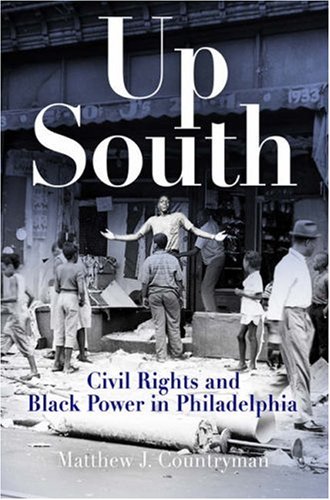
“Up South: Civil Rights and Black Power in Philadelphia”
by Matthew J. Countryman
2007 University of Pennsylvania
This book was not quite what I expected, but I’m not sure what I was expecting. The strength of Up South is that it gives a broad overview of the 1940s-60s civil rights/black power movement in Philadelphia, which was very helpful for me as someone who wanted to learn more about the history of the city I’m living in, especially about the work against racism in one of the most racially divided cities in America.
The book captures a really interesting narrative from postwar liberalism to early-60s protest, to late-60s radicalism, to 70s electoral politics. Along the way we meet some of the most important players, like Cecil B. Moore, Philadelphia Welfare Rights Organization, and Council of Organizations Philadelphia Police Accountability and Responsibility (COPPAR). We learn a bit about their strategies, we learn about the white backlash and Frank Rizzo, and attempts by the system to co-opt and dilute the movement through politics and money.
However, the book also lacks in some substantial ways. For one thing, the author is a professor in Michigan, who as far as I know is not from Philadelphia and is not black. This doesn’t mean he has nothing valuable to contribute from his research, but it does mean the writing is overly academic and emotionally detached.
My other major complaint is that while the book doesn’t heat up until about pg. 120 with chapter 4, the conclusion is way too short and very unsatisfying. It’s only 1 page, front and back, and only hints at the issues which are crying out to be examined.
For example, did the huge protests and deep radicalism of the late 60s really get co-opted into pointless electoral campaigns? How is that possible, and why did it happen?
Why wasn’t there sustained grassroots pressure to hold the newly-elected black politicans accountable, or if there was, why did it fail?
How did the Rizzo Mayorship of the 70s affect the black freedom movement in Philly? In what ways did Rizzo gain greater power in moving from his position as Police Commissioner, and in what ways was he held more accountable as Mayor? More generally, how much did it matter who was in charge of the city government, as far as the movements were concerned?
These are just a few questions that I wish had been addressed in the book more substantially, but I think the fact that the book left me wanting to know more actually points to the success of the book in captivating my interest.
This wasn’t the holistic and movement-centered study that I was looking for, but it helped me clarify my questions on the subject so I recommend it for anyone living in Philadelphia and wanting to know more about the history of their city.
The US government is becoming more and more a tool for huge corporations and banks to eliminate their risk despite insanely short-sighted and self-serving policies. The American public will not accept our money being handed to those who don’t deserve it, and never intend to pay us back. That is fascism.
“We, the people” need a bailout too. Today I attended a rally in Philadelphia, to stop the mayor from making budget cuts to close down 11 libraries around the city. How are you supposed to provide educational opportunities for inner-city youth if you’re closing libraries? Closing doors, eliminating opportunities for advancement – this fuels the cycle of violence and crime.
We have to demand money for human needs, not corporate greed! It’s our government, it must work for us, not just the rich. [alex]
Originally published by Forbes.
Washington’s $5 Trillion Tab
Elizabeth Moyer, 11.12.08
Fighting the financial crisis has put the U.S. on the hook for some $5 trillion a report says. So far.
For all the fury over Treasury Secretary Henry Paulson’s $700 billion emergency economic relief fund, it seems downright puny when compared to the running total of the government’s response to the credit crisis.
According to CreditSights, a research firm in New York and London, the U.S. government has put itself on the hook for some $5 trillion, so far, in an attempt to arrest a collapse of the financial system.
The estimate includes many of the various solutions cooked up by Paulson and his counterparts Ben Bernanke at the Federal Reserve and Sheila Bair at the Federal Deposit Insurance Corp., as the credit crisis continues to plague banks and the broader markets. Read the rest of this entry »
A petition by Friends of the RNC 8 has been put together calling for the Ramsey County Attorney Susan Gaertner to drop all the charges against the RNC 8. Defend The RNC8! Dismiss the Charges! : http://www.thepetitionsite.com/1/defendthernc8
The goal is 100,000 signatures. Please take a moment to sign the petition. Then help get the word out by forwarding the petition to friends and family.
For updates on the case visit: http://rnc8.org . To get automatic email updates, sign up here: http://rnc8.org/get-updates/
The legal costs for the RNC 8 are estimated at $250,000. Donations can be made via PayPal or you can mail in a check (there is even a tax deductible option). All the information you need is at: http://rnc8.org/donations/ Donations of all sizes are greatly appreciated.
Recent article:
RNC Terrorists? Or just young people speaking their minds?
Three activists nabbed in pre-convention raid deny any plans for violence
At times, they laugh at how ridiculous it seems.
But Monica Bicking and Garrett Fitzgerald weren’t laughing when police broke down the door of their South Minneapolis house before 8 a.m. Aug. 30, stormed inside and pointed guns in their faces.
“I was woken up out of a deep sleep to screaming and banging,” Bicking said. “It’s scary.”
Max Specktor was not there when police came to his house two miles away. But he was arrested two days later, on Sept. 1. “I was leaving in a car, and they pulled the car over right away,” he said.
Bicking, Fitzgerald and Specktor are three of eight young Minneapolis residents charged in Ramsey County with conspiracy to commit riot “in furtherance of terrorism,” allegedly to disrupt last month’s Republican National Convention in St. Paul.
The unusual charge stems from a 2002 Minnesota terrorism law, a version of the federal Patriot Act passed after the Sept. 11 terrorist attacks.
“These charges are an effort to equate publicly stated plans to blockade traffic and disrupt the RNC as being the same as acts of terrorism,” said Bruce Nestor, an attorney with the National Lawyers Guild who is representing Bicking, in a recent statement. Read the rest of this entry »
US Senate — Working for Wall St., not us
Jerry Silberman, Oct. 2, 2008
The Wall St. Rescue bill which gained new life with the Senate rubber stamp yesterday will neither halt the decline of the US economy nor penalize the financial gamblers who have been the most immediate cause of this disaster.
Here are two important historical comparisons —
In the late 70’s and early ’80’s, the offensive by big business against workers took the form of demanding concessions in wages and benefits mostly from industrial unions, claiming that if factories weren’t made more “competitive” through reduction of labor costs, they would go out of business. Of course, no employer guaranteed the future of the plant of the job, we were supposed to trust them. Of course, it was a scam. Plants that took concessions closed. Plants that didn’t closed. The economic transformation was based in much larger issues. In plants that closed after concessions, the bosses simply walked away with more, and the workers were left with less. The money stolen by the bosses as a result of concessions helped fund the elimination of thousands of jobs through automation, as well as the transfer of manufacturing plants out of the country. The labor movement at the time was unprepared to fight back, since it bought into the general principles of the bosses, and is still suffering, despite renewed energy in certain unions.
The several “bail outs” that have happened over the past year are identical to those concessions — big business is threatening us with dire consequences if we don’t protect them, while making no promise that anything will get better if we do. Each bailout is bigger than the last, and more futile — except for the corporate executives who are continuing to stash the cash. Each bailout imposes more costs on us, now and in the future, as positive government programs are sacrificed and more debt is imposed on our tax dollar. Right now about 51 cents of every tax dollar goes to the military. Interest on the national debt, that is tax dollars which go directly to pay the government bond holders is the third largest item in the federal budget, right now one half trillion per year. Since about 140 million people file federal income tax returns annually, this means that on average, about $2000 of your taxes are already going to pay off bondholders on Wall St, in Saudi Arabia, China, and many other countries. This number will jump as a result of this bailout. That’s all money not available for schools, health care, environmental protection, etc.
In the early ’30’s the economy collapsed in what is commonly referred to as the Great Depression. Unlike this collapse that began early in the term of Herbert Hoover. By the time of the next presidential election, millions of Americans were impoverished and beginning to organize to fight back. They were marching in the streets for unemployment insurance, refusing to allow people to be evicted from their homes by blockading homes from the sheriff, WWI vets marched on Washington demanding relief and were fired on by current troops under the command of Gen. MacArthur (later of WWII fame) Radical political movements were growing. The new president recognized that some concessions had to be made to the working class by big business or the US would risk a revolutionary situation. Roosevelt, pressured by those movements of ordinary people who couldn’t take it any more, finally convinced Congress to enact several reforms, including unemployment insurance, Social Security, and tough banking regulations (repealed in the Reagan and Bush administrations) to stabilize the economy.
Although there are many very important differences in the current situation from those historical times, there are some very important common threads, the most important being that collective action by working people to challenge the rich and powerful is the key to any change which can create a more stable, secure and healthy life for us. And our goal must be based on a comprehensive vision of a just society, not just trying to protect a niche for ourselves.
I’ve reposted a nice article which highlights the class dynamics at the heart of the current financial meltdown and potential bailout. It gives a very simple and straightforward summary from a revolutionary point of view, so I’m reposting it.
This is by no means a complete analysis however – for example it overlooks the critical role of oil, which is the lifeblood of the US capitalist economy and motivates many of its military aggression around the world. Specifically, there is a need to understand how the peak in global oil production has affected and continues to undermine the US-led industrial capitalist system, particularly in regards to the bursting of the housing bubble in the first place, along with the rising gas prices, food prices, heating costs, and subsequent inflation of the failing dollar.
Because oil production will never recover to its 2005/6 level, but will continue to decrease more rapidly, there can be no long-term recovery of the global financial markets, and for that reason I disagree with the declaration here that “Capitalism will not collapse…” On the contrary, it WILL collapse, because any system that structurally depends upon constant growth and speculation-upon-that-growth cannot coexist forever on a finite planet where necessary and crucial resources are in permanent and deepening shortage.
The current economic crisis is often compared to other historical crises of capitalism, where after appearing on the verge of death, the system restored itself and came back stronger than ever. Thus we are warned that capitalism is a self-destructive beast, but not a suicidal one. On its face this is solid logic but it overlooks the specific nature of the current crisis and its roots in the global peak oil phenomenon. It is my contention and the purpose of this website to demonstrate that the oil crisis is sucking global industrial capitalism dry like the vampire it is, and that there is no combination of “alternative” energy sources – whether coal, gas, nuclear, ethanol, wind, solar, whatever – that can do for this system what oil does.
Oil is not only the largest energy source, it also provides the material for 99% of pesticides (along with the entire industrial agriculture system), all plastics, almost all pharmaceutical drugs and chemicals, and a massive array of other products and components that keep the industrial economy chugging along. But the real killer is that oil literally fuels almost all transportation of materials and people for this system, including 95% of transportation in the US itself, as well as essentially ALL global air and sea transport. There is simply no way to keep this monster running without more and more petroleum.
Now, just because we’re confident that capitalism won’t recover from the current death-blows doesn’t mean a more vicious and destructive system won’t replace it, which is why this article’s conclusions are relevant and necessary. If we’re headed in the US towards fascism – which is where the rich and their Washington cronies seem to want to take us to protect their wealth and power – the only solution, which will become more and more apparent daily, is to organize a massive resistance here in the US that can stop the vampires and build towards a society based on freedom, justice and democracy.
[alex]
SOME TALKING POINTS ON THE FINANCIAL CRISIS
By Kate Griffiths and Isaac Silver
1. The era of the United States as a “the world’s only superpower” is ending.
The United States economy has not been this bad since the Great Depression. The rulers of the US hoped to retain global power militarily, through the wars in Iraq and Afghanistan, as the country’s raw economic superiority slipped. But these wars cannot be won: opposition among the occupied populations, and growing dissent within the military, prevent any victory on US terms even as the death toll climbs.
2. Beginning during the 1970s, manufacturing stalled, while government and investors focused on the financial sector: banks, real estate, and insurance.
Increasing competition, strong unions, and victories of the Black freedom movement had begun to limit the profits made by US corporations and threaten the power of the ruling class. In response, employers shifted good-paying manufacturing jobs overseas and to nonunionized areas of the USA. As wages stagnated, and workers’ purchasing power declined, workers maintained a precarious hold on our livelihood through working longer hours, sending more household members to work, and buying extensively on credit. The globalization of US capitalism and growth of credit both fueled the financial sector, which provided fluid economic resources that could be quickly moved and re-invested – unlike a physical investment such as a factory or railroad.
3. In 2008, years of government policies favoring the rich provoked instability and sparked collapse of major Wall Street institutions.
As the cost of the basic necessities went up, and wages failed to cover them Read the rest of this entry »
See this website to find the nearest Emergency Rally, or organize one yourself!
Originally an email by Arun Gupta of The Indypendent, September 22, 2008.
Forward widely….
Everyone,
This week the White House is going to try to push through the biggest robbery in world history with nary a stitch of debate to bail out the Wall Street bastards who created this economic apocalypse in the first place.
This is the financial equivalent of September 11. They think, just like with the Patriot Act, they can use the shock to force through the “therapy,” and we’ll just roll over!
Think about it: They said providing healthcare for 9 million children, perhaps costing $6 billion a year, was too expensive, but there’s evidently no sum of money large enough that will sate the Wall Street pigs. If this passes, forget about any money for environmental protection, to counter global warming, for education, for national healthcare, to rebuild our decaying infrastructure, for alternative energy.
This is a historic moment. We need to act now while we can influence the debate. Let’s demonstrate this Thursday at 4pm in Wall Street (see below).
We know the congressional Democrats will peep meekly before caving in like they have on everything else, from FISA to the Iraq War.
With Bear Stearns, Fannie and Freddie, AIG, the money markets and now this omnibus bailout, well in excess of $1 trillion will be distributed from the poor, workers and middle class to the scum floating on top.
This whole mess gives lie to the free market. The Feds are propping up stock prices, directing buyouts, subsidizing crooks and swindlers who already made a killing off the mortgage bubble.
Worst of all, even before any details have been hashed out, The New York Times admits that “Wall Street began looking for ways to profit from it,” and its chief financial correspondent writes that the Bush administration wants “Congress to give them a blank check to do whatever they want, whatever the cost, with no one able to watch them closely.”
It’s socialism for the rich and dog-eat-dog capitalism for the rest of us.
Let’s take it to the heart of the financial district! Gather at 4pm, this Thursday, Sept. 25 in the plaza at the southern end of Bowling Green Park, which is the small triangular park that has the Wall Street bull at the northern tip.
By having it later in the day we can show these thieves, as they leave work, we’re not their suckers. Plus, anyone who can’t get off work can still join us downtown as soon as they are able.
There is no agenda, no leaders, no organizing group, nothing to endorse other than we’re not going to pay! Let the bondholders pay, let the banks pay, let those who brought the “toxic” mortgage-backed securities pay!
On this list are many key organizers and activists. We have a huge amount of connections – we all know many other organizations, activists and community groups. We know P.R. folk who can quickly write up and distribute press releases, those who can contact legal observers, media activists who can spread the word, the videographers who can film the event, etc.
Do whatever you can – make and distribute your own flyers, contact all your groups and friends. This crime is without precedence and we can’t be silent! What’s the point of waiting for someone else to organize a protest two months from now, long after the crime has been perpetrated?
We have everything we need to create a large, peaceful, loud demonstration. Millions of others must feel the same way; they just don’t know what to do. Let’s take the lead and make this the start!
AGAIN:
When: 4pm – ? Thursday, September 25.
Where: Southern end of Bowling Green Park, in the plaza area
What to bring: Banners, noisemakers, signs, leaflets, etc.
Why: To say we won’t pay for the Wall Street bailout
Who: Everyone!


 The End of Capitalism
Recent Comments