
You are currently browsing the category archive for the ‘New World’ category.
Walden Bello explains the logic of breaking with corporate globalization and points the way towards a more socially and ecologically responsible economic paradigm. Includes “11 pillars of deglobalization.” [alex]
The Virtues of Deglobalization
by Akbayan! Representative Walden Bello
originally posted on Foreign Policy in Focus
reposted from Focus on the Global South.
The current global downturn, the worst since the Great Depression 70 years ago, pounded the last nail into the coffin of globalization. Already beleaguered by evidence that showed global poverty and inequality increasing, even as most poor countries experienced little or no economic growth, globalization has been terminally discredited in the last two years. As the much-heralded process of financial and trade interdependence went into reverse, it became the transmission belt not of prosperity but of economic crisis and collapse.
End of an Era
In their responses to the current economic crisis, governments paid lip service to global coordination but propelled separate stimulus programs meant to rev up national markets. In so doing, governments quietly shelved export-oriented growth, long the driver of many economies, though paid the usual nostrums to advancing trade liberalization as a means of countering the global downturn by completing the Doha Round of trade negotiations under the World Trade Organization. There is increasing acknowledgment that there will be no returning to a world centrally dependent on free-spending American consumers, since many are bankrupt and nobody has taken their place.
Moreover, whether agreed on internationally or unilaterally set up by national governments, a whole raft of restrictions will almost certainly be imposed on finance capital, the untrammeled mobility of which has been the cutting edge of the current crisis.
Intellectual discourse, however, hasn’t yet shown many signs of this break with orthodoxy. Neoliberalism, with its emphasis on free trade, the primacy of private enterprise, and a minimalist role for the state, continues to be the default language among policymakers. Establishment critics of market fundamentalism, including Joseph Stiglitz and Paul Krugman, have become entangled in endless debates over how large stimulus programs should be, and whether or not the state should retain an interventionist presence or, once stabilized, return the companies and banks to the private sector. Moreover some, such as Stiglitz, continue to believe in what they perceive to be the economic benefits of globalization while bemoaning its social costs.
But trends are fast outpacing both ideologues and critics of neoliberal globalization, and developments thought impossible a few years ago are gaining steam. “The integration of the world economy is in retreat on almost every front,” writes the Economist. While the magazine says that corporations continue to believe in the efficiency of global supply chains, “like any chain, these are only as strong as their weakest link. A danger point will come if firms decide that this way of organizing production has had its day.”
“Deglobalization,” a term that the Economist attributes to me, is a development that the magazine, the world’s prime avatar of free market ideology, views as negative. I believe, however, that deglobalization is an opportunity. Indeed, Read the rest of this entry »
This article only scratches the surface of why capitalism as a system based in constant expansion is absolutely incompatible with a planet of real social and ecological limits, peak oil being one. My book will flesh these arguments out in greater detail, but for now check out what Professor Wolff has been cooking up. [alex]
Peak Oil and Peak Capitalism
by Professor Richard Wolff, March 27, 2009.
Originally posted on The Oil Drum, and on Rick Wolff’s homepage.
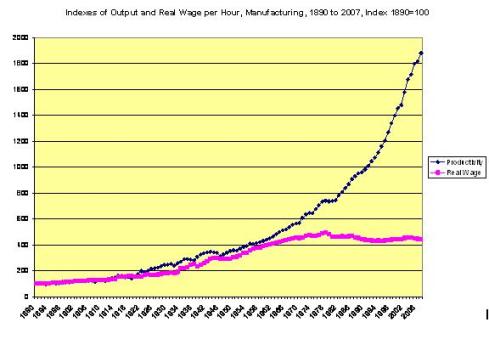
Worker Productivity (blue) vs. Wages (pink), 1890-2009
The concept of peak oil may apply more generally than its friends and foes realize. As we descend into US capitalism’s second major crash in 75 years (with another dozen or so “business cycle downturns” in the interval between crashes), some signs suggest we are at peak capitalism too. Private capitalism (when productive assets are owned by private individuals and groups and when markets rather than state planning dominate the distribution of resources and products) has repeatedly demonstrated a tendency to flare out into overproduction and/or asset inflation bubbles that burst with horrific social consequences. Endless reforms, restructurings, and regulations were all justified in the name not only of extricating us from a crisis but also finally preventing future crises (as Obama repeated this week). They all failed to do that.
The tendency to crisis seems unstoppable, an inherent quality of capitalism. At best, flare outs were caught before they wreaked major havoc, although usually that only postponed and aggravated that havoc. One recent case in point: the stock market crash of early 2000 was limited in its damaging social consequences (recession, etc.) by an historically unprecedented reduction of interest rates and money supply expansion by Alan Greenspan’s Federal Reserve. The resulting real estate bubble temporarily offset the effects of the stock market’s bubble bursting, but when real estate crashed a few years later, what had been deferred hit catastrophically.
Repeated failure to stop its inherent crisis tendency is beginning to tell on the system. The question increasingly insinuates itself even into discourses with a long history of denying its pertinence: has capitalism, qua system, outlived its usefulness? Read the rest of this entry »
 The Ecology of Freedom: The Emergence and Dissolution of Hierarchy
by Murray Bookchin
1982 Cheshire Books
Murray Bookchin (R.I.P., 2006) was one of the most important American theorists of the 20th century. He is most known for pioneering and promoting social ecology, which holds that “the very notion of the domination of nature by man stems from the very real domination of human by human.” In other words, the only way to resolve the ecological crisis is to create a free and democratic society.
The Ecology of Freedom is one of Bookchin’s classic works, in which he not only outlines social ecology, but exposes hierarchy, “the cultural, traditional and psychological systems of obedience and command”, from its emergence in pre-‘civilized’ patriarchy all the way to capitalism today. The book explains that hierarchy is exclusively a human phenomena, one which has only existed for a relatively short period of time in humanity’s 2 million year history. For that reason, and also because he finds examples of people resisting and overturning hierarchies ever since their emergence, Bookchin believes we can create a world based on social equality, direct democracy and ecological sustainability.
It seems to me this fundamental hope in human possibility is the most essential contribution of this book. In discussing healthier forms of life than we currently inhabit, Bookchin makes a distinction between “organic societies”, which were pre-literate, hunter-gatherer human communities existing before hierarchy took over, and “ecological society”, which he hopes we will create to bring humanity back into balance with nature, but without losing the intellectual and artistic advances of “civilization” (his quote-marks).
Of ‘organic society’ he says “I use the term to denote a spontaneously formed, noncoercive, and egalitarian society – a ‘natural’ society in the very definite sense that it emerges from innate human needs for association, interdependence, and care.” This, he explains, is where we come from. Not a utopia free of problems, but a real society based on the principle of “unity of diversity,” meaning respect for each member of the community, regardless of sex, age, etc. – an arrangement that is free of domination. Read the rest of this entry »
In a dispute which perfectly represents the struggle for “Green Jobs”, workers at the Vestas wind energy plant in the UK have occupied their factory to save 600 jobs and one of the largest wind turbine manufacturing sites in the country. A coalition of labor and environmental groups have organized to support them with daily rallies, while the workers inside wait for the government to step in and start production again. “Now I’m not sure about you but we think it’s about time that if the government can spend billions bailing out the banks – and even nationalise them – then surely they can do the same at Vestas.”
For background and updates, see the workers’ blog: http://savevestas.wordpress.com or this article: Vestas Protest, What’s it All About?
Send messages of support to savevestas@googlemail.com
The events at Vestas have been just one in a series of worker occupations around the world in the wake of the current economic crisis. Workers are not allowing their jobs to be closed down, when corporations and banks are receiving large financial bailouts. This article gives some of the highlights of the new wave of worker militancy. [alex]
Global Trend for Sit-ins and Occupations as Mass Redundancies Continue
Terry Macalister
Originally published by The Guardian, UK – July 24, 2009
Trade union leaders warned tonight that the direct action seen at the Vestas factory was likely to be repeated elsewhere as workers refused to “bend their knee and accept their fate” in the face of mass redundancies caused by recession.
The sit-in at the Isle of Wight wind turbine plant was the latest in Britain, they said, and was part of a wider trend of militant tactics being used as far afield as the US, South Korea and China.
In France, where such tactics have been more common, the manager of a British company was taken hostage by workers today in a dispute over redundancies. About 60 workers at Servisair Cargo at Roissy airport in Paris prevented the director, Abderrahmane El-Aouffir, from leaving the firm’s offices after he refused to meet their demands in the latest case of so-called “boss-napping” to hit France.
The four day Vestas sit-in, which is an embarrassment both to the world’s biggest turbine manufacturer and a government trying to launch a low-carbon jobs revolution, follows a similar occupation in April at three Visteon (car parts manufacturer) plants in the UK in addition to action at Waterford Crystal in Ireland and Prisme Packaging in Dundee.
Tony Woodley, the joint general secretary of the Unite union, whose members were involved at Visteon, said: “I think it is absolutely understandable and justified for workers to fight back where they feel there are no other alternatives and employers act badly.” Read the rest of this entry »
An excellent talk on the relation between mental health and capitalism/neoliberalism. This is worth watching all the way through if you can. Dr. Stephen Bezruchka discusses the pharmaceutical/psychiatric industry and the spiraling rates of anti-depressants and other drugs given out to adults and children. This medicating of America doesn’t seem to be curbing mental illness or mental disorders, which are more prevalent in the US today than ever before, or in any other countries.
He suggests a more “caring and sharing” society, focused especially on better childhood development and reducing the gap between rich and poor, would do much to help us heal our over-stressed and depressed nation. This is a great line of thought, as understanding psychological disorder within the context of political decision-making allows us to imagine strategies to overcome it. Human-made problems have human solutions.
[The tremendous waste and planned destruction that is inherent to capitalism is really quite astounding, but acknowledging this opens a great doorway for all those concerned about social justice and protecting the environment. Rational production, organized by society rather than for profit, would allow a great reduction in environmental damage, without sacrificing social welfare. In fact, as Don Fitz points out, economic production scaled to meet human and ecological needs would be so much more efficient than capitalist production that we could produce far less, while simultaneously increasing quality of life dramatically.
This brief overview of the military, food, health care, etc. industries suggests ways to completely transform and down-scale the economy, which would actually make us all richer. Worth the read! -alex]
We Can Produce Less and Consume More
by Don Fitz
Originally published by ZNet, July 15, 2009.
A major gulf between environmental and social justice activists is “stuff.” Environmentalists (or at least serious ones) say “less.” Social justice organizers have the habit of saying “more.”
This divisive question cuts to the edge of the sort of society we want to build. Deep greens envision a world with much less stuff. A great outline is Annie Leonard’s The Story of Stuff. [1] An excess of human-produced objects destroys species habitat, poisons communities with toxins, depletes oil and intensifies climate change.
Social justice activists, however, have devoted centuries to denouncing capitalism as placing fetters on the expansion of production. Whether the struggle is against racism, for labor rights, or resistance to imperialism, the cry is for the oppressed to have a much bigger piece of the pie.
In response to the current economic crisis, a near-unanimous chorus sings “There must be a stimulus package.” There is considerable debate over the size of the stimulus and what should be stimulated but not a whimper asking whether growth is really a good idea. It is a rare Michael Moore suggesting that auto plants should not produce autos, but rather solar panels and windmills for a society without privately owned cars. [2] It is even more rare to hear suggestions that auto plants should manufacture less and that unemployment could be resolved by shortening the work week.
A shorter work week is not exactly of the top of most environmental agendas. In fact, environmentalists often shoot themselves in the foot when they call for “sacrifices” from those who have already done more than their fair share of doing without.
Production and consumption: A broken connection
These conceptual problems stem from progressives using corporate economic frameworks. The error is believing that there is a connection between the amount of production and the amount of consumption. The common misperception is that an increase in consumption requires increased production, and, conversely, a fall in production means there will be less available to consume.
Accepting corporate economics, environmentalists make the false conclusion that if CO2 levels are to drop, then people must consume less. Social justice activists mistakenly believe that putting people back to work and providing basic necessities for all requires an increase in production. Neither of these are true. The greatest decrease in CO2 levels would come with a change in production and requires no personal sacrifice. Increasing production would not guarantee enough jobs; but, changing production could.
The mistake in economic thinking is hardly surprising since there was a direct link between production and consumption during more than 99% of human history. In pre-capitalist societies, if people wanted more, they produced more of what they wanted. This characterized the first few centuries of capitalism.
But between WWI and WWII, something happened that could only be considered a problem within the capitalist mode of production: Industry had the ability to produce enough to satisfy everyone’s basic needs. The first capitalists to realize this were aghast.
Jeffrey Kaplan chronicles their dismay at the discovery “that the industrial capacity for turning out goods seemed to be increasing at a pace greater than people’s sense that they needed them.” [3] Though a tiny handful of business leaders thought that America should switch to a four hour workday, most concluded that such leisure could breed radicalism and that a failure to increase production would threaten profits.
In 1929 President Herbert Hoover’s Committee on Recent Economic Changes announced the growing corporate consensus that capitalism could best survive by creating artificial needs. The Committee gleefully announced that “Economically we have a boundless field before us; that there are new wants which will make way endlessly for newer wants, as fast as they are satisfied.” [4] Read the rest of this entry »
Last night I watched the movie Food Inc., which presents a damning critique of the industrial food system in the United States. The food industry is dominated by a few huge corporations making enormous profits producing non-nutritious, environmentally destructive, farmer-ruining, worker-exploiting, cruel-to-animals and even dangerous food in massive quantities. Worse, the food lobby dominates Washington and with millions of dollars systematically prevents federal regulations which could save lives.
But just as An Inconvenient Truth does, Food Inc. hurts its impressive presentation by missing the landing. The movie tells us exactly what the problem is, but neglects to present an adequate solution to the concerned audience, who by the end of the film is ready to take action. Instead, the makers of Food Inc. tell us that this horrible corrupt system can be undone if we “vote with our dollars” and buy organic yogurt from Wal-Mart, even though Michael Pollan in the film has already told us that organic and healthy foods cost more and many families can’t afford them. Is this film aimed at people who think social change means being more mindful about their personal consumption habits? This might make people feel better, but will it actually stop the machine of destruction that is the industrial food system?
In this essay (below), author Derrick Jensen refutes the logic of this sort of “change” as ineffective – consumers don’t make change, organized citizens/workers/students/communities do. He rightly argues that “moral purity” is a different, and ultimately less noble, goal than “to confront and take down those systems.” This is one of Jensen’s better essays, but I still find it lacking in another crucial measure: Does it inspire hope? Jensen tends towards the apocalyptic, which shuts down people’s ability to see the light at the end of the tunnel, a light which is crucial to help us find our path out of the darkness.
I hope my website provides real solutions to the enormous problems we face, while also inspiring hope that we can achieve those solutions, ourselves. Making better individual consumption/lifestyle decisions is a great thing, and part of the picture, but it’s not enough. We need to work together, to organize, to achieve the social change that is needed, and that we deserve. [alex]
Why personal change does not equal political change
by Derrick Jensen
Published in the July/August 2009 issue of Orion magazine
WOULD ANY SANE PERSON think dumpster diving would have stopped Hitler, or that composting would have ended slavery or brought about the eight-hour workday, or that chopping wood and carrying water would have gotten people out of Tsarist prisons, or that dancing naked around a fire would have helped put in place the Voting Rights Act of 1957 or the Civil Rights Act of 1964? Then why now, with all the world at stake, do so many people retreat into these entirely personal “solutions”?
Part of the problem is that we’ve been victims of a campaign of systematic misdirection. Consumer culture and the capitalist mindset have taught us to substitute acts of personal consumption (or enlightenment) for organized political resistance. An Inconvenient Truth helped raise consciousness about global warming. But did you notice that all of the solutions presented had to do with personal consumption—changing light bulbs, inflating tires, driving half as much—and had nothing to do with shifting power away from corporations, or stopping the growth economy that is destroying the planet? Even if every person in the United States did everything the movie suggested, U.S. carbon emissions would fall by only 22 percent. Scientific consensus is that emissions must be reduced by at least 75 percent worldwide.
Or let’s talk water. We so often hear that the world is running out of water. People are dying from lack of water. Rivers are dewatered from lack of water. Because of this we need to take shorter showers. See the disconnect? Because I take showers, I’m responsible for drawing down aquifers? Well, no. More than 90 percent of the water used by humans is used by agriculture and industry. The remaining 10 percent is split between municipalities and actual living breathing individual humans. Collectively, municipal golf courses use as much water as municipal human beings. People (both human people and fish people) aren’t dying because the world is running out of water. They’re dying because the water is being stolen.
Or let’s talk energy. Kirkpatrick Sale summarized it well: “For the past 15 years the story has been the same every year: individual consumption—residential, by private car, and so on—is never more than about a quarter of all consumption; the vast majority is commercial, industrial, corporate, by agribusiness and government [he forgot military]. So, even if we all took up cycling and wood stoves it would have a negligible impact on energy use, global warming and atmospheric pollution.”
Or let’s talk waste. In 2005, per-capita municipal waste production (basically everything that’s put out at the curb) in the U.S. was about 1,660 pounds. Let’s say you’re a die-hard simple-living activist, and you reduce this to zero. You recycle everything. You bring cloth bags shopping. You fix your toaster. Your toes poke out of old tennis shoes. You’re not done yet, though. Since municipal waste includes not just residential waste, but also waste from government offices and businesses, you march to those offices, waste reduction pamphlets in hand, and convince them to cut down on their waste enough to eliminate your share of it. Uh, I’ve got some bad news. Municipal waste accounts for only 3 percent of total waste production in the United States.
I want to be clear. I’m not saying we shouldn’t live simply. I live reasonably simply myself, but I don’t pretend that not buying much (or not driving much, or not having kids) is a powerful political act, or that it’s deeply revolutionary. It’s not. Personal change doesn’t equal social change. Read the rest of this entry »


 The End of Capitalism
Recent Comments