
You are currently browsing the category archive for the ‘Housing’ category.
I’ve reposted a nice article which highlights the class dynamics at the heart of the current financial meltdown and potential bailout. It gives a very simple and straightforward summary from a revolutionary point of view, so I’m reposting it.
This is by no means a complete analysis however – for example it overlooks the critical role of oil, which is the lifeblood of the US capitalist economy and motivates many of its military aggression around the world. Specifically, there is a need to understand how the peak in global oil production has affected and continues to undermine the US-led industrial capitalist system, particularly in regards to the bursting of the housing bubble in the first place, along with the rising gas prices, food prices, heating costs, and subsequent inflation of the failing dollar.
Because oil production will never recover to its 2005/6 level, but will continue to decrease more rapidly, there can be no long-term recovery of the global financial markets, and for that reason I disagree with the declaration here that “Capitalism will not collapse…” On the contrary, it WILL collapse, because any system that structurally depends upon constant growth and speculation-upon-that-growth cannot coexist forever on a finite planet where necessary and crucial resources are in permanent and deepening shortage.
The current economic crisis is often compared to other historical crises of capitalism, where after appearing on the verge of death, the system restored itself and came back stronger than ever. Thus we are warned that capitalism is a self-destructive beast, but not a suicidal one. On its face this is solid logic but it overlooks the specific nature of the current crisis and its roots in the global peak oil phenomenon. It is my contention and the purpose of this website to demonstrate that the oil crisis is sucking global industrial capitalism dry like the vampire it is, and that there is no combination of “alternative” energy sources – whether coal, gas, nuclear, ethanol, wind, solar, whatever – that can do for this system what oil does.
Oil is not only the largest energy source, it also provides the material for 99% of pesticides (along with the entire industrial agriculture system), all plastics, almost all pharmaceutical drugs and chemicals, and a massive array of other products and components that keep the industrial economy chugging along. But the real killer is that oil literally fuels almost all transportation of materials and people for this system, including 95% of transportation in the US itself, as well as essentially ALL global air and sea transport. There is simply no way to keep this monster running without more and more petroleum.
Now, just because we’re confident that capitalism won’t recover from the current death-blows doesn’t mean a more vicious and destructive system won’t replace it, which is why this article’s conclusions are relevant and necessary. If we’re headed in the US towards fascism – which is where the rich and their Washington cronies seem to want to take us to protect their wealth and power – the only solution, which will become more and more apparent daily, is to organize a massive resistance here in the US that can stop the vampires and build towards a society based on freedom, justice and democracy.
[alex]
SOME TALKING POINTS ON THE FINANCIAL CRISIS
By Kate Griffiths and Isaac Silver
1. The era of the United States as a “the world’s only superpower” is ending.
The United States economy has not been this bad since the Great Depression. The rulers of the US hoped to retain global power militarily, through the wars in Iraq and Afghanistan, as the country’s raw economic superiority slipped. But these wars cannot be won: opposition among the occupied populations, and growing dissent within the military, prevent any victory on US terms even as the death toll climbs.
2. Beginning during the 1970s, manufacturing stalled, while government and investors focused on the financial sector: banks, real estate, and insurance.
Increasing competition, strong unions, and victories of the Black freedom movement had begun to limit the profits made by US corporations and threaten the power of the ruling class. In response, employers shifted good-paying manufacturing jobs overseas and to nonunionized areas of the USA. As wages stagnated, and workers’ purchasing power declined, workers maintained a precarious hold on our livelihood through working longer hours, sending more household members to work, and buying extensively on credit. The globalization of US capitalism and growth of credit both fueled the financial sector, which provided fluid economic resources that could be quickly moved and re-invested – unlike a physical investment such as a factory or railroad.
3. In 2008, years of government policies favoring the rich provoked instability and sparked collapse of major Wall Street institutions.
As the cost of the basic necessities went up, and wages failed to cover them Read the rest of this entry »
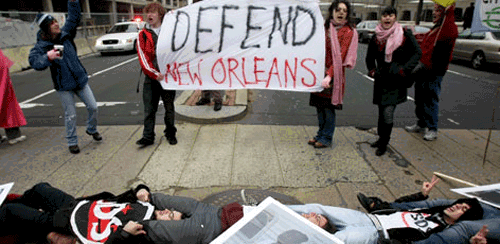

Photo by Alex Wong, Getty Images
Today, as part of a solidarity action with folks struggling to save public housing in New Orleans, members of Students for a Democratic Society (SDS) helped to organize a civil disobedience as a part of a larger demonstration outside the D.C. office of Department of Housing and Urban Development (HUD) organized by the Hip Hop Caucus and the Advancement Project. At the culmination of the rally where the crowd demanded the right of return for New Orleans residents, 6 members of SDS and a local high school student rushed into a nearby intersection and laid down, effectively blocking traffic at three intersections in northeast D.C. When it was clear that the cops were taking their time, the folks lying down, with the support of the rest of the protesters who were standing with them, picked up and moved further into the intersection, shutting down a total of six intersections around the HUD office. After an hour of disrupting busy D.C. streets, folks stretched out on the ground declared victory as the demonstration concluded with protesters marching through the lunchtime streets.
Residents of New Orleans public housing have called on folks from around the country to come down to Louisiana to support their efforts directly or to organize actions in their own cities. The recent Northeast Convention in Philly endorsed this call. This particular D.C. action, due to short notice, was only endorsed by the George Mason University (GMU) chapter of SDS, although members of most local chapters were in attendance. The fight is still going on down in Louisiana, so organize a demonstration in your city to support folks at this critical point in their struggle to return to their homes.
Check out the USA TODAY article for a picture of local SDSers and more details on the situation in New Orleans.
Here is the New Orleans Indymedia article on the D.C. action.
Article by Jasper Conner, GMU SDS


 The End of Capitalism
Recent Comments