
You are currently browsing the category archive for the ‘Capitalism’ category.
Not particularly surprising for those who’ve been paying attention to oil reserve estimates, but it’s now official that the International Energy Agency (IEA) has been deliberately distorting their estimates to make it appear that peak oil is much further away than in reality. Also interesting that the US govt has been pressuring the agency to lie about it.
As I state in my Synopsis, peak oil is one of the most important ecological limits, which will prevent global capitalism from continuing to expand – if it hasn’t already. [alex]
Guardian / UK Tuesday, November 10, 2009
Key Oil Figures Were Distorted by US Pressure, Says Whistleblower
Watchdog’s estimates of reserves inflated says top official
by Terry Macalister
The world is much closer to running out of oil than official estimates admit, according to a whistleblower at the International Energy Agency who claims it has been deliberately underplaying a looming shortage for fear of triggering panic buying.
The senior official claims the US has played an influential role in encouraging the watchdog to underplay the rate of decline from existing oil fields while overplaying the chances of finding new reserves.
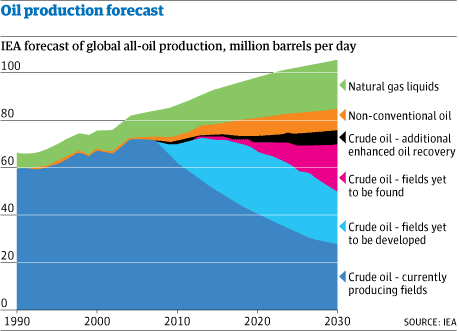
This official oil production estimate is overly-optimistic
The allegations raise serious questions about the accuracy of the organisation’s latest World Energy Outlook on oil demand and supply to be published tomorrow – which is used by the British and many other governments to help guide their wider energy and climate change policies.
In particular they question the prediction in the last World Economic Outlook, believed to be repeated again this year, that oil production can be raised from its current level of 83m barrels a day to 105m barrels. External critics have frequently argued that this cannot be substantiated by firm evidence and say the world has already passed its peak in oil production.
Now the “peak oil” theory is gaining support at the heart of the global energy establishment. “The IEA in 2005 was predicting oil supplies could rise as high as 120m barrels a day by 2030 although it was forced to reduce this gradually to 116m and then 105m last year,” said the IEA source, who was unwilling to be identified for fear of reprisals inside the industry. “The 120m figure always was nonsense but even today’s number is much higher than can be justified and the IEA knows this.
“Many inside the organisation believe that maintaining oil supplies at even 90m to 95m barrels a day would be impossible but there are fears that panic could spread on the financial markets if the figures were brought down further. And the Americans fear the end of oil supremacy because it would threaten their power over access to oil resources,” he added.
A second senior IEA source, who has now left but was also unwilling to give his name, said a key rule at the organisation was that it was “imperative not to anger the Americans” but the fact was that there was not as much oil in the world as had been admitted. “We have [already] entered the ‘peak oil’ zone. I think that the situation is really bad,” he added. Read the rest of this entry »
Also published by The Rag Blog, OpEdNews, Signs of the Times, Interactivist Info Exchange, and Toward Freedom.
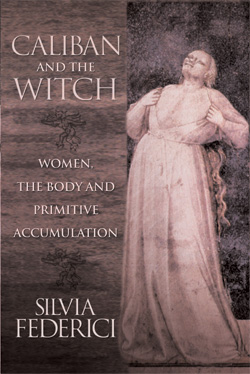 Who Were the Witches? – Patriarchal Terror and the Creation of Capitalism
Alex Knight
November 5, 2009
This Halloween season, there is no book I could recommend more highly than Silvia Federici’s brilliant Caliban and the Witch: Women, the Body, and Primitive Accumulation (Autonomedia 2004), which tells the dark saga of the Witch Hunt that consumed Europe for more than 200 years. In uncovering this forgotten history, Federici exposes the origins of capitalism in the heightened oppression of workers (represented by Shakespeare’s character Caliban), and most strikingly, in the brutal subjugation of women. She also brings to light the enormous and colorful European peasant movements that fought against the injustices of their time, connecting their defeat to the imposition of a new patriarchal order that divided male from female workers. Today, as more and more people question the usefulness of a capitalist system that has thrown the world into crisis, Caliban and the Witch stands out as essential reading for unmasking the shocking violence and inequality that capitalism has relied upon from its very creation.
Who Were the Witches?
Parents putting a pointed hat on their young son or daughter before Trick-or-Treating might never pause to wonder this question, seeing witches as just another cartoonish Halloween icon like Frankenstein’s monster or Dracula. But deep within our ritual lies a hidden history that can tell us important truths about our world, as the legacy of past events continues to affect us 500 years later. In this book, Silvia Federici takes us back in time to show how the mysterious figure of the witch is key to understanding the creation of capitalism, the profit-motivated economic system that now reigns over the entire planet.
During the 15th – 17th centuries the fear of witches was ever-present in Europe and Colonial America, so much so that if a woman was accused of witchcraft she could face the cruellest of torture until confession was given, or even be executed based on suspicion alone. There was often no evidence whatsoever. The author recounts, “for more than two centuries, in several European countries, hundreds of thousands of women were tried, tortured, burned alive or hanged, accused of having sold body and soul to the devil and, by magical means, murdered scores of children, sucked their blood, made potions with their flesh, caused the death of their neighbors, destroyed cattle and crops, raised storms, and performed many other abominations” (169).
In other words, just about anything bad that might or might not have happened was blamed on witches during that time. So where did this tidal wave of hysteria come from that took the lives so many poor women, most of whom had almost certainly never flown on broomsticks or stirred eye-of-newt into large black cauldrons?
Caliban underscores that the persecution of witches was not just some error of ignorant peasants, but in fact the deliberate policy of Church and State, the very ruling class of society. To put this in perspective, today witchcraft would be a far-fetched cause for alarm, but the fear of hidden terrorists who could strike at any moment because they “hate our freedom” is widespread. Not surprising, since politicians and the media have been drilling this frightening message into people’s heads for years, even though terrorism is a much less likely cause of death than, say, lack of health care.1 And just as the panic over terrorism has enabled today’s powers-that-be to attempt to remake the Middle East, this book makes the case that the powers-that-were of Medieval Europe exploited or invented the fear of witches to remake European society towards a social paradigm that met their interests.
Interestingly, a major component of both of these crusades was the use of so-called “shock and awe” tactics to astound the population with “spectacular displays of force,” which helped to soften up resistance to drastic or unpopular reforms.2 In the case of the Witch Hunt, shock therapy was applied through the witch burnings – spectacles of such stupefying violence that they paralyzed whole villages and regions into accepting fundamental restructuring of medieval society.3 Federici describes a typical witch burning as, “an important public event, which all the members of the community had to attend, including the children of the witches, especially their daughters who, in some cases, would be whipped in front of the stake on which they could see their mother burning alive” (186).
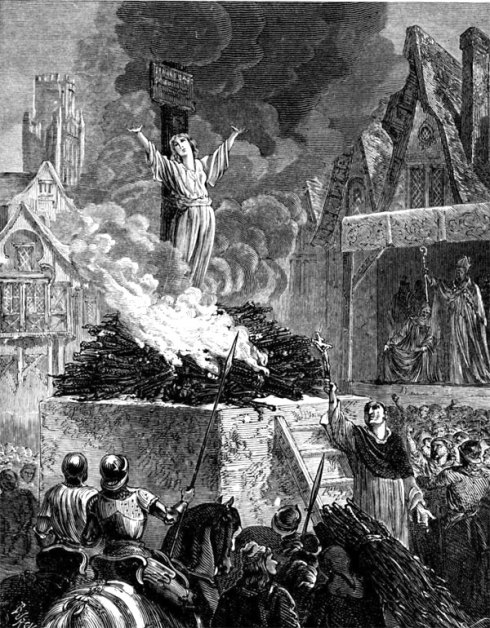
The witch burning was the medieval version of "Shock and Awe"
The book argues that these gruesome executions not only punished “witches” but graphically demonstrated the repercussions for any kind of disobedience to the clergy or nobility. In particular, the witch burnings were meant to terrify women into accepting “a new patriarchal order where women’s bodies, their labor, their sexual and reproductive powers were placed under the control of the state and transformed into economic resources” (170). Read the rest of this entry »
a self-explanatory call to action from Jobs with Justice that is right on. [alex]

|

Walden Bello explains the logic of breaking with corporate globalization and points the way towards a more socially and ecologically responsible economic paradigm. Includes “11 pillars of deglobalization.” [alex]
The Virtues of Deglobalization
by Akbayan! Representative Walden Bello
originally posted on Foreign Policy in Focus
reposted from Focus on the Global South.
The current global downturn, the worst since the Great Depression 70 years ago, pounded the last nail into the coffin of globalization. Already beleaguered by evidence that showed global poverty and inequality increasing, even as most poor countries experienced little or no economic growth, globalization has been terminally discredited in the last two years. As the much-heralded process of financial and trade interdependence went into reverse, it became the transmission belt not of prosperity but of economic crisis and collapse.
End of an Era
In their responses to the current economic crisis, governments paid lip service to global coordination but propelled separate stimulus programs meant to rev up national markets. In so doing, governments quietly shelved export-oriented growth, long the driver of many economies, though paid the usual nostrums to advancing trade liberalization as a means of countering the global downturn by completing the Doha Round of trade negotiations under the World Trade Organization. There is increasing acknowledgment that there will be no returning to a world centrally dependent on free-spending American consumers, since many are bankrupt and nobody has taken their place.
Moreover, whether agreed on internationally or unilaterally set up by national governments, a whole raft of restrictions will almost certainly be imposed on finance capital, the untrammeled mobility of which has been the cutting edge of the current crisis.
Intellectual discourse, however, hasn’t yet shown many signs of this break with orthodoxy. Neoliberalism, with its emphasis on free trade, the primacy of private enterprise, and a minimalist role for the state, continues to be the default language among policymakers. Establishment critics of market fundamentalism, including Joseph Stiglitz and Paul Krugman, have become entangled in endless debates over how large stimulus programs should be, and whether or not the state should retain an interventionist presence or, once stabilized, return the companies and banks to the private sector. Moreover some, such as Stiglitz, continue to believe in what they perceive to be the economic benefits of globalization while bemoaning its social costs.
But trends are fast outpacing both ideologues and critics of neoliberal globalization, and developments thought impossible a few years ago are gaining steam. “The integration of the world economy is in retreat on almost every front,” writes the Economist. While the magazine says that corporations continue to believe in the efficiency of global supply chains, “like any chain, these are only as strong as their weakest link. A danger point will come if firms decide that this way of organizing production has had its day.”
“Deglobalization,” a term that the Economist attributes to me, is a development that the magazine, the world’s prime avatar of free market ideology, views as negative. I believe, however, that deglobalization is an opportunity. Indeed, Read the rest of this entry »
This article only scratches the surface of why capitalism as a system based in constant expansion is absolutely incompatible with a planet of real social and ecological limits, peak oil being one. My book will flesh these arguments out in greater detail, but for now check out what Professor Wolff has been cooking up. [alex]
Peak Oil and Peak Capitalism
by Professor Richard Wolff, March 27, 2009.
Originally posted on The Oil Drum, and on Rick Wolff’s homepage.
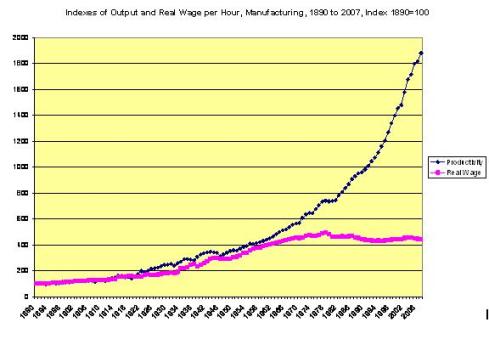
Worker Productivity (blue) vs. Wages (pink), 1890-2009
The concept of peak oil may apply more generally than its friends and foes realize. As we descend into US capitalism’s second major crash in 75 years (with another dozen or so “business cycle downturns” in the interval between crashes), some signs suggest we are at peak capitalism too. Private capitalism (when productive assets are owned by private individuals and groups and when markets rather than state planning dominate the distribution of resources and products) has repeatedly demonstrated a tendency to flare out into overproduction and/or asset inflation bubbles that burst with horrific social consequences. Endless reforms, restructurings, and regulations were all justified in the name not only of extricating us from a crisis but also finally preventing future crises (as Obama repeated this week). They all failed to do that.
The tendency to crisis seems unstoppable, an inherent quality of capitalism. At best, flare outs were caught before they wreaked major havoc, although usually that only postponed and aggravated that havoc. One recent case in point: the stock market crash of early 2000 was limited in its damaging social consequences (recession, etc.) by an historically unprecedented reduction of interest rates and money supply expansion by Alan Greenspan’s Federal Reserve. The resulting real estate bubble temporarily offset the effects of the stock market’s bubble bursting, but when real estate crashed a few years later, what had been deferred hit catastrophically.
Repeated failure to stop its inherent crisis tendency is beginning to tell on the system. The question increasingly insinuates itself even into discourses with a long history of denying its pertinence: has capitalism, qua system, outlived its usefulness? Read the rest of this entry »
After a wild but empowering week of demonstrations in Pittsburgh, here’s a short media recap of some of the highlights. [alex]
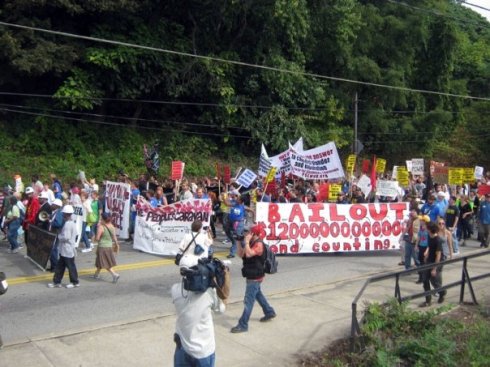
$12 Trillion has been given by the US government to large banks and corporations since last year
Great short news video on why the protesters were in Pittsburgh.
Exposes the police repression felt by the whole city last week, not just protesters.
The successes of mass protest.

IVAW held a press conference and action Friday morning about no longer sacrificing for war
Finally, see this audio report from Free Speech Radio News for more context.


 The End of Capitalism
Recent Comments