You are currently browsing the yearly archive for 2009.
a self-explanatory call to action from Jobs with Justice that is right on. [alex]

|

Walden Bello explains the logic of breaking with corporate globalization and points the way towards a more socially and ecologically responsible economic paradigm. Includes “11 pillars of deglobalization.” [alex]
The Virtues of Deglobalization
by Akbayan! Representative Walden Bello
originally posted on Foreign Policy in Focus
reposted from Focus on the Global South.
The current global downturn, the worst since the Great Depression 70 years ago, pounded the last nail into the coffin of globalization. Already beleaguered by evidence that showed global poverty and inequality increasing, even as most poor countries experienced little or no economic growth, globalization has been terminally discredited in the last two years. As the much-heralded process of financial and trade interdependence went into reverse, it became the transmission belt not of prosperity but of economic crisis and collapse.
End of an Era
In their responses to the current economic crisis, governments paid lip service to global coordination but propelled separate stimulus programs meant to rev up national markets. In so doing, governments quietly shelved export-oriented growth, long the driver of many economies, though paid the usual nostrums to advancing trade liberalization as a means of countering the global downturn by completing the Doha Round of trade negotiations under the World Trade Organization. There is increasing acknowledgment that there will be no returning to a world centrally dependent on free-spending American consumers, since many are bankrupt and nobody has taken their place.
Moreover, whether agreed on internationally or unilaterally set up by national governments, a whole raft of restrictions will almost certainly be imposed on finance capital, the untrammeled mobility of which has been the cutting edge of the current crisis.
Intellectual discourse, however, hasn’t yet shown many signs of this break with orthodoxy. Neoliberalism, with its emphasis on free trade, the primacy of private enterprise, and a minimalist role for the state, continues to be the default language among policymakers. Establishment critics of market fundamentalism, including Joseph Stiglitz and Paul Krugman, have become entangled in endless debates over how large stimulus programs should be, and whether or not the state should retain an interventionist presence or, once stabilized, return the companies and banks to the private sector. Moreover some, such as Stiglitz, continue to believe in what they perceive to be the economic benefits of globalization while bemoaning its social costs.
But trends are fast outpacing both ideologues and critics of neoliberal globalization, and developments thought impossible a few years ago are gaining steam. “The integration of the world economy is in retreat on almost every front,” writes the Economist. While the magazine says that corporations continue to believe in the efficiency of global supply chains, “like any chain, these are only as strong as their weakest link. A danger point will come if firms decide that this way of organizing production has had its day.”
“Deglobalization,” a term that the Economist attributes to me, is a development that the magazine, the world’s prime avatar of free market ideology, views as negative. I believe, however, that deglobalization is an opportunity. Indeed, Read the rest of this entry »
This article only scratches the surface of why capitalism as a system based in constant expansion is absolutely incompatible with a planet of real social and ecological limits, peak oil being one. My book will flesh these arguments out in greater detail, but for now check out what Professor Wolff has been cooking up. [alex]
Peak Oil and Peak Capitalism
by Professor Richard Wolff, March 27, 2009.
Originally posted on The Oil Drum, and on Rick Wolff’s homepage.
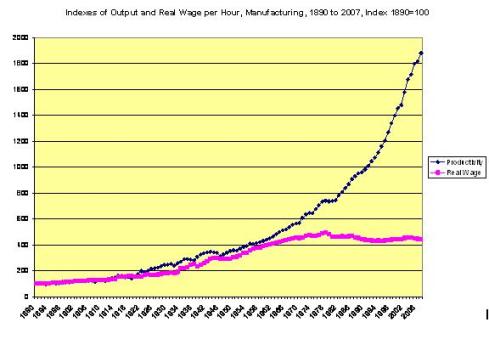
Worker Productivity (blue) vs. Wages (pink), 1890-2009
The concept of peak oil may apply more generally than its friends and foes realize. As we descend into US capitalism’s second major crash in 75 years (with another dozen or so “business cycle downturns” in the interval between crashes), some signs suggest we are at peak capitalism too. Private capitalism (when productive assets are owned by private individuals and groups and when markets rather than state planning dominate the distribution of resources and products) has repeatedly demonstrated a tendency to flare out into overproduction and/or asset inflation bubbles that burst with horrific social consequences. Endless reforms, restructurings, and regulations were all justified in the name not only of extricating us from a crisis but also finally preventing future crises (as Obama repeated this week). They all failed to do that.
The tendency to crisis seems unstoppable, an inherent quality of capitalism. At best, flare outs were caught before they wreaked major havoc, although usually that only postponed and aggravated that havoc. One recent case in point: the stock market crash of early 2000 was limited in its damaging social consequences (recession, etc.) by an historically unprecedented reduction of interest rates and money supply expansion by Alan Greenspan’s Federal Reserve. The resulting real estate bubble temporarily offset the effects of the stock market’s bubble bursting, but when real estate crashed a few years later, what had been deferred hit catastrophically.
Repeated failure to stop its inherent crisis tendency is beginning to tell on the system. The question increasingly insinuates itself even into discourses with a long history of denying its pertinence: has capitalism, qua system, outlived its usefulness? Read the rest of this entry »
After a wild but empowering week of demonstrations in Pittsburgh, here’s a short media recap of some of the highlights. [alex]
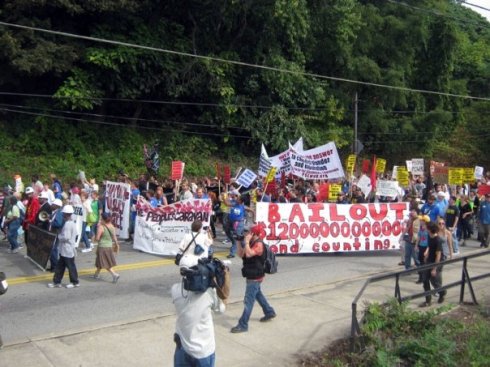
$12 Trillion has been given by the US government to large banks and corporations since last year
Great short news video on why the protesters were in Pittsburgh.
Exposes the police repression felt by the whole city last week, not just protesters.
The successes of mass protest.
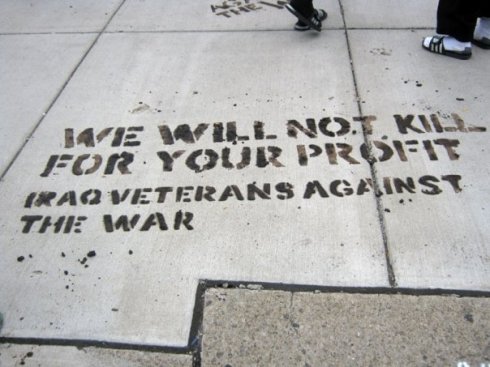
IVAW held a press conference and action Friday morning about no longer sacrificing for war
Finally, see this audio report from Free Speech Radio News for more context.
Organizers from Philly will be traveling across PA ahead of the G20 summit in Pittsburgh next week to meet with grassroots movements and strengthen statewide social change networks. This is being called the People’s Caravan. There are still spots available, so please RSVP if you’d like to join the caravan! – alex
A Call to Join the People’s Caravan
Pennsylvania, along with the rest of the world, is in crisis. Many people do not have access to decent housing, education, healthcare, jobs, healthy food, transportation and communication. While we are told that there are not resources to provide for our basic needs, bankers and the ultra-rich get trillions of dollars in bail-out funding, and our services are cut and costly wars are waged. From pools, libraries and health centers in urban areas closing, to factory lay-offs and families losing their farms, Pennsylvanians are feeling the impact of an economic and political system that has placed profit over people. We will not pay for their crisis!
In the coal mines, steel mills, textile mills, family farms and in the front seats of rigs, poor and working Pennsylvanians built this state. As one industry after another has collapsed in Pennsylvania, we’ve become poorer. Our economic crisis didn’t start in 2007. Now, all across the state, local governments and business people are spending our taxpayers’ money on developments that benefit developers and not the communities that paid for it. Meanwhile, our population has been in decline for generations because too many of our young people see no future in our state, and need to look for jobs elsewhere.
What is the G-20?
The G-20 summit is a gathering of financial ministers and heads of states of the 20 richest countries in the world. They are meeting in Pittsburgh, September 24-25 to advance their agenda: cutting essential social services; privatizing schools, healthcare, and social security, promoting “free-trade,” which cuts labor and environmental standards across the globe and places corporate profit above human needs. They are meeting to rebuild the world’s economies- in a way that keeps them on top.
Pittsburgh’s history of economic decline is why it was chosen to host the G-20. It will be promoted as an example of how to rebuild an economy. They’ve done this by bringing in companies that provide low wage jobs while reaping large profit and rebuilding the region with little thought to community benefit. This is unfortunately a familiar story to not just Pennsylvania, but much of the country.
The Caravan
We want to take this opportunity to focus on Pennsylvania, and strengthen our statewide networks. We want to meet up with people who are organizing locally for their dignity and a better Pennsylvania. Whether you are working for better wages, organizing for childcare, demanding healthcare, fighting pollution, struggling to keep your home and put food on the table or to keep your family’s farm; we all have an interest in making our voices heard and working together to advance an agenda for economic human rights.
We will be taking our own vehicles, carpooling and splitting the travel costs. The caravan will depart Philadelphia on Monday morning, September 21, stopping in Lancaster, traveling to York for the afternoon, and then spend the evening in Harrisburg. On Tuesday, September 22, we will rally at the state capitol, make a stop in Altoona, and arrive in Pittsburgh for the G-20 summit.
Join Us!
This is a perfect time to make connections between our struggles and communities so that we can break our isolation and work together. We want you to invite your neighbors, church, family, school, VFW chapter, and your community organizations to join us on this caravan. While we bring stories of our struggles in Philadelphia, we want to learn from people struggling throughout the rest of Pennsylvania.
Contact us if you are interested in organizing a local event along the route that can benefit your work, joining or supporting the caravan. We need RSVP’s, and we can tell you about costs, ride information and answer any other questions.
http://www.g20caravan.info
g20caravan@riseup.net
215-586-9198


 The End of Capitalism
Recent Comments