
You are currently browsing the category archive for the ‘Collapse’ category.
This latest turn of events signals quite literally the end of capitalism. We in the US are now entering the age of fascism.
More on this story soon. For now, answer me this: what would you do with $700 billion?
[alex]
Democracy Now! covered this today pretty thoroughly. Here’s the audio.
And here’s one article among thousands, this one from wallstreetpit.com
Treasury Sends Congress Unprecedented $700 billion Bailout Plan
By Ron Haruni · September 20, 2008
According to Saturday’s news reports, the federal government is asking Congress for $700 billion to buy up bad debt from U.S. financial institutions in efforts to deal with the ongoing financial crisis.
The plan, part of the government’s largest financial bailout since the 1930s, would give the government broad power to purchase distressed assets of any U.S. financial institutions Read the rest of this entry »
Originally published by Democracy Now!, September 16, 2008.
Stock Markets Plummet as Lehman Brothers & Merrill Lynch Collapse
Stock prices are continuing to fall sharply across the globe today following the collapse of Lehman Brothers and Merrill Lynch, two of the world’s largest investment banks. On Monday, the Dow Jones index fell 504 points. It was the Dow’s sixth-largest point drop ever. The shakeup on Wall Street has seen the 158-year-old investment bank Lehman Brothers declare bankruptcy and the 94-year-old Merrill Lynch being bought by Bank of America in a $44 billion deal. Forbes magazine said the United States is now facing perhaps the worst financial crisis since the banking panic that former President Franklin Roosevelt faced in 1933.
Future Remains Uncertain for Washington Mutual and AIG
Fears are growing that the nation’s largest savings and loan, Washington Mutual, and the nation’s largest insurance company, American International Group, could also go under. On Monday, Washington Mutual had its credit rating cut to junk by Standard and Poor’s. The bank’s stock value has dropped 94 percent over the past year. And the Wall Street Journal reports the Federal Reserve has asked Goldman Sachs and JPMorgan Chase to help make up to $75 billion in loans available to AIG. Stock in AIG plummeted 61 percent on Monday.
“Peak Oil and Energy Imperialism” by John Bellamy Foster in the latest issue of Monthly Review is at the tip of a growing awareness of Peak Oil among Left intellectuals. I’ve been waiting for this for a few years now, and it’s good to see that people are starting to make the connections between oil scarcity and US imperialism.
Foster is pushing a kind of “Green Marxism” – in fact the Monthly Review as a whole is beginning to focus quite a bit on energy and ecology in its critiques of US empire.
The approach is good – peak oil is examined with calm as an inevitable geological event, “alternative” energy sources like tar sands and ethanol are shown in their true nasty colors, and the reader is presented with the option of allowing the government to continue to assault those unfortunate enough to be born on top of oil reserves, or to work for a new humane world.
However, one place this critique falls short is in (explicitly or implicitly) propagating the notion that awareness of Peak Oil by neo-conservatives in the halls of power is what prompted aggression against Afghanistan, Iraq or Venezuela, and labeling this a “new energy imperialism.”
Unfortunately the capitalist system is far more complex and multi-faceted than that, and the neo-cons, like all US elites, are just tools existing to serve the interests of US corporations and the Pentagon, which they are doing quite well by continuing the same old foreign policy of trying to control the oil-rich Middle East (by force if necessary – with the added bonus of trillions of dollars of contracts for the military-industrial complex). If only it were as easy as pinning our problems on the ideas in the heads of those in power, all we’d need to do to end the crisis would be to put someone with better ideas in power! Sorry, it’s not gonna work like that.
The “energy imperialism” we see today as the US gears up for war with Iran is nothing “new” at all; it’s the exact same system that toppled Mossadegh in 1953, that provided tanks, planes and chemical weapons to both sides of the Iran-Iraq war throughout the 80s, and that has been pouring billions of dollars of military aid into Israel to act as regional policeman for 60 years.
The only thing that’s new is that the system is beginning to fail, and the US is having a much harder time maintaining its dominance over the Persian Gulf region, relying on brute force and direct occupation, and even that isn’t working for them anymore.
What we face is not a “new energy imperialism” but an old energy imperialism, newly being beaten. I see peak oil as a major catalyst in the inevitable crumbling of the US empire, and an immense opportunity for all who desire peace, justice or human rights. [alex]
Peak Oil and Energy Imperialism
by John Bellamy Foster
Originally published by Monthly Review. July/August 2008.
The rise in overt militarism and imperialism at the outset of the twenty-first century can plausibly be attributed largely to attempts by the dominant interests of the world economy to gain control over diminishing world oil supplies.1 Beginning in 1998 a series of strategic energy initiatives were launched in national security circles in the United States in response to: (1) the crossing of the 50 percent threshold in U.S. importation of foreign oil; (2) the disappearance of spare world oil production capacity; (3) concentration of an increasing percentage of all remaining conventional oil resources in the Persian Gulf; and (4) looming fears of peak oil.
The response of the vested interests to this world oil supply crisis was to construct what Michael Klare in Blood and Oil has called a global “strategy of maximum extraction.”2 This required that the United States as the hegemonic power, with the backing of the other leading capitalist states, seek to extend its control over world oil reserves with the object of boosting production. Seen in this light, the invasion and occupation of Afghanistan (the geopolitical doorway to Western access to Caspian Sea Basin oil and natural gas) following the 9/11 attacks, the 2003 invasion of Iraq, the rapid expansion of U.S. military activities in the Gulf of Guinea in Africa (where Washington sees itself as in competition with Beijing), and the increased threats now directed at Iran and Venezuela—all signal the rise of a dangerous new era of energy imperialism. Read the rest of this entry »
I’m reposting this article not because I agree with everything said in it (just feel like I need to start pointing that out so people don’t get confused), but because I think it should spark some good ideas and maybe discussion.
Sale is hitting here on some fundamental ways of seeing the actions of the current U.S. government – that they are desperate to cling to an existing imperial power structure that is deteriorating rapidly – which should help us as anti-imperialists to formulate an appropriate strategy for 1) speeding up that dismantling process so that less damage is done to us and people all over the world, as well as the planet, and 2) figuring out what should replace this system (democracy, freedom, justice, sustainability…) and how we can best usher that new world into being. [-alex]
Collapse of the American Empire
by Kirkpatrick Sale (author of SDS)
Originally published in Counterpunch, February 22, 2005.
It is quite ironic: only a decade or so after the idea of the United States as an imperial power came to be accepted by both right and left, and people were actually able to talk openly about an American empire, it is showing multiple signs of its inability to continue. And indeed it is now possible to contemplate, and openly speculate about, its collapse. Read the rest of this entry »
World Economy Would Collapse If Oil Hit $200, Deutsche Says
By Shigeru Sato and Yuji Okada
June 25 (Bloomberg) — The global economy would collapse if oil hit $200 a barrel, said the top energy analyst at Germany’s largest bank.
“Two-hundred dollar oil would break the back of the global economy,” Deutsche Bank AG’s Chief Energy Economist Adam Sieminski said in an interview today in Tokyo. “Next step after $200 would be global recession and bad news for everybody.”
Sieminski’s comments come after Goldman Sachs Group Inc. forecast oil may rise to between $150 and $200 within two years as supply growth, especially from producers outside the Organization of Petroleum Exporting Countries, fails to keep pace with demand. Deutsche Bank is due to release its oil-price forecast on June 27.
Oil doubled in the past year, touching a record $139.89 a barrel on June 16. Read the rest of this entry »
Excerpts from Democracy Now!, May 6, 2008.
[Kevin Phillips, author of “Bad Money: Reckless Finance, Failed Politics, and the Global Crisis of American Capitalism”, surveys the economic crisis facing U.S.-dominated global capitalism – including peak oil, the collapse of the Dollar, rising food costs, and the growing dominance of the banking and credit industries. This is fairly radical stuff coming from a former GOP strategist.]
AMY GOODMAN: What do you think is one of the most serious signs of this overall global crisis of American capitalism?
KEVIN PHILLIPS: Well, not to single out just one, I have an approach I use to say that normally when a country is—United States is—heading into a recession, there are one or two, sometimes three, factors that you worry about. But at this point in time, the American economy, you can think of it as being kind of in a shark tank, and there are like six or seven sharks, and you don’t usually see anything like that number. Read the rest of this entry »
http://www.chycho.com/?q=oil_us_dollar_euro
Update April 30, 2008: Iran dumps U.S. dollar for oil trades – “Iran, OPEC’s second-largest producer, has stopped conducting oil transactions in U.S. dollars.”
In the last eight years implementing the plans for the Project for the New American Century (PNAC) designed “to promote American global leadership” has backfired.
To accomplish PNAC’s goals, all threats needed to be eliminated. From the onset, the United Sates earmarked two countries as mortal enemies: Venezuela and Iran. With Venezuela, it is well documented that the CIA attempted to overthrow the democratically elected government of Chavez. And with Iran, the United States continues to use it as a scapegoat for its failures in Iraq. These cold war tactics however are proving to be US’s undoing.
The United States is hemorrhaging from every orifice, and oil prices can be used to measure the rapidity of its demise. Read the rest of this entry »
This week, food riots are erupting in the poorest countries of the world, such as Haiti, where the majority of the population lives on under $2 a day. The protesters are calling for the resignation of their government, for its inability to provide basic necessities to the population. See this BBC News short video.
The price of grains, especially wheat (which has doubled in the past year), has been on a steady uphill trend for the past few years, causing major food shortages across much of the Global South.
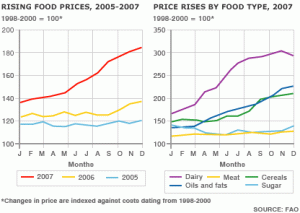
(image from BBC)
I want to highlight 4 underlying causes of this global food shortage:
1) Growing Inequality between the wealthiest and poorest people. Greater affluence in industrializing countries is driving larger levels of meat consumption, which requires far more wheat, other grains, and water to be consumed in order to produce the same amount of food. In fact, the majority of grains produced in the world are now fed to animals for meat. Meanwhile, hundreds of millions of people in the Global South are on the brink of starvation, or literally already starving.
2) Global Warming is causing unreliable and chaotic weather patterns across much of the food-producing regions of the world. Arable lands are turning into deserts as droughts worsen, while other regions are flooding with unseasonable downpours. These combine to create massive agricultural loss.
3) Biofuels like ethanol from corn production in the U.S. are quite literally food being used to fuel industry and automobiles. This manifests in driving up the cost of food for everyone, especially the poor, so that the largest agribusiness firms can earn huge profits, and the illusion of American prosperity surrounding large cars and wasteful consumerism can be maintained at all costs.
4) Most fundamental, The Global Oil Production Peak, which took place in 2006, is causing declining supplies of oil while demand surges across the industrial and industrializing world. We have seen a drastic and increasing rise in the price of oil over this period, which most Americans recognize in the high cost of gasoline. But for the poor of the world, a much more dire situation is emerging with food, because oil and other fossil fuels are the sources for most industrial fertilizers and pesticides, and because the modern system of food production and distribution are heavily dependent on oil for transportation, processing, packaging, refrigeration and cooking. In fact, the average American consumes over 10 calories of fossil fuels for every calorie of food eaten! Most people in the world can’t continue to afford this oil subsidy, and the crisis will only deepen as oil production declines in the coming years.
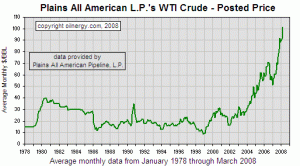
(Image courtesy OILNERGY)


 The End of Capitalism
Recent Comments